

Economical Warfare: How to Win Without the Most Expensive Fleet
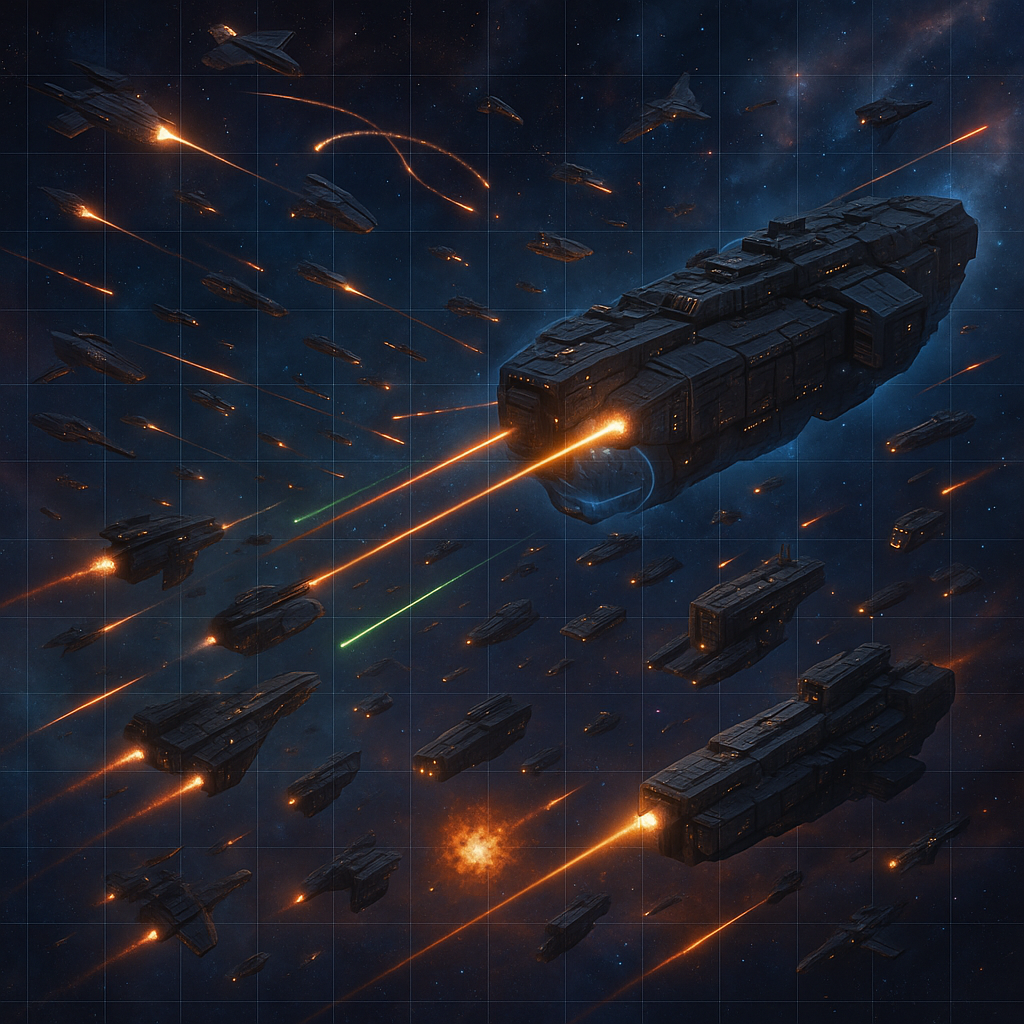
Economical Warfare: How to Win Without the Most Expensive Fleet
In War for Galaxy, it’s easy to fall into a trap: see the biggest ship, calculate its cost, and decide it is the main argument in any battle. But good browser strategies work differently. A strong fleet is not the most expensive fleet, but a properly assembled fleet for a specific purpose.
War for Galaxy is an online strategy about space battles where economy and combat are directly linked. Every lost ship represents titanium, silicon, antimatter, build time, and rating points. The fleet’s total rating is calculated as 1 point per 1000 resources invested, and if the fleet is destroyed, these points are lost. Combat rating works separately: it uses the Elo system, where victory gains points, defeat loses points, and beating a higher-rated opponent is valued more.
The game has a hidden benchmark — conditional combat power. It helps roughly predict outcomes: if one fleet has greater total conditional power, it is likely to win; with a fivefold advantage, the winner usually suffers minimal losses. But this is not an automatic win by calculator. Even with equal conditional combat power, one composition may penetrate armor better, another may sustain damage longer, a third shoot from a favorable distance. For example, 1 Colossus approximately corresponds to 86 Destroyers in conditional combat power, but this number doesn’t negate the roles of support, firing sectors, and counter-compositions.
The main idea of economical warfare is simple: don’t ask "how much does my fleet cost?" Ask: "how much damage will it deal per resource invested, what will I lose if I fail, and how accurately does it counter the scouted target?"
The Basis of Counterplay: Defense, Weapons, and Sectors
Counter-compositions start with understanding defense levels. War for Galaxy has three: 1, 2, and 3. Different weapon types deal varying damage percentages to them. Infrared lasers deal 100% damage to level 1 targets, but only 16% to levels 2–3. Photon weapons are steadier: 100% at level 1 and 67% at levels 2–3. Type-2 ultraviolet lasers deal 100% to levels 1–2, but only 20% damage at level 3, while Type-1 ultraviolet lasers work at 100% across all three levels. Lepton weapons are 100% effective against levels 1–2 but drop to 52% against level 3. The Bomber's rocket volley system does 100% damage across levels 1, 2, and 3.
The first practical takeaway: you can't just accumulate one expensive ship type. A fleet that burns light targets may perform poorly against heavy armor; a composition built against Colossi and defense might be excessively costly versus light masses. Before attacking, consider the chain: target defense level → your weapons' effectiveness → cost of losses.
The second part of the battle is geometry. The battlefield is 20×20 cells, with sides occupying 4 rows on opposite sides, and all ships of one type merge into a super-unit. Almost all ships’ weapons have limited firing sectors. The sector counts clockwise; if it crosses 0°, e.g., 355°–5°, it passes through the ship’s bow. Thus, frontal weapons are deadly when a target is ahead but less effective if the enemy is to the side or rear. Exception: missiles with sector 0–360° can fire without sector limitations.
Damage is absorbed first by shields, then armor. If residual damage remains after destroying one unit in a squad, it transfers to the next unit. Battle lasts until one side is destroyed or 10 minutes expire; if time runs out, the battle ends in a draw. Therefore, an economical commander considers not only "will I penetrate the armor?" but also "will I do it before the timer?"
Ship Roles: What to Counter and Where to Save
Don’t build an armada of one ship type: each hull has specific weaknesses by defense level, sectors, speed, cost, and role. An economical fleet isn’t the cheapest set but one where each ship type serves its purpose.
- Fighter: conditional combat power 9, defense level 1, base speed 12,500, small infrared lasers with a frontal sector 355°–5°. Individually a light target, but massed light ships help against heavies with numbers and maneuvering, especially if they reduce the efficiency of expensive ships’ sectors.
- Assaulter: conditional power 24, defense 1, frontal medium infrared lasers and the “Torpedoes” skill for extra damage to defenses. Good where attacking fleet and pressing defense is needed.
- Corvette: conditional power 73, defense 2, multiple turrets with various sectors and photon weapon in the frontal sector. Medium ships generally better clear light targets and fill the gap between mass and heavy strike units.
- Frigate: conditional power 135, defense 2, skill “Barrier” which grants +150% shields for 5 seconds. Useful as a tough mid-layer but not a universal answer.
- Galacton: conditional power 270, defense 2, skill “Radio Jamming” disables enemy unit skills and cuts the target’s attack by 50%. Against fleets relying on “Barrier”, “Grad”, or “Lepton Strike”, Galactons save more resources than just increasing numbers.
- Bomber: conditional power 265, defense 3, rocket volley system with 0–360° sector and skill “Grad” — massive rocket bombardment of defenses. A specialized tool against planetary defenses.
- Destroyer: conditional power 360, defense 3, skill “Lepton Strike” — +300% damage to the strongest target from the lepton weapon. Strong against large targets and defenses but requires support to avoid expensive damage exchanges.
- Colossus: conditional power 28,000, defense 3, cost 5,000,000 titanium, 4,000,000 silicon, and 1,000,000 antimatter, base speed 100 and fuel consumption 10,000. Very powerful holding a target in front in main caliber sector. Vulnerable and slow without support, and side or rear attacks may dodge some of its weapons. A monster, but costly and slow.
The practical logic: light ships excel against heavies en masse and with the right approach; mediums clear lights better; heavies are strong against large targets and defenses; Bombers are useful versus defenses; Galactons important against fleets with skills. Don’t blindly copy others’ stacks but tailor a counter composition to scouted defense levels, presence of defenses, and enemy abilities.
Battle Economy: Victory, Losses, Recovery, and Debris
Victory in the report doesn’t guarantee profit. Economical warfare evaluates the outcome after battle: how many resources invested, lost, recovered, and debris salvaged.
Ships can only be recovered upon victory. Chances depend on ship type: from 15% for Fighters up to 85% for Colossi. This makes a ‘thin’ attack risky: losing means recovery of destroyed ships won’t save economics. Defense works differently: destroyed defense installations may recover regardless of battle outcome according to their parameter. Ranges: 25% recovery for Missile Blocks to 75% for Graviton and Lepton Cannons. So, frontal assaults on strong planets for a flashy report can be a bad deal: some enemy guns regenerate, but your losses are paid.
Consider Energy Domes. They are passive defenses: do not shoot or attack and do not recover after battle but absorb damage aimed at ground defenses. One planet can have only one Small and one Large Energy Dome. Small dome has 30,000 shields and 8,000 armor; Large has 150,000 shields and 40,000 armor. Domes protect only surface defense, not fleets, but significantly increase the cost of the first strike on fortifications. That’s why Bombers are valued: their rockets and "Grad" skill efficiently handle defenses, avoiding waste of expensive ships.
Don’t forget debris. After attack, debris does not have fixed lifetime and exists until collected or server reset. Only Collectors can recycle debris via the "Recycle" mission; other ships cannot. Collectors have 20,000 cargo, 300 fuel consumption, and conditional combat power 14. Their role isn’t combat but resource recovery after battle. Planning an attack? Plan collection beforehand.
Preparing an Economical Attack
The proper sequence is simple: reconnaissance, verification, force redeployment, then main sortie. The scout probe has conditional combat power 0, base speed 100,000,000, fuel consumption 1, used for “Espionage” mission. It can be destroyed accidentally during spying—by debris on an empty planet or enemy fleet—but the owner still receives the report. This is a cheap way to avoid blind fleet movements.
Account for Premium Store shields: these block espionage both ways. Other players can’t scan your planet, and you can’t scan others’ while shield is active. If info is missing, don’t replace reconnaissance with hope.
Pirates are useful for practice. They reset every 4 hours server time if the system has fewer pirate fleets than the required number. Pirate fleet composition depends on average combat power of all inhabited planets: beginners face light pirates; experienced players face heavy fleets including those with Colossi. Pirates bring almost no combat rating but drop debris like normal fleets, making them a safe testing ground without risking war.
Use Teleport for mobility. It is a strategic building for rapid relocation of own fleets between your planets also equipped with Teleport. It can’t be used for attacks, espionage, or moving to enemy planets. Teleportation time is fixed at 5 minutes; no fuel cost but occupies one fleet slot. Teleport level increases max cargo for relocated fleet and reduces cooldown. Once started, teleportation can’t be canceled, so check coordinates, fleet size, and mission before confirming.
Economical Warfare in Alliances
Alliance counterplay shines even more. An Alliance unites players forming a shared multiprofile empire controlling galaxy territories. A standard account is the player’s personal empire; the Alliance is military and territorial collective. No need to force one commander to build the most expensive fleet: one player provides Bombers, another Galactons, a third heavy ships, a fourth covers defense.
“Defense” mission is available only among alliance members and allows temporarily placing a fleet in orbit of an allied planet. The protected planet must have a Supply Base; its level equals slots for allied fleets. A fleet on “Defense” stays with ally for 3 days or 72 hours unless canceled earlier.
For attacks there is Joint Attack: alliance members combine fleets into a single battle force. The organizer must be the slowest to allow others to join. Max number of fleets depends on organizer’s “Navigation” tech: ⌊Navigation level / 5⌋ + 1. In joint attacks, same-type ships merge into a super-unit; tech levels are weighted averages by ship count. So group sorties must be carefully built, not just a mix of whatever stands in docks.
Alliance combat rating forms through collective battles and accounts for destroyed enemy ships and defenses converted into resource cost. Alliance vs alliance battles in joint or SAB apply a ×2 multiplier to alliance combat rating. Coordination here truly beats chaos.
Main Conclusion
War for Galaxy combines features of space games, online strategy games, space MMO games, and real-time strategy games, but the main rule is earthly: victory belongs not to those who build the most expensive fleet, but to those who calculate carefully. Watch defense levels, choose weapons accordingly, consider firing sectors, plan recovery, collect debris, train on pirates, and coordinate with your alliance.
Ready to test economical warfare? Open the browser version of War for Galaxy, visit the official site, download the client, or install the game on mobile devices via Google Play and App Store. Scout your target, assemble a counter composition, and prove in the galaxy that a smart fleet is more dangerous than an expensive one.