

System Control and Alliance Synergy: How Neighboring Territories Strengthen Multi-Accounts in War for Galaxy
System Control and Alliance Synergy: How Neighboring Territories Strengthen Multi-Accounts in War for Galaxy
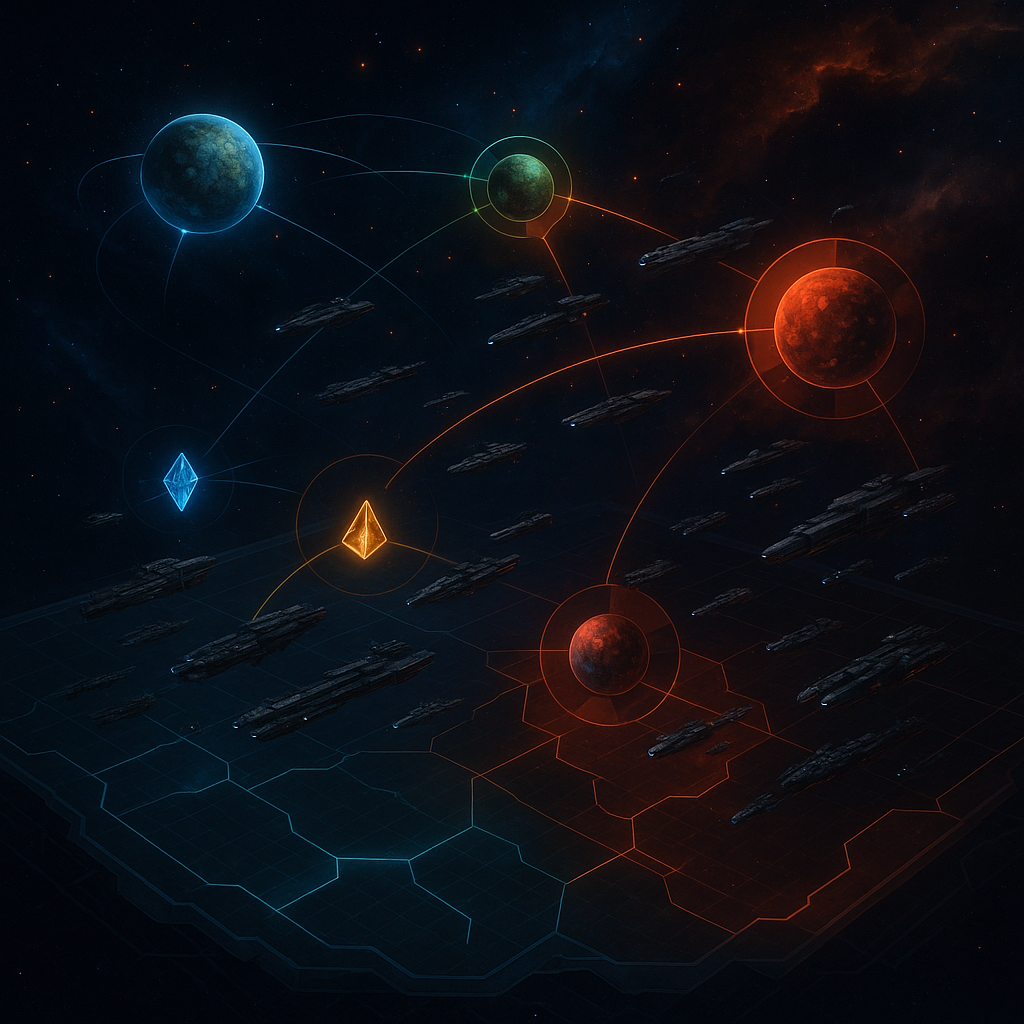
In War for Galaxy, a player's personal empire is only the first layer of strategy. You develop planets, build an economy, research technologies, assemble fleets, and choose moments for space battles. But the real alliance game begins where the map reveals not just isolated colonies but zones of influence, contested systems, supply lines, and a frontier that must be held by the entire force.
Control of systems in War for Galaxy is important because an Alliance here is not just a decorative tag next to a name or merely a chat channel for coordination. The Alliance is a union of players creating a shared Alliance Multi-Account to capture and control territories in the galaxy. If a regular account is a personal player's empire, an Alliance is a joint military and territorial structure with shared goals, common risks, and a shared war map.
The Alliance Multi-Account is the Alliance’s shared account that members can use. It is not intended for peaceful solo development but for specific strategic tasks: capturing and holding alliance planets, fighting other alliances, and consolidating territory. Thus, a strong War for Galaxy Alliance looks not only at members’ individual fleets but also at the placement of multi-account planets: which systems are occupied, where there is risk of a draw, where opponents can overcome the majority, and where to build the next foothold.
Alliance planets are marked on the map in a special way and differ from regular planets. This changes the perception of the galaxy: instead of a scatter of coordinates, you see a strategic map where each point can be a base, a border beacon, a resource hub, or the cause of a large war. This territorial layer sets War for Galaxy apart from many space games, browser strategy games, online strategy games, and space MMO games: it is not only about spaceship battles but a long-term struggle for map control.
How system ownership is determined: single planet, majority, and a draw
The rule for system ownership seems simple: an Alliance owns a planetary system if its Alliance Multi-Account has at least one planet there. A single successful flag grants the right to claim the system. But claiming doesn't mean reliable control.
As long as only one Alliance is present in the system, it's clear: if its multi-account occupies at least one planet there, the system is considered theirs. For example, if you colonize an empty planet and there are no other alliance planets in the system, this serves as a base entry point into territorial gameplay. The Alliance marks its sector, establishes a foothold, and can begin development.
However, when another Alliance enters the same system, a single planet becomes a disputed flag rather than stable control. Then, the number of captured planets decides. If multiple Alliance multi-accounts hold planets in one system, the owner is the Alliance with the majority.
- One Alliance in the system: If there is at least one multi-account planet, the system belongs to it.
- Multiple Alliances in the system: The one with more alliance planets owns it.
- Equal number of planets: The system belongs to no one, even if strong rivals are present.
Imagine Alliance A holds two planets and Alliance B has one. Ownership goes to A. If B captures another planet making it 2:2, ownership resets: formally, the system belongs to no one. If B takes the lead at 3:2, control passes to B. So for expansion officers, the key takeaway is: a single planet means presence, majority is real influence.
Empty planets are captured for the Alliance through the multi-account. While in the Alliance Multi-Account, a Pathfinder is sent to the empty planet with a “Colonization” mission. Upon the fleet’s arrival, the planet becomes Alliance property, not a personal player colony.
Creating an Alliance under new rules also involves the Pathfinder. In “Alliance” → “Create” window, you specify name and coordinates of an empty planet; after confirmation, a Pathfinder launches from the active planet, and the Alliance forms upon arrival.
Do not associate system ownership with visual or hidden planet parameters. Star color is decorative and has no gameplay effect. Temperature, sector count, and other parameters of a free planet are unknown until colonization. System control depends not on sun color but dry arithmetic: how many alliance planets are in a system and who has the majority.
Alliance synergy of neighboring systems: when territory strengthens the multi-account
Capturing a single convenient planet at the map edge is nice but insufficient for long-term strategy. The main economic reason to expand as a cluster is Alliance synergy: a local resource extraction bonus on multi-account planets.
The key word is local. The synergy bonus doesn’t spread galaxy-wide or boost any multi-account planets just because you own some system somewhere. It applies only to multi-account planets within a connected network of neighboring systems. Neighboring systems are those sharing borders on the map.
If an Alliance controls several connected neighboring systems, they form a linked territory. All alliance planets inside get the bonus. If a system is captured far away, disconnected from the core cluster, it’s isolated and gets no synergy bonus. Such a system may serve as a forward base, future link point, or diplomatic signal but doesn’t strengthen the resource network.
- Controlling three neighboring systems grants a starting bonus: +1.5% to titanium, silicon, and antimatter production.
- Each added system in the connected network adds another +0.5% to titanium, silicon, and antimatter production.
- Max base synergy bonus growth is 50%.
Example: An Alliance holds three neighboring systems — synergy activates, granting +1.5% production of the three resources to multi-account planets inside. Adding a fourth system contiguous to the cluster adds +0.5%. Adding a fifth that’s disconnected doesn’t add synergy and that system receives no bonus.
It's important to avoid strategies based on rumors. This article covers confirmed basic synergy effects: production of titanium, silicon, and antimatter. Don’t plan campaigns expecting unconfirmed boosts to construction speed, armor, attack, or other stats. For an Alliance leader, safe math beats guesswork: check system adjacency, calculate network connectivity, and expand so each new system benefits the whole cluster.
Feeding the territory: resources, ships, and multi-account limitations
System control doesn’t rest on a single flag. A system may be listed as owned by an Alliance, but without resupply, fleet reinforcements, and logistics, that territory quickly becomes an empty marker. The Alliance Multi-Account is not a second personal empire but a shared military tool that must be supported by all members.
Players from their regular accounts can send fleets to their Alliance planets with two key tasks: “Transport” delivers resources to the alliance planet, underpinning construction, defense, and operation readiness. “Relocation” transfers ships into the Alliance Multi-Account's ownership — a full reinforcement, not temporary aid.
The main restriction: ship movement is one-way only. The multi-account can receive ships from members but cannot send them back to personal accounts. Relocation from the multi-account to personal planets is unavailable. The alliance fleet is not a shared garage. Once ships are transferred to the Alliance, they become frontline assets.
A regular account can launch a standard attack on another Alliance’s planets, but this is not a capture mechanism. One's own alliance planets serve as supply points; others' are potential targets, threats, or pressure elements.
The multi-account has restrictions that affect expansion planning: it has no main planet, planets can’t be deleted, Marauders don’t appear, it doesn’t influence pirate spawn or attack them — attempts to attack will return an error: “Alliance Code forbids attacking Pirates”. Also, Missions, Shop, Profile, and Reward Calendar are unavailable; no free Hermes tokens and reports can’t be deleted.
On the plus side, the “Navigation” technology in the multi-account boosts fleet slots by +2 instead of +1. In territorial warfare, more slots mean more simultaneous sorties, transports, redeployments, and attacks at the border. The conclusion: do not expand territory faster than you can supply it.
Capturing enemy planets and the cost of lost control
Alliance expansion doesn't stop at colonizing empty spots. The real front appears where multi-accounts from different Alliances collide within a system. Here, resources, fleet, precise calculations, and understanding the cost of errors matter: which planet shifts the balance, who strikes, and what the Alliance loses if defense fails.
The rule is strict: only Alliance Multi-Accounts can capture planets — and only from other Alliances. If a personal player attacks an Alliance’s planet, it’s a normal raiding attack. Even if victorious, ownership remains with the original Alliance. Personal fleets can inflict damage, pillage, and pressure, but the map flag stays unchanged.
To capture an enemy multi-account planet, switch to the Alliance Multi-Account, select the target planet, and send a standard attack mission. If the attacking multi-account wins, the planet transfers to them with all buildings, resources, infrastructure, and restored defenses.
Rating here is not cosmetic. The multi-account’s total rating depends on the combined value of all buildings, ships, and defenses owned. Successful capture increases the attacker’s rating by the planet’s value, while the loser loses that many points. In contested systems, this is a double blow: losing rating and potentially losing majority. One lost planet can turn a controlled system into a draw or hand it to the enemy.
If the defender wins, the attacker’s fleet is destroyed and planet ownership remains unchanged. Attacking an alliance planet is thus a real-time strategy operation: reconnaissance, timing, fleet assembly, and assessing mistake cost.
For large battles, the Alliance can organize joint attacks: members combine fleets to strike together. The maximum number of participants depends on the organizer's Navigation level by formula: ⌊Navigation level / 5⌋ + 1. This is a key limit for operation officers: weak Navigation limits strike group size.
A critical point after capture: only the organizer’s fleet stays on the conquered planet; all joined fleets return to their home planets. Thus the organizer must be more than a rally beacon — they must hold the new position until supply and defense arrive.
Defense is also collective. The “Defense” command is available only among members of the same Alliance and requires a Refueling Base on the protected planet. Its level determines slots for allied fleets. This is classic front logic for space combat games: attacker gathers strike force, defender readies hangars for allies instead of waiting until enemies hover in orbit.
Practical expansion plan: building a connected front and maintaining the network
Good expansion doesn’t start with “fly anywhere” orders but with a map. The Alliance Multi-Account grows stronger when it holds not scattered distant points but a connected network of neighboring systems. Isolated planets can be useful outposts but won’t replace an integrated cluster for synergy.
- Choose a cluster of neighboring systems. Look not for a single convenient planet but for groups of contiguous systems. Your goal is a continuous front.
- Secure majority in key systems. In contested systems, the number of alliance planets matters. Majority grants ownership; ties reset control for all contenders.
- Build the network to at least three neighboring systems. This is the first synergy threshold: +1.5% titanium, silicon, and antimatter production on multi-account planets within the connected network.
- Expand from the core, not by jumping into the void. Each added system in the network adds +0.5% to resource production up to the 50% base maximum.
- Constantly supply the multi-account. Members must transport resources via “Transport” and send ships via “Relocation” to alliance planets.
- Attack to shift system balance. Before striking, calculate not only combat but resulting ownership arithmetic: will majority emerge, will a draw disappear, will the enemy lose control.
The most common mistake is dispersion. Seeing free or weak targets far from the core, an Alliance collects a patchwork of coordinates. On the map, this looks active but strategically breaks the network: no synergy, harder logistics, disputed systems lack majorities, and enemies can take one planet to reset ownership.
The working model is simpler: core → majority → three neighboring systems → supply → border expansion. This way, the Alliance Multi-Account grows not chaotically but as a true territorial machine in a galaxy game where economy, fleet, and diplomacy are linked by one map.
If you want to test this strategy practically, open the Russian version of War for Galaxy or immediately play the game in a browser. If you prefer device installation options, they are collected on the download page. Form your Alliance, choose a cluster, secure majority — and turn neighboring systems into a source of strength, not just map points.