

System Control and Alliance Synergy: How Territory Turns into Bonuses in War for Galaxy
System Control and Alliance Synergy: How Territory Turns into Bonuses in War for Galaxy
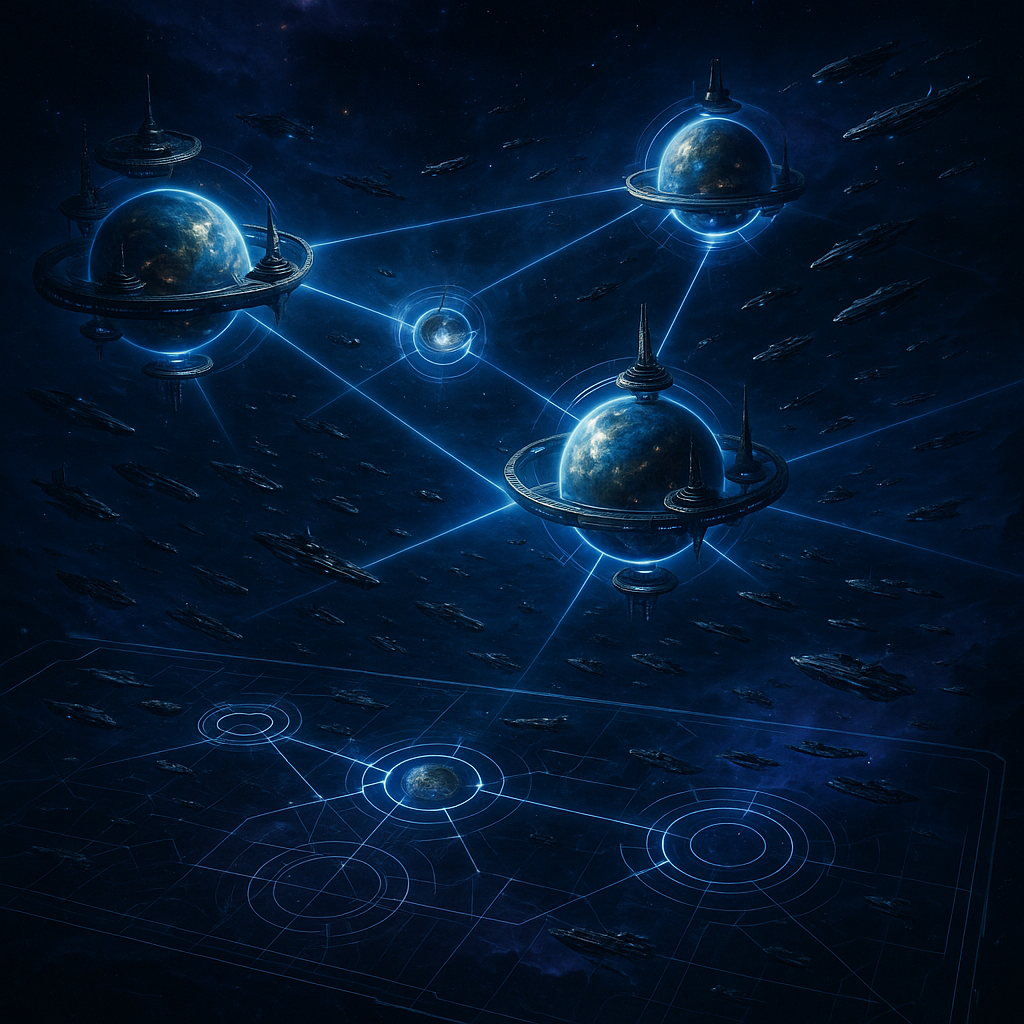
In War for Galaxy, the map is not just a decorative background behind mines, docks, and spaceships. In the mid and late stages, it becomes a separate strategic layer: who has established control in a system, who holds the majority of alliance planets, where influence borders lie, and which neighboring systems form an operational network. Here, ordinary planet development evolves into a territorial meta-game.
An ordinary player's account represents a personal empire: economy, fleet, defense, colonies, and individual risks. An Alliance works differently. According to War for Galaxy rules, an Alliance is a union of players that creates a common Alliance multi-account to capture and control territories in the galaxy. While a personal account is responsible for individual growth, the Alliance is a joint military and territorial structure created for war, holding planets, and fighting for systems.
The Alliance multi-account is the main tool of this struggle. Alliance members may use it; through it, alliance planets are captured and held, wars with other Alliances are waged, and territorial control is established. Therefore, collective strength is measured not only by the sum of personal fleets but importantly by where the multi-account's planets stand and whether they form a compact cluster.
Thus, War for Galaxy functions as a galaxy game at the intersection of space games, online strategy, browser strategy games, and space MMO games: fleets win battles, the economy supports the war, and the map defines where this all turns into long-term advantage.
Who Owns a System: Basic Ownership Rules
Control of systems in War for Galaxy begins with a simple question: does a planetary system have planets that belong specifically to the Alliance multi-account? The personal planets of members—even if half the alliance resides in the system—are not considered markers of alliance ownership. They may assist with supplies, reconnaissance, and military support, but actual control of the system is determined only by planets owned by the Alliance account.
The basic rule is: a system belongs to the Alliance if the Alliance multi-account has at least one planet there. But if multiple Alliances have multi-account planets in the same system, ownership goes to the one with more captured planets there. If the number of planets is equal, the system belongs to no one. This is not shared control or "draw with a bonus"—ownership resets to zero.
For leaders or officers, it's useful to remember this rule as a simple checklist:
- One Alliance in the system. Your multi-account has 1 planet, others have none — system is yours.
- Several Alliances in the system. You have 3 multi-account planets, competitor has 1 — system belongs to you.
- Equality. You have 2 alliance planets and competitor has 2 — no owner, system belongs to no one.
Alliance planets are specially marked on the map and visually distinct from ordinary ones. This is more than decoration: such markers quickly inform headquarters where real territorial control exists, where majority needs to be secured, and where players' personal colonies only create an illusion of presence. In this regard, War for Galaxy is closer to serious strategy and online strategy games: what matters is not settlement beauty but precise ownership arithmetic.
How an Alliance Gains and Loses Planets
An Alliance's territory begins with a multi-account planet. To create an Alliance under new rules, one Pioneer is required. In the "Alliance" → "Create" window, a player specifies a name and coordinates for an empty planet; upon clicking "Create" from an active planet, a Pioneer deploys. Upon reaching its destination, the Alliance forms along with its shared multi-account.
Further expansion happens through this multi-account. To capture an empty planet for the Alliance, you must be in the multi-account, send a Pioneer to the free planet, and choose the "Colonization" mission. Upon arrival, the planet becomes the property of the Alliance multi-account, not a personal colony of any participant.
Members can strengthen these planets from their own accounts using "Transportation" — delivering resources to Alliance planets—and "Relocation" — transferring ships to the Alliance's ownership. Important: multi-account can only receive ships. Relocation from multi-account back to personal planets is unavailable. Transferred fleets become part of the common military force.
Capturing another Alliance's planet works differently than a standard raid. To take an opponent’s alliance planet, you switch to your multi-account, select the opponent's Alliance multi-account planet and send a standard attack mission. Only Alliance multi-accounts can capture planets from other Alliances. If the attacking multi-account wins, the planet transfers ownership to the attacker; buildings, defenses, and infrastructure become theirs. The attacker's fleet remains on the captured planet, while supporting fleets return to their starting planets.
If defenders win, the attacker’s fleet is destroyed and territory ownership remains unchanged. A regular player may attack an Alliance planet from their personal account, resulting in standard looting: even a successful personal attack does not change planet ownership. For fans of real-time strategy, space combat, and spaceship games, this is a key distinction: personal raids can cause damage and loot resources, but cannot rewrite territorial control.
Each alliance planet is also important for ranking. The multi-account’s total rating depends on the cumulative value of all buildings, ships, and defenses it owns. Capturing an opponent’s planet grants rating points equivalent to the planet's value; the losing Alliance loses those points. Thus, territorial war involves not just battles over coordinates but struggles over accumulated infrastructure value.
Synergy of Neighboring Systems: When the Map Starts to Work
The main incentive to build not a scatter of isolated points but a connected territory is Alliance synergy. This bonus applies locally: only to Alliance multi-account planets in connected neighboring systems. It does not boost players' personal planets, isn't global for the entire tag, and does not turn every distant colony into a bonus zone.
Neighboring systems are those adjacent on the map. If the Alliance controls such systems connected into a single chain, bonuses apply to all multi-account planets within this linked network. Isolated systems get no bonus. A lone system may be a foothold, pressure point, or future bridge, but until it connects with a network of controlled neighbors, synergy doesn’t activate.
The basic math of synergy is:
- Controlling 3 neighboring systems grants +1.5% to titanium, silicon, and antimatter mining;
- Each additional joined system adds +0.5% to titanium, silicon, and antimatter production;
- The maximum base synergy bonus is 50%.
Key term here is "joined." New systems must be part of a connected network, not a distant standalone point. That’s why territorial control in War for Galaxy encourages form: a compact cluster is worth more than a random spread of planets across the galaxy. For space games and strategy games, this is a strong strategic layer: it’s important not just to occupy space but to build a network where each system supports neighbors.
The economic logic is clear: extra percentages in harvesting titanium, silicon, and antimatter gradually translate into more buildings, stronger defense, bigger fleets, and more options for the next war. However, calculations should strictly follow known rules: synergy affects only the output of these three resources, with no reference to build speed, armor, or other parameters unless explicitly detailed.
Practical Strategy: Plan a Cluster, Not Just Flags
A common mistake in territorial gameplay is celebrating every new point captured. Isolated systems don’t receive synergy bonuses, so it’s strategically smarter to expand through neighboring systems connected to your main core. A new planet next to your cluster can be a step toward the next bonus; a faraway planet without connection usually remains just an outpost.
Start planning with the connectivity map. Which systems do you already control? Where would losing a single point break your network? In which disputed systems can opponents quickly match your number of alliance planets? Systems with tied multi-account planet counts belong to no one and effectively lose their control node. Thus, key systems require not just presence but majority.
Practically, territory splits into three types. Core cluster systems — losing these breaks connectivity and shuts down part of synergy and must be fortified first. Border systems — zones for future attacks and counterattacks where you need to know in advance how many planets for majority. Isolated points — temporary footholds or preparation spots for expansion, but no synergy until connected to the network.
It is also vital to supply the multi-account in advance. Regular players can deliver resources via "Transportation" and transfer ships with "Relocation" to their Alliance’s planets. Do this before a crisis, not after the enemy is preparing a capture. Treat the multi-account as a shared warehouse, frontline base, and striking tool—not a regular account with all usual features.
For serious attacks, use joint attacks. This allows alliance members to combine fleets into a single striking force and coordinate a strike. The organizer selects "Joint Attack," specifies target coordinates and arrival time; participants join if they can arrive on time and if slots are available. The maximum number of fleets in a joint attack depends on the organizer’s Navigation level by formula: ⌊Navigation Level / 5⌋ + 1. In this type of online strategy, coordination often matters more than individual heroic sorties.
Defense of connectivity is built around the "Defense" mission, available only among alliance members. It enables placing a fleet temporarily in orbit around an allied planet. The defended planet must have a Refueling Station whose level equals the number of slots for allied fleets. A defending fleet remains on the planet up to 3 days (72 hours). Holding requires no fuel; antimatter is consumed only for travel. This makes defense a convenient tool for holding nodes where losing one planet risks losing the system or breaking the cluster.
When planning, consider multi-account limitations. It has no main planet; you cannot delete planets; Marauders do not spawn; it doesn't affect pirate spawns and cannot attack pirates. Missions, Shop, Profile, and Reward Calendar are unavailable; no free Hermes tokens and no report deletion. In exchange, the "Navigation" technology gives the multi-account a stronger bonus to fleet slots: +2 instead of +1. This highlights its role: fewer routine functions, more territorial warfare.
Conclusion: A Strong Alliance Controls a Network, Not Points
Territory in War for Galaxy is valuable not by itself but as an advantage when individual multi-account planets form a connected decision system: planets grant system ownership, majority settles disputes, neighboring systems enable local synergy, and captures and losses change overall multi-account rating.
If a system has at least one Alliance account planet and no competitor with more such planets, it belongs to your Alliance. Equal numbers mean no owner. Connected neighboring systems generate synergy bonuses for internal multi-account planets; isolated systems do not. Capturing enemy planets grants rating points equal to their value, while the loser loses those points.
Therefore, a strong Alliance thinks in terms of networks: where is the core, the bridge, disputed systems, majorities, where fleets need defenses, and where to send the next Pioneer. Among space games, strategy games, browser strategy games, and Russian-language space games, War for Galaxy is notable as fleet, economy, and territory converge on a single map of decisions.
Ready to test the territorial meta in practice? Visit the Russian page of War for Galaxy, launch the game in your browser via the official web client, or choose a convenient platform: download page, VK Play, Google Play, or App Store. Gather your Alliance, build a connected cluster, and turn the galaxy map into a resource worth fighting for.