

Mini-Guide for Starting Out: The First Rule of Fleet Composition in War for Galaxy
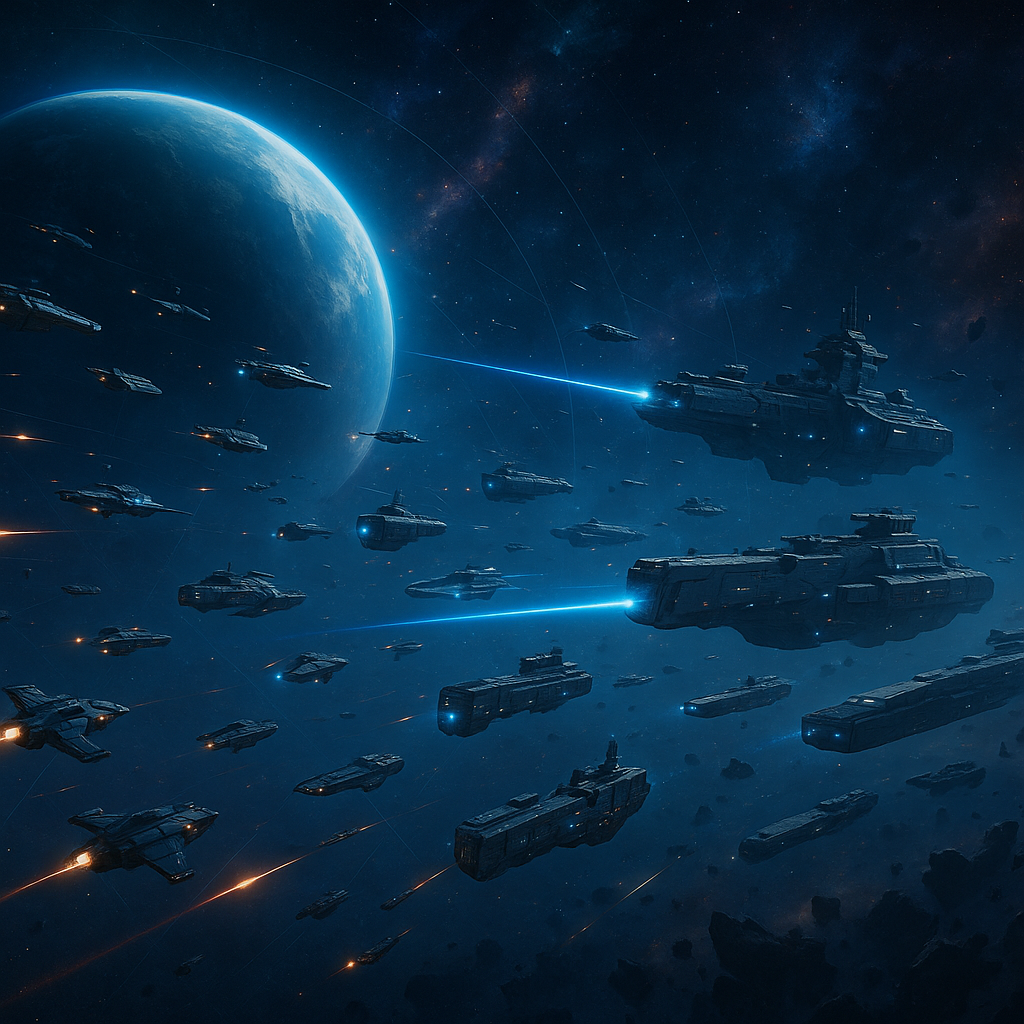
Mini-Guide for Starting Out: The First Rule of Fleet Composition in War for Galaxy
The main mistake beginners make in War for Galaxy is thinking that victory in battle goes to whoever has more or more expensive ships. At first glance, this logic is obvious: gather resources, build the most impressive unit, assemble an armada, and send it to attack. But in real space battles, this approach often ends not with victory but with a field of debris orbiting in space.
The first fleet rule is simple: a strong fleet is not the most expensive fleet; a strong fleet is a properly assembled fleet. You shouldn’t build an armada from one ship type and hope it breaks through any target. Each class has weaknesses: some ships poorly withstand certain damage types, others only shine with support, and some are only dangerous at the right distance and angle.
War for Galaxy is a game about spaceships, space battles, and strategic fleet development. If you like space games, browser strategies, online strategy games, space combat games, or spaceship games, it quickly becomes clear: a fleet is not just a sum of profile points but a tool for a specific task.
Even a high theoretical power does not guarantee the same battle outcome. Composition, armor, shields, weapon types, firing arcs, and whether ships can effectively deal damage all matter. So before hitting the send button in the game, ask the key question: does this fleet fit this specific purpose?
Why Combat Power Alone Is Not Enough
War for Galaxy has a conditional combat power — a hidden parameter used to roughly predict victory. If the combined combat power of one fleet is higher, that side will likely win. When one side has five times the power, the winner usually suffers minimal losses: a large power reserve truly overwhelms.
But this number is a guideline, not an auto-win button. For scale: 1 Colossus is roughly equal to 86 Destroyers in conditional combat power. This seems obvious: build a Colossus and conquer the galaxy. In practice, many lose their first truly expensive fleet this way, because actual battle accounts for more than just the total amount of metal.
Two similarly powered fleets can fight very differently. One penetrates armor better, another survives longer due to shields and defense level, a third hits targets more reliably, a fourth shoots more effectively at advantageous distance, and a fifth is simply better tailored for a specific task: fleet attack, defense cleanup, or finishing off survivors.
There is also a time limit. The battle cycle lasts until one side is destroyed or 10 minutes elapse. If neither side finishes off the enemy in that time, the battle ends in a draw. Therefore, a fleet that looks powerful on paper but poorly penetrates the target or slowly applies damage may not close the fight with a win in time.
This is precisely the depth that makes good strategy and real-time strategy games beloved: numbers help assess risk, but decisions are made by the player. A strong commander looks not only at power but how ships interact in real combat.
Basic Battle Mechanics: Defense, Weapons, and Firing Arcs
Space battles in War for Galaxy occur on a 20×20 grid. Attacking and defending sides occupy 4 rows on opposite edges. This is important: battle is not an abstract exchange of numbers but a clash where positioning, range, and fire direction matter.
All ships of the same type combine into a single super-unit. For example, 100 Fighters in battle act as one squad with combined health and a role. Hence, massed light ships behave very differently than a single heavy ship with a comparable rating.
Damage proceeds through a clear chain: first absorbed by shields, then reduces armor. If the hit exceeds what's needed to destroy the current unit within the squad, the leftover damage transfers to the next unit. A powerful volley can penetrate the pack further if damage suffices.
Three Defense Levels
Ships and defenses have three levels of protection: 1, 2, and 3. Different weapon types impact them differently, and this is a main reason why a mono-fleet quickly hits a ceiling.
- Infrared lasers deal 100% damage to level 1 defense but only 16% to levels 2 and 3.
- Lepton weapons deal 100% damage to levels 1 and 2, but only 52% to level 3.
- Ultraviolet and missile weapons often seem more versatile but shouldn’t be considered a catch-all: certain setups have their exceptions and dips.
The takeaway: a fleet built only on infrared lasers can efficiently deal with light targets but struggle against well-protected ships. Focusing only on heavy guns can struggle against crowds of small targets. A mixed fleet is more reliable by covering more combat scenarios.
Firing Arcs
Almost all ships’ weapons have firing arcs. Guns fire not all around but within a sector: forward, on the flank, rear, or a wide sector. Exception — missiles. Defensive structures differ: they’re stationary and fire at 360°.
The clearest example is the Colossus. It’s especially dangerous facing a target in front, where its main guns are. But if small ships approach from the side or rear, some Colossus weapons may not reach them in the firing arc. So a lone large ship without support is not a magic win button but a costly target needing cover.
Ship Roles: What to Understand Before Your First Attack
Before your first sortie, don’t think only “which ship is strongest — I’ll build that.” War for Galaxy fleets are like toolkits. You don’t assemble the most expensive composition; you assemble a composition for the task.
- Light ships excel by numbers and evasion. In right quantities, they can threaten heavy ships, especially if those are poorly supported.
- Medium ships better clear light targets and keep enemy small craft from picking apart your expensive units.
- Heavy ships are strong against large targets and defenses but usually require escorts.
- Bombers are especially useful against defensive structures; their role can’t be ignored if the target is a fortified planet.
- Galaction ships are key against fleets relying on active skills; their value lies not only in damage but control.
- Colossus is very powerful but expensive, slow, and vulnerable without proper support. A lone Colossus can become not a symbol of power but the most costly mistake.
Also remember active abilities. Frigate activates "Barrier" and gains +150% shields for 5 seconds. Galaction uses "Radio Suppression": disables enemy unit skills and reduces its attack by 50%. Destroyer applies "Lepton Strike" — +300% damage on the strongest lepton weapon target. Colossus with "Duel" skill draws all fire from other Colossi and increases main weapon damage to 100,000 base value.
So the right question before attack isn’t "how much power do I have?" but "what exactly do I want to penetrate?" Light ships overwhelm by numbers, medium clear small craft, heavy break large targets, bombers hit defenses, Galactions disrupt skills, and Colossus needs protection.
Practical Mini-Checklist Before Battle
Your first sortie is better planned calmly, not on impulse. In space, you’re punished more often for blind fleets than weak fleets.
- Assess the target. An enemy planet can have ships, defenses, energy domes, and resources. Victory can destroy ships and defenses and grab half the resources. You cannot completely erase a planet: it’s a raid, not player removal.
- Don’t send everything blindly. Keep reserves at home, especially if this is your first combat fleet. Losing your entire fleet early slows development more than avoiding a risky attack.
- Use scouting. A scout drone performs the "Espionage" mission and can be destroyed during it — by debris on an empty planet or enemy fleet. But even if the drone is shot down, you still receive a scout report.
- Don’t confuse battle and special-purpose ships. Marauders only do "Theft" missions. They don’t attack, defend your planet, can’t be destroyed during defense, and don’t redeploy between your planets.
- Practice on pirates. Pirates are good for beginners: you can learn fleet ratios safely without provoking PvP wars. They can’t be scanned, yield little combat rating, but leave debris like normal fleets after battle. Pirate fleet composition depends on average combat power of inhabited planets in the system.
- Plan debris collection. Debris isn’t gathered automatically. It’s collected only by Collectors sent on a "Recycle" mission. If you win a battle but don’t send Collectors, another player might scoop the loot.
- Remember about the rating. Combat rating uses an Elo system: you gain points for victory and lose for defeat. Extra PvP risks can cost not only your fleet but your league position.
A good commander’s habit is not to press "attack" until risk is clear. Scouting, target composition, defense type, possible debris, and retreat path matter more than impulse.
When Your Fleet Becomes Part of a Larger Strategy
Your personal fleet is only the beginning. First, you learn not to lose ships on early sorties, adapt composition to the target, and read battle beyond numbers. But the galaxy later shows: large wars are decided not by one player with a fine armada but by a group acting as a single command center.
Alliance is a player union creating a shared Alliance Multi-account to capture and control territories. Your personal empire builds your base, and the Alliance turns scattered fleets into territorial strategy.
In defense, allies can cover each other using the "Defense" mission by temporarily placing fleets in orbit of an ally’s planet. For offense, there is Joint Attack: it lets alliance members combine fleets into a single fighting force for a coordinated strike. It is the only way to mass-combine fleets offensively.
- The joint attack organizer must be the slowest participant, otherwise slower allies cannot join in time.
- In battle, all ships of the same type from participants merge into one super-unit.
- Technologies in such detachments are calculated as weighted averages proportional to ship numbers from each player.
- All participants receive the battle report.
This system prevents simply riding on one strong ally’s back. It rewards fair contribution: ships, tech, flight time, and discipline.
Here the first fleet rule becomes even more essential: composition fitting the task is more important than blindly betting on the most expensive ship. This applies in solo raids, against pirates, attacking fortified planets, and in large-scale alliance operations. Don’t build mono-fleets for pretty numbers — build combat combinations that truly solve the task.
Ready to test this in action? Visit the official War for Galaxy website, launch the game in browser at play.warforgalaxy.com, download the game from the downloads page, or get the mobile version: Android on Google Play and iOS on the App Store. Assemble your first smart fleet — and let your space battles start with a victory report, not a mistake.