

Pirates in War for Galaxy: How They Appear and Why Their Composition Depends on the System's Strength
Pirates in War for Galaxy: How They Appear and Why Their Composition Depends on the System's Strength
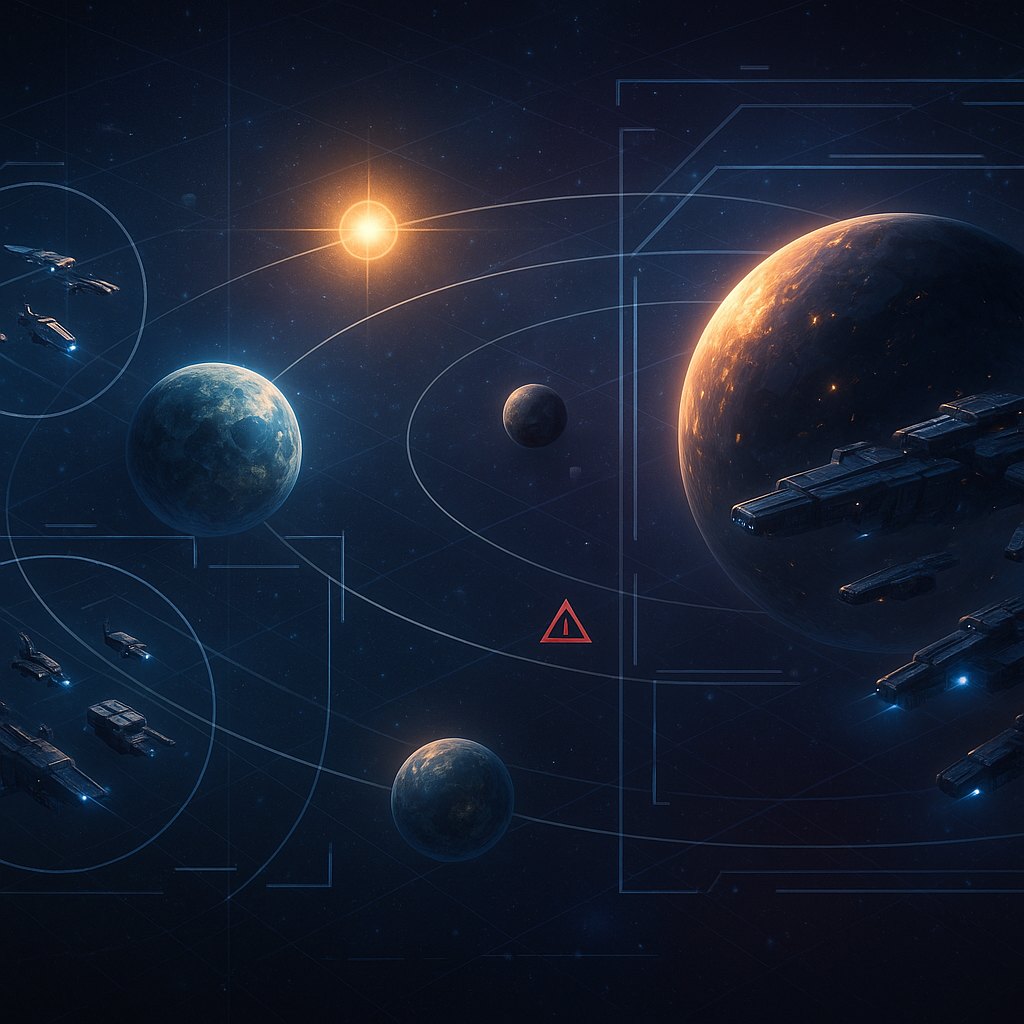
If you've already opened a system map in War for Galaxy, you have probably noticed a seemingly strange pattern: pirate fleets sometimes stand nearby as convenient training targets, sometimes disappear after attacks by others, and sometimes return after some time looking more dangerous. Yesterday, these were light groups you wanted to attack without much calculation, but today in the same system you may encounter an opponent you better not face with your entire valuable fleet blindly.
Pirates in War for Galaxy are not mere decoration or someone’s hidden fleet. By game mechanics, pirate scout fleets are autonomous combat formations that appear in planetary systems with active players. They belong to no one: not another player's fleet and not an NPC empire's army. Their role is to maintain the galaxy's combat rhythm and create PvE challenges even for commanders who are not yet interested in full-scale PvP wars.
That’s why pirates are important for newbies and mid-level players. In this space online strategy, they allow training in real space battles, testing your fleet setup, seeing losses, and obtaining a debris field after battles. These encounters bring almost no battle rating, so pirates should not be viewed as a quick path to league growth. Their value lies elsewhere: practice, understanding combat mechanics, and collecting debris without direct conflict with a live player.
It's important to remove one main expectation immediately: pirates do not spawn by pressing a button. Players cannot manually trigger their respawn, choose their composition, or guarantee an "easy" target. The server periodically checks suitable systems and according to internal rules can add new pirate flotillas. Thanks to this, War for Galaxy feels less like a static map and more like a living galaxy game and space MMO in the spirit of browser strategy games: the galaxy changes, targets appear unpredictably, and the player must read the situation.
How Pirates Appear: Server Check Every 4 Hours
The basic logic for pirate appearance is simple but often misunderstood. Pirate fleets do not have to appear immediately after you cleared a system. The game operates through a server cycle: every 4 hours at fixed times a check is launched. The server goes through planetary systems with active players and determines if conditions are met to replenish pirate activity.
The key condition is the presence of active inhabited planets. Pirates do not spawn in empty systems: without normal player activity, the server does not create PvE targets. Also, they do not spawn in systems with banned or "dead" planets. Such systems are considered unsuitable environments for generating pirate fleets.
After this, the server checks if there are enough pirates in a system according to the game's internal rules. The exact number that "should be" in the system is not disclosed, so don’t build calculations around fixed limits. What matters is: if the check shows that pirate fleets are fewer than needed, the server may add new flotillas. It may, but is not obligated to do so.
- The check runs every 4 hours;
- Only systems with active inhabited planets are considered;
- If pirates are fewer than the internal target number, there is a chance of replenishment;
- The server can add a random number of new pirate fleets—from 0 up to the needed amount;
- A complete respawn after each check is not guaranteed.
In practice, this means: if you destroyed all pirates and returned after 4 hours, the system does not have to be full of targets again. The server may add several fleets, may fill the deficit, or may add none. Thus, hunting pirates is not a machine dispensing guaranteed loot but a PvE mechanic with uncertainty.
This logic fits War for Galaxy’s format well as a space game at the crossroads of online strategy, real-time strategy, and classic browser strategy games. The galaxy lives on the server’s schedule, and players adjust routes, farming, and combat prep accordingly. To understand the project better, you can visit the War for Galaxy about page, but for pirates, it’s enough to remember: a check does not equal guaranteed targets.
Why Pirate Composition Depends on System Strength
The most important part of the mechanic begins after the server has decided that a new pirate fleet should generate in a system. The second step is determining the fleet’s exact composition. Here the main rule applies: the composition depends strictly on the average combat power of all inhabited planets in that system.
This isn’t tuned to just one of your planets or a personal punishment. Pirates don’t care who exactly plans to attack them. The mechanic looks at the overall combat level of all inhabited planets and selects the threat accordingly. In other words, it evaluates not "you personally" but the area's average strength.
This leads to situations that may surprise at first. If a new player with nearly no ships lives in the system, low-ranked light pirates are generated there. In such systems with newbies, expect simpler compositions: fighters, shuttles, transporters. These are suitable targets for early training when players are just learning fleet ratios, losses, and debris collection.
In mid-level systems things get more serious. When inhabited planets have notable combat forces, pirate groups get denser and more dangerous. They cease to be just training targets and begin to test how well you assembled your fleet: does it have resilience, enough damage, is your army not too one-sided?
In systems of experienced players expect another risk level. If players in the system have Colossi, expect mostly powerful pirate fleets there. Such locations may feature heavy and elite pirates: frigates, bombers, up to Colossi. For space combat and spaceship game fans, this is precisely the part of War for Galaxy where PvE feels like real space battles rather than a shooting gallery.
The biggest mistake of newbies is to believe pirate composition is tailored to their single colony. The correct phrasing is: composition is calculated by the average combat power of all inhabited planets in the planetary system. If near your young colony there is a developed planet with a heavy fleet, the overall average power may be higher than expected. Hence pirates may be more dangerous than anticipated.
The reverse is also true. If the system as a whole is weak, don’t expect elite pirate armadas everywhere. The mechanic keeps the threat close to the system level. This makes hunting more predictable: you don’t know a fleet’s exact composition but can estimate the overall background. A weak system usually means easier targets; a system with developed fleets and Colossi demands caution.
What You Can Know in Advance and What Remains a Risk
Even understanding the average combat power rule does not turn pirate hunting into a perfectly safe table. The main limit: pirates are invulnerable to espionage. They cannot be scanned. The usual scenario of “send a scout probe, see the exact composition, build a counter fleet” does not work here.
This is not a UI bug but a PvE mechanic feature. The pirate flotilla remains a combat unknown. You can estimate the system’s strength, guess the threat level, and compare it with your fleet, but you won’t get a precise ship list beforehand. Preparation relies on indirect risk assessment.
Before attacking, consider these questions: How strong is the system overall? Are there developed inhabited planets with heavy fleets nearby? Does your fleet have sufficient margin if the pirate composition is unfavorable? Are you relying on just one ship type that might perform poorly against certain armor, range, or firing sector?
The game uses conditional combat power for rough prognosis. This hidden parameter helps assess likely combat outcomes. If the total conditional combat power of one fleet surpasses another, the battle likely ends in that side’s victory. With a fivefold advantage, the winner suffers practically no losses.
But conditional power isn’t a magical guarantee. Even equal power does not guarantee an equal fight. War for Galaxy values armor penetration, shields, damage endurance, hits, range, firing sectors, and fleet assembly itself. A ship may be terrifying when the target is in its optimal firing sector and noticeably worse if the opponent is at the side or rear. Another fleet may be cheaper but better at distributing damage and surviving under fire.
The main tactical takeaway: don’t look for a single perfect setup against all pirates. Their composition isn’t scanned beforehand; no universal recipe for any flotilla exists. A better approach is to bring a buffer, consider system strength, avoid mono-type fleets, and remember that a strong fleet is one assembled well, not just the most expensive.
Practical Tips: How to Hunt and Collect Debris Safely
Pirates are useful as a training ground but shouldn’t be viewed as guaranteed free loot. These PvE targets help practice combat without immediately triggering wars with other players. Debris remains after destroying pirate fleets just as after regular fleets, making pirates a reliable source of debris without direct PvP conflict.
They are especially helpful for newcomers. You can practice fleet ratios for victory on pirates, observe real losses, and gradually see where your build lacks durability, damage, or density. But it’s important not to confuse training with impunity: rush into a strong system without backup, and the fight may be an expensive lesson.
Don’t forget recycling after a successful battle. Debris does not go straight into the hold. Only Collectors sent on the “Recycling” mission can process debris. Other ships—transports, shuttles, combat units—cannot recycle debris fields. A normal farming cycle looks like: find a suitable target, defeat pirates, see debris field, send Collectors.
Debris has no fixed lifetime. It exists until collected or the server restarts. That means leaving debris "for later" is risky. In browser strategies, often the winner is not who first created resources but who is faster and more disciplined at collecting them.
- Start with systems matching your level. Systems mostly with weak inhabited planets tend to have easier pirates. Systems filled with strong fleets carry higher risks.
- Don't build an armada of one ship type. Each ship type has weaknesses. A one-sided fleet may look impressive in numbers but work poorly against unfavorable compositions.
- Consider the system’s average strength. Heavy pirates appear more commonly in systems with higher average combat power of inhabited planets.
- Keep Collectors ready. Hunting without recycling is only half the result.
- Never fly without reserves. Pirates cannot be scanned, so always expect surprises.
It’s worth noting that the Alliance multiaccount does not affect pirate spawning and cannot attack pirates. Attempting such an attack results in an error: “Alliance Code prohibits attacking Pirates.” So, pirate hunting is done with a normal player account, not an alliance’s territory control tool.
If you enjoy strategy games, space games, and browser strategies, pirates in War for Galaxy provide a clear and useful combat cycle: assess the system, choose risk, send fleet, analyze results, recycle debris. It doesn’t replace player wars but prepares players well for them.
Summary: How to Read a System Before Facing Pirates
Pirate mechanics boil down to three main rules. First: they refresh not constantly but through a server check every 4 hours. Second: if the system has fewer pirates than internal rules require, the server may add a random number of new flotillas—from zero to the needed amount. Thus, incomplete respawn after a cycle is not a bug.
Third and most important rule: pirate fleet composition depends on the average combat power of all inhabited planets in the system. A weak system usually means lighter targets. Systems with developed players, heavy fleets, and Colossi require serious preparation. Pirates cannot be scanned, so preparation relies on understanding mechanics, risk assessment, and smart fleet assembly.
Use pirates as a PvE trainer: learn to read systems, don’t attack blindly where threats are high, and prepare Collectors for debris in advance. This makes hunting not a lottery but a deliberate part of developing your space empire.
Ready to test the mechanics? Visit the official War for Galaxy site, open the browser game, or choose a launcher on the War for Galaxy download page. Build a fleet, find a suitable system, assess risk—and turn pirates from a random threat into a source of experience, debris, and confidence ahead of real galactic wars.