

Why Equal Combat Power Doesn't Guarantee an Even Fight in War for Galaxy
Why Equal Combat Power Doesn't Guarantee an Even Fight in War for Galaxy
In War for Galaxy, it's easy to fall into the trap of relying on a single number. Players compare their combat power to the target's, see similar values, and conclude that the fight will be nearly even, losses predictable, and the result an honest exchange ship for ship. But space battles in War for Galaxy run deeper. Estimated combat power is a useful guide but does not replace understanding fleet composition, defense levels, firing sectors, and loss economics.
Estimated combat power is a hidden parameter that helps roughly predict outcomes when comparing invasion fleets and defense forces. If one side's total estimated power is higher, the battle will most likely end in their victory. But "most likely" doesn't mean "guaranteed," especially when values are close. Two armies with the same number may have very different penetration power, survivability, and exchange value.
There's a rough boundary: with a fivefold superiority in estimated combat power, the winner practically suffers no losses. But between "roughly equal" and "five times stronger" lies all the game's tactics. A telling example: one Colossus approximately equals 86 Destroyers in estimated combat power. On paper, a simple ratio, but in actual combat, the Colossus can be the centerpiece of victory or an expensive target if not properly covered or if targets move out of favorable firing sectors.
That's why War for Galaxy is closer to serious strategy games and space combat games than a game of "compare number — press attack." This galaxy game blends space games, browser strategies, and online strategies, where the strongest fleet is not the most expensive but the properly composed one. Let's explore the mechanics that break the illusion of equal strength.
Battlefield: 20×20 Grid, Starting Rows, and Super-Units
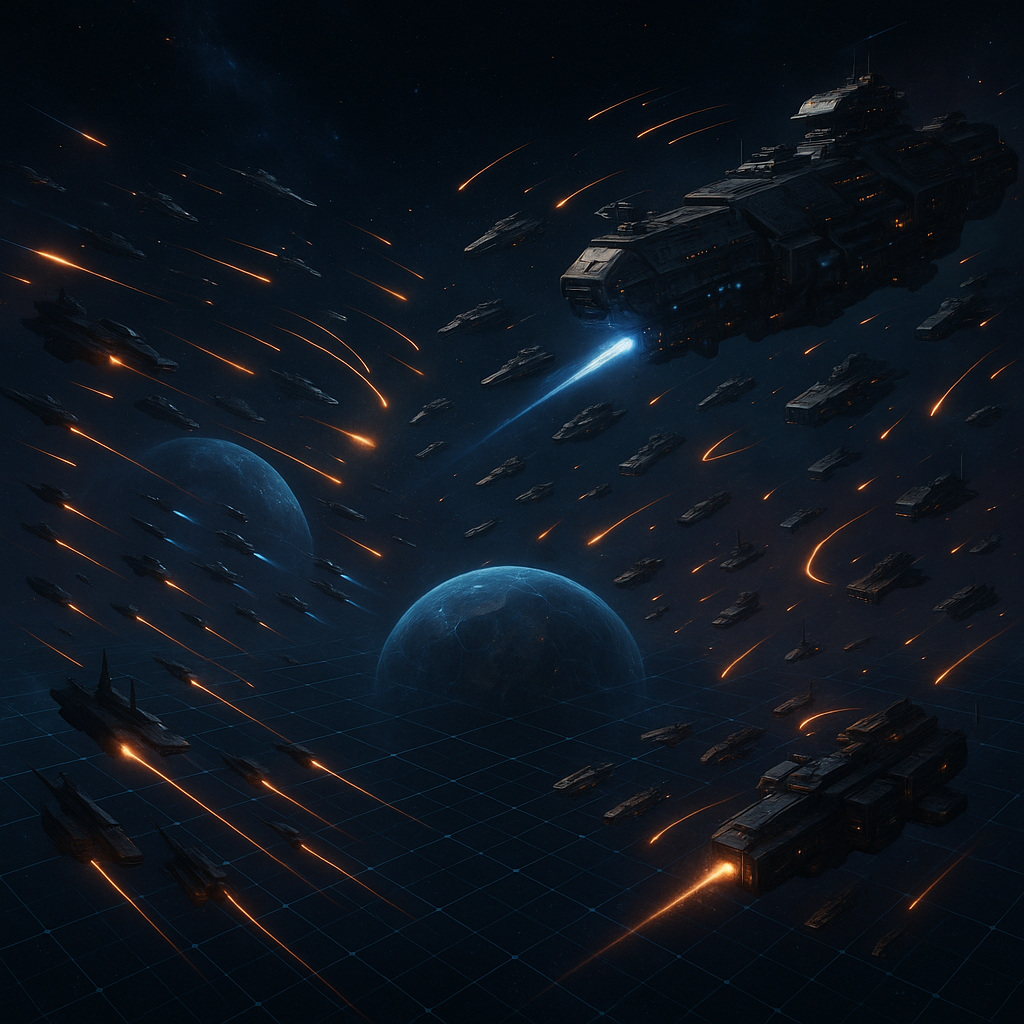
The first factor is battle geometry. Fights take place on a tactical field sized 20×20 cells. Each side occupies four rows from opposite edges. This means the fleet is not just an abstract sum of damage: which squads face each other, who contacts first, and which targets enter firing zones matter.
A key feature of War for Galaxy is grouping ships of the same type into super-units. If you have 300 Fighters, they don't act as 300 separate objects: it's one large Fighter squad. Forty Corvettes form a second super-unit, Destroyers a third, Bombers a fourth. So, two fleets with the same estimated power can behave differently: one assembled in a couple of heavy blocks, the other in several specialized squads that take damage and select targets differently.
Defensive structures operate separately from ship logic. They are stationary, do not move on the field, fire 360°, and are not tied to the front. They don't need to turn their hull toward the target as ships with limited sectors do. This is especially important when attacking planets: ground defense may be less mobile but has stable firing directions.
In joint attacks, this mechanic becomes even more important. All ships of one type from all alliance siege participants merge into one common super-unit. If one player brings 80 Corvettes, another 20, and a third 1, a combined squad of 101 Corvettes appears. Technologies — weapons, armor, and shields — in such a unit are averaged weighted by the number of ships. One perfectly upgraded Corvette won't magically boost a hundred weak ones; its bonus mostly dilutes in the mass. For players used to browser strategy games, real-time strategy games, and space MMO games, this is an important lesson: the quality of contribution must match its volume.
Defense Levels and Weapon Effectiveness
The second layer is matching weapons and armor. War for Galaxy has three defense levels: 1, 2, and 3. Weapon damage depends not only on the base stats but also on efficiency against the target's defense level. So, "high damage" doesn't always mean "high real losses."
Infrared lasers work well against light targets with defense level 1: effectiveness is 100%. But against levels 2 and 3 it drops to 16%. Mass infrared fire can quickly clear light ships but struggles notably against heavier armor. Lepton weapons are fully effective against levels 1 and 2 but only 52% against level 3. Still a solid hit but not full potential.
Photon weapons deal 420 damage per shot, fire 15 times per minute, with 100% effectiveness at defense level 1 and 67% at levels 2 and 3. Ultraviolet Laser Type-2 seems powerful with 260 damage and 100 shots per minute: 100% effective against levels 1–2, but drops to 20% against level 3. On paper, the firing rate is huge; in combat against heavy armor, the result is very different.
There are more universal solutions. Heavy Ultraviolet Laser deals 400 damage, 30 shots per minute, and is 100% effective against all defense levels. Bomber's Rocket Salvo deals 220 damage, 48 launches per minute, also 100% effective against levels 1, 2, and 3. So Bombers are valued not just for "countering defense" but for damage stability across target types.
Defense follows the same principles. Rocket Block has estimated combat power 4, defense level 1, 120 damage per shot, 24 shots per minute. Its effectiveness is 100% against defense 1, 10% against 2, and just 5% against 3. It bites against light raiders but barely scratches heavy ships. Graviton weapon is a different threat level: estimated power 97, defense level 3, 1450 damage per shot, 15 shots per minute, 100% effectiveness at levels 1–2, and 78% at level 3.
The practical takeaway: compare not just total power but the combination "my weapon → enemy defense level." Equal estimated power can lose if your main damage poorly penetrates the target's armor.
Firing Sectors and Ship Roles
The third factor is firing direction. A ship in War for Galaxy is not a sphere with guns all around. It has bow, sides, stern, and specific sectors where its weapons work. 0° is strictly forward along the ship's course. The firing sector counts clockwise. If a sector crosses 0°, e.g. 355°–5°, it passes through the bow: 355° → 360° → 0° → 5°. This is a narrow frontal corridor, not nearly a full circle.
Almost all ships' weapons are not positioned "everywhere at once." Each weapon fires only within a certain angle; exceptions are rockets. The system automatically selects the most advantageous target in the weapon's damage zone. But if a target is outside that sector, the weapon simply doesn't participate in the exchange.
The Fighter carries two small Infrared Lasers Type-2 with a frontal sector of 355°–5°. The Striker has four medium infrared lasers with the same frontal sector. They push forward but depend on direction. Transport and Collector have small Infrared Laser Type-1 with 0–360° sector: this doesn't make them fighting ships but prevents helplessness when a target approaches from any angle. The Pathfinder carries two small Infrared Lasers Type-2 with 0–360° sectors.
The Bomber is especially interesting: its Rocket Salvo fires in a 0–360° sector, but additional lasers have restrictions. Therefore not all Bomber damage is circular. The Colossus is even more striking. It carries powerful lepton weapons and heavy ultraviolet lasers with different sectors and is particularly dangerous when targets are in front within main caliber sectors. If small ships flank or approach from behind, part of the Colossus's armament cannot reach targets. This demonstrates the depth of spaceship games: it's important not only how much damage a ship has but also where that damage can be directed.
Active Skills: The Factor That Can Change the Exchange
Even with similar compositions, the battle can shift due to active skills. The Fighter uses Rocket Salvo, the Striker Torpedoes, the Corvette Suppressive Fire, the Bomber Hailstorm, the Destroyer Lepton Strike. Support and heavy target skills are especially noticeable.
The Frigate with Barrier gets +150% shields for 5 seconds. Sometimes those seconds suffice to survive focus fire and give the rest of the fleet time to deal damage. The Galaktion with Jam disables an enemy unit's skills and gives the target –50% attack. Against a fleet relying on active abilities, this is not just support but a battle plan blow. The Colossus's Duel skill diverts all fire onto Colossuses, increasing main weapon damage up to 100,000 base. Therefore equal power in real-time strategy games like War for Galaxy is just the starting point. It's crucial who disables key skills first and who forces an expensive ship to shoot at the wrong targets.
Battle Cycle, Shields, and Recovery
Battle lasts until one side is destroyed or 10 minutes expire. If no side is fully destroyed in 10 minutes, the battle ends in a draw. Each round, all squads simultaneously check available targets and fire at those in their weapons' damage zones. It's not a turn-by-turn "you first, then me": both sides inflict damage within the cycle.
Damage is absorbed by shields first, then armor. If damage exceeds what's needed to destroy the current unit in the squad, excess carries over to the next unit. Thus the same volley might just remove a shield or pierce it, armor, and impact the next ship in the super-unit. Over the battle distance, this greatly influences losses.
After battle begins the economic part. Destroyed ships can only recover if victorious — by the "Recovery Chance on Victory" parameter. Fighters, Strikers, and Energy Drones have 15%; Corvettes, Transport, Collector, and Pathfinder 25%; Frigates, Galaktion, Destroyer, and Bomber 65%; Colossus 85%. If the attack is lost, this chance doesn't help the fleet.
Defense is more advantageous over time: destroyed defensive structures can recover after any battle outcome according to their chance. Rocket Block and Infrared Laser have 25%, Ultraviolet Laser and Photon Cannon 35%, Graviton Weapon and Lepton Cannon 75%. So even a won attack can be economically poor if the attacker lost an expensive fleet while the defender restored a significant portion of defenses.
Energy Domes: Zero Attack but Huge Mistake Cost
The Small and Large Energy Domes have zero estimated combat power and do not fire. But they can radically change battles because their shields cover all ground defense but do not protect fleets. Any damage to defense is first absorbed by the domes' shields; if damage exceeds the shield, the remainder hits the defense itself.
The Small Energy Dome has 8,000 armor, 30,000 shield, defense level 2, and 0% recovery chance. The Large Energy Dome has 40,000 armor, 150,000 shield, defense level 3, and also 0% recovery. Only one Small and one Large Energy Dome can be built per planet. If a dome's armor is destroyed, it disables and must be rebuilt. For the attacker, a target with domes may look weaker in direct damage but requires a much higher penetration reserve.
Practical Conclusions: Win by Composition, Not Just Numbers
Don't build an armada of only one ship type. Each class has strengths and weaknesses. Light ships excel against heavy ones with numbers and evasion. Medium ships better clear light targets. Heavy ships are strong against big targets and defenses but need cover. Bombers are useful against defenses. Galaktions are vital against fleets relying on skills. Colossus is strong but expensive, slow, and vulnerable without proper support.
Before attacking, ask yourself some questions: How does my main damage penetrate the enemy's defense level? Am I losing half my weapons because of firing sectors? Does the opponent have domes? What recovers after battle? Will the loot cover fleet losses? You cannot completely destroy an enemy planet: with attacks you can damage ships and defense, and upon victory take half the planet's resources. Thus, the raid's goal is not to erase a player but to gain favorable combat and economic results.
Remember rating: combat rating is calculated by Elo system. Victory gives points, defeat loses them; the higher the opponent's rating relative to yours, the more points you can gain for a win. But rating does not compensate for a bad exchange if you lose a fleet you spent weeks building.
For practice, use pirates. Pirate fleets appear in systems with active players and refresh every 4 hours. Their composition depends on the average combat power of all inhabited planets in the system, and after battle they drop debris like regular fleets. This is a good test ground for checking ship ratios without immediate PvP wars. But only Collectors on "Recycling" missions process debris.
The final formula is simple: equal combat power is just a starting comparison, but outcomes are determined by counter composition, firing sectors, defense levels, shields, skills, and loss cost. If you want to grow not just in numbers but in skill, join the browser version of War for Galaxy, test builds on pirates, study reports, and build fleets for specific tasks. Play in-browser or download War for Galaxy or install mobile versions via Google Play and App Store. Victory belongs not to those with prettier numbers but those who understand why those numbers work.