

Weak vs Strong: How Strategic Fleet Depth Works in War for Galaxy
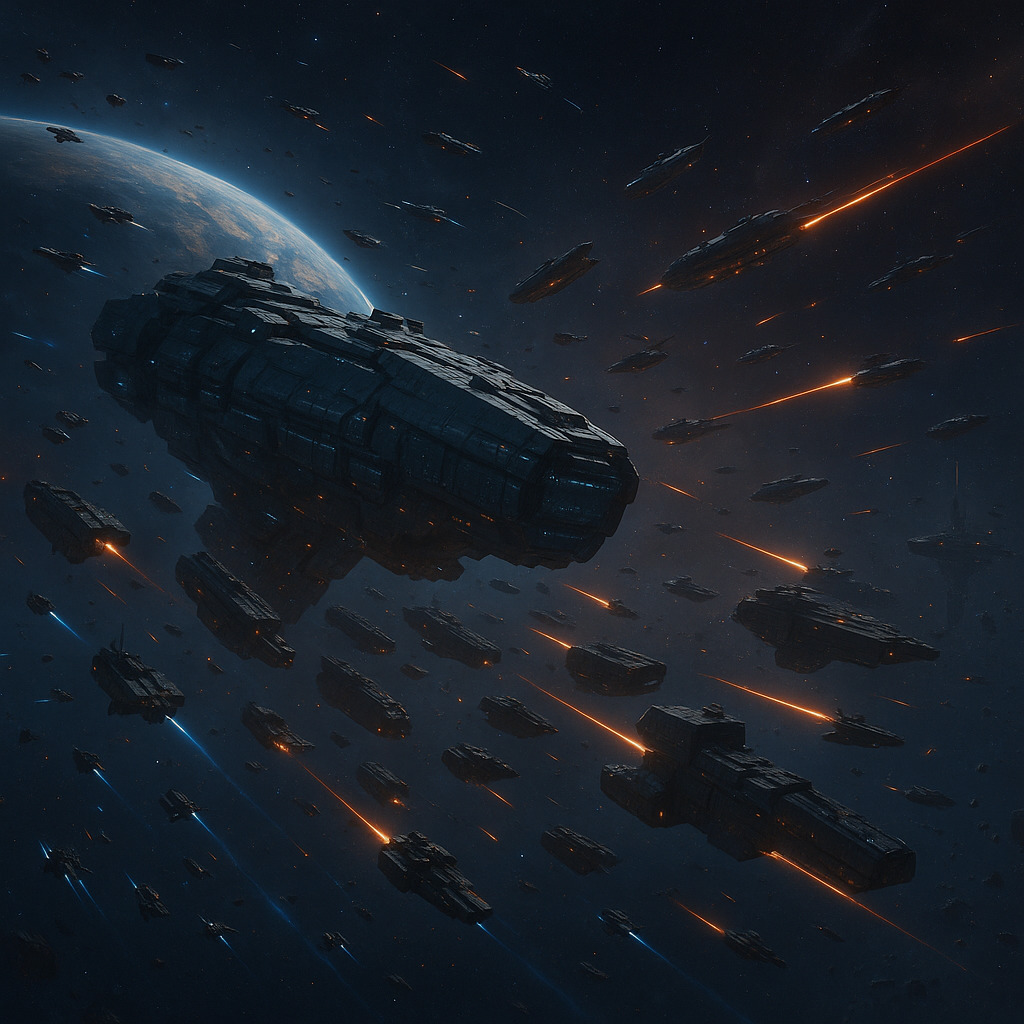
Weak vs Strong: How Strategic Fleet Depth Works in War for Galaxy
In War for Galaxy, it's easy to fall into the trap of first impressions: you see your neighbor's Colossus, Destroyers, or a tight line of heavy ships—and assume your fighters, shuttles, and corvettes are already outdated. The numbers seem to confirm that fear: the Colossus has a conventional combat power of 28,000, making early units appear nearly insignificant by comparison.
But War for Galaxy is not just a simple price race. The conventional combat power is for rough forecasts: if a fleet’s total power is higher, it likely has the advantage; with a fivefold superiority, the winner practically suffers no losses. However, without such a gap, true strategy begins: composition, armor, weapon type, distance, firing sectors, speed, holds, recovery, and coordination with allies.
This is why the game appeals to those who enjoy space games, browser strategies, and online strategies with depth. In spirit, it is a full galaxy game for players who appreciate space games and strategy games: a ship may be weak in a duel but indispensable in reconnaissance, logistics, debris collection, or preparing an attack. The main principle is simple: a strong fleet is not the most expensive fleet. A strong fleet is a properly assembled fleet.
Combat System: Why Expensive Is Not Always Better
The core of War for Galaxy's depth is not a flashy power number, but combat mathematics. Battles take place on a 20×20 grid: sides start from opposite edges occupying 4 rows each. Combat lasts until one side is destroyed or 10 minutes expire; if no one is defeated, it is a draw. For real-time strategy fans, this is an important nuance: sometimes the goal isn’t to annihilate the enemy but to disrupt their attack rhythm and hold the time limit.
All ships of the same type unite into one super-unit. A pack of fighters, corvettes, or destroyers acts like a class squad, so mass plays a unique role. Damage is first absorbed by shields, then armor, and residual damage transfers to the next unit in the squad. Thus, one expensive hull and a swarm of cheaper ships can yield very different results despite similar conventional power.
The game has three protection levels—1, 2, and 3. Weapons vary in effectiveness against targets. Infrared lasers deal 100% damage to level 1 protection but only 16% against levels 2–3. Lepton weapons hit 100% against levels 1–2 but only 52% for level 3. Photon weapons deal 100% damage to level 1 and 67% to levels 2–3. Ultraviolet and rocket weaponry are often more versatile, though specifics depend on the weapon.
There are also firing sectors. Almost all ships cannot fire in all directions at once: each barrel has an angle, except for rockets. The Colossus is especially dangerous when the target is in front within its main caliber sector. If small ships approach from the sides or rear, part of its armament may not reach. That’s why space battles in War for Galaxy resemble space combat games with positioning rather than just comparing two numbers in a report.
Modest Ships: Not Weakness, but Role
Early and mid-tier ships don’t disappear from the meta with heavy classes’ arrival. They fulfill essential roles without which no serious fleet functions: fast strikes, reconnaissance, resource transport, debris recycling, colonization, and economic pressure.
Fighter—an affordable light combat unit: conventional power 9, armor 1600, shield 150, base speed 12,500, frontal sector 355–5 degrees, 15% chance of recovery after victory. Requirements are minimal—Dock 1 and Barion Engine 1. This is early access to initiative, not just a short-term ship. Assaulter is stronger: power 24, armor 4000, shield 375, speed 10,000, and after level 7 Annihilation Engine—15,000. Its "Torpedoes" skill adds extra damage to defensive structures, making it useful for breaching planetary defenses.
Corvette—the first versatile layer: power 73, armor 10,800, shield 750, protection level 2, speed 15,000, hold capacity 800. Several weapons with different firing sectors make it more flexible than pure frontal ships. Shuttle seems modest—with power 6, holds 5,000, speed 5,000, after level 5 Annihilation Engine 10,000—but such logistics are essential for development. Transport with power 14, hold 25,000, speed 7,500 is needed for large transfers; its weapons fire in 0–360 degrees sector, but cargo capacity remains its main value.
Recon Probe has zero power but base speed 100,000,000 and is designed for the "Spy" task. Even if the probe is shot down, its owner still gets reconnaissance data, which can be more valuable than a salvo. Collector has power 14, hold 20,000, speed 2,000 and is used for the "Recycle" task—and this is critical: only Collectors can process debris; other ships cannot. Pioneer with power 16 is needed for colonization and for creating Alliances and capturing empty planets in multi-accounts via the "Colonize" mission.
Separately, there is the Marauder. This special non-combat ship is solely for the "Steal" task: it doesn't fight, doesn't attack, is not destroyed when the home planet is attacked, and remains anonymous. It steals antimatter at 2,500 units per 5 minutes, with a maximum of 50,000 per raid. Therefore, War for Galaxy leans toward deep browser strategy and spaceship games rather than a simple armor race: a modest ship can lose duels but win campaigns.
Heavy Ships Are Strong But Need Context
Heavy classes are impressive but don’t replace light and medium ships. In good space MMO games, a heavy hull is a building layer, not a fleet replacement. Frigate has power 135, armor 24,000, shield 3,000, protection level 2, speed 10,000, and 65% recovery chance after victory. Its "Barrier" skill gives +150% shields for 5 seconds—a great survival window but not a solution for all tasks.
Galaktion is useful against fleets relying on skills: power 270, armor 28,000, shield 6,000, speed 10,000, and "Radio Suppression" disables enemy unit skills and reduces the target's attack by 50%. Bomber was made to pressure defenses: power 265, armor 30,000, shield 7,500, speed 4,000, after level 8 Subspace Engine—5,000; its "Hail" skill launches a massive rocket barrage at defensive structures. Destroyer hunts large targets: power 360, armor 48,000, shield 7,500, speed 5,000, and "Lepton Strike" adds +300% damage to the strongest lepton weapon target.
Colossus is a league apart. It has power 28,000, armor 3,600,000, shield 500,000, hold 1,000,000, fuel consumption 10,000, and an 85% recovery chance post-victory. But its base speed is only 100. Costs are huge: 5,000,000 titanium, 4,000,000 silicon, and 1,000,000 antimatter; requirements include Dock 12, Subspace Movement 6, Subspace Engine 7, and Vibrotron 1. Its "Duel" skill redirects all fire to Colossi, and main weapon damage boosts to 100,000 base. The knowledge base emphasizes: Colossus is powerful but expensive, slow, and vulnerable without proper support.
Conclusion: do not build an "armada of one type." Each class has weaknesses. Heavy ships unlock their potential when accompanied by reconnaissance, fast groups, medium ships for clearing, transports, collectors, and allies. This is what makes War for Galaxy interesting for players seeking space games and strategy games with genuine fleet composition.
Strategy Beyond Duels: Debris, Pirates, Teleport, and Alliance
The fleet's value extends beyond direct PvP. Pirates refresh every 4 hours: the server checks systems with active players and adds pirate fleets if below quota. Their composition strictly depends on the average combat power of inhabited planets in the system: newbies face low-rank light pirates; players with Colossi face powerful elite fleets. Pirates hardly yield combat rating but drop debris like regular fleets. Debris has no lifespan and stays until recycled or server restart—making Collectors turn victories and drills into a resource cycle.
The second layer is mobility. Teleport is designed for quick redeployment of your fleets between your own planets equipped with Teleport. It cannot be used for attacks, reconnaissance, or enemy planets. Transfer takes a fixed 5 minutes, consumes no fuel, occupies 1 fleet slot, and cannot be cancelled once started. Teleport level affects max cargo capacity moved and cooldown. For online, browser, and real-time strategy games, such responsiveness often matters more than raw power.
The third layer is alliances. The "Defense" mission is available only between alliance members, and the defended planet must have a Refueling Base. Its level equals the number of slots for allied fleets in SAB mode. In joint attacks, alliance members combine fleets, but the organizer must be the slowest; otherwise, slower allies can't join in time. The max number of participants depends on the organizer’s Navigation: ⌊Navigation level / 5⌋ + 1. In battle, ships of the same type from all participants unite into super-units, and technology averages are weighted by ship quantity. Thus, space battles are won not just by firepower but also slots, timing, and discipline.
How to Think About Your Fleet if You Are Currently Weaker
If your neighbor already has a Colossus while you have fighters, corvettes, transports, and collectors in your docks, that’s not a verdict. Assess not just the scariest ship but the task and assembly. Light ships are useful against heavy ones en masse and maneuvering, mediums better at clearing light targets, heavies strong versus big targets and defenses, Bombers needed against defenses, Galaktion effective against skill-based fleets.
- Check protection levels, weapons, and sectors. A big number doesn’t guarantee victory if your damage is ineffective against armor or weapons cannot reach the target.
- Don’t forget the non-combat base. Recon probes provide information, transports move resources, Collectors gather debris, pirates help train fleet ratios.
- Calculate recovery. Fleets recover only after victory; recovery chance varies: from 15% for fighters to 85% for Colossus. Defense recovers after any outcome: from 25% for Rocket Blocks to 75% for Lepton Guns, remaining a long-term investment.
- Separate ratings. Combat rating uses the Elo system: winning grants points, losing loses points; the higher the opponent's rating, the more you gain for victory. Leagues depend on combat rating: League 10 from 2300+, 9 at 2200–2299, 8 at 2000–2199, 7 at 1800–1999, 6 at 1600–1799, 5 at 1400–1599, 4 at 1000–1399. Overall rating reflects resources spent: buildings and research give 2 points per 1,000 resources; fleet and defense 1 point; points are lost if fleet or defense is destroyed.
War for Galaxy is a galaxy game for those interested not only in flashy explosions but also calculation, logistics, reconnaissance, alliance coordination, and thoughtful space combat games. If you love space games, browser strategies, and games about spaceships, start at the official War for Galaxy site, launch the browser version, or visit the download page. Build not the most expensive but the smartest fleet—and test it in real space battles.