

Joint Attack and Defense: How an Alliance Unites Fleets in Battle
Joint Attack and Defense: How an Alliance Unites Fleets in Battle
In War for Galaxy, you start as the ruler of a personal space empire: developing planets, building an economy, researching technologies, assembling a fleet, and choosing targets to attack. But as the galaxy becomes more active, a simple truth becomes clear: a single fleet can win a raid, but a war is usually won by an organized team.
That's why an Alliance is not just a social label next to a player's name. According to War for Galaxy rules, an Alliance is a union of players that creates a common military and territorial structure. If a regular account is a player's personal empire, then the Alliance is a joint tool of pressure, defense, and control. It brings shared goals and mechanics that allow multiple players to act as one force.
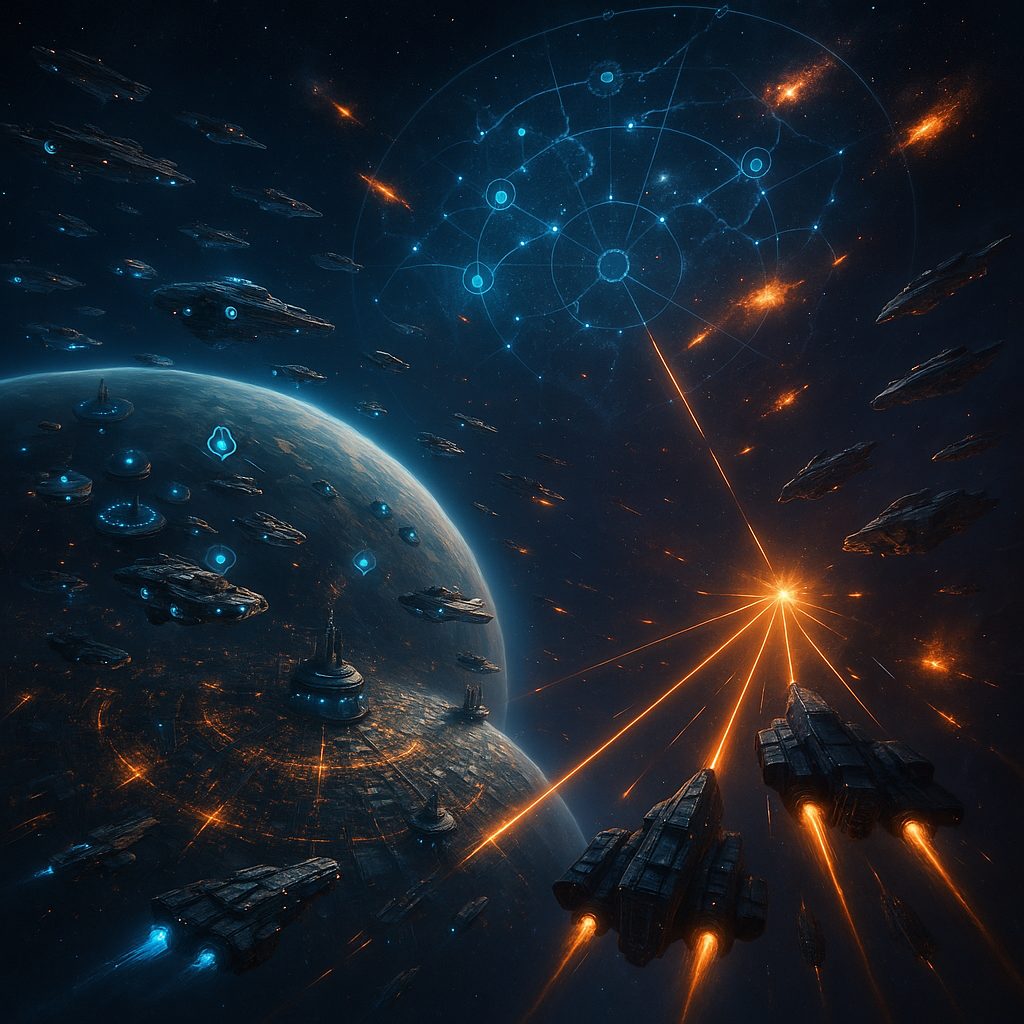
Two systems are especially important in alliance battles: Defense and Joint Attack. Defense allows members of the same Alliance to temporarily station fleets on an allied planet’s orbit and participate in its defense. Joint Attack, by contrast, gathers allied fleets into a single strike on a chosen target. These are different scenarios and confusing them is dangerous: a personal attack is your fleet against an enemy planet; normal defense is your ships and defensive structures on your planet; alliance actions require coordination of several players, slots, timings, and fuel.
Below is a practical guide on joint attack and defense in War for Galaxy: how to prepare a planet for defense, how to place allied fleets in orbit, how to initiate a joint sortie, why the organizer should be the slowest participant, and why one upgraded ship does not turn an entire weak squad into an invincible armada. For players who love space games, browser strategies, online strategy games, and space combat games, this is the layer of War for Galaxy where not only fleet size but also team discipline decide outcomes.
Defense: How Allied Fleets Station on Your Planet’s Orbit
Defense is a fleet task that lets players in the same Alliance temporarily place ships in orbit around an allied planet. If you hold a border colony, resource warehouse, or strategic point, Defense transforms a single planet into a collective stronghold. But the mechanic only works under specific conditions.
The first condition: the "Defense" task is only available between members of the same Alliance. A player outside cannot place a fleet on your planet through this mechanic, even if you agree in chat. The system is tied strictly to Alliance membership.
The second condition: the defended planet must have a Refueling Base constructed. This is the key building for SAB/Defense mode. Without it, Defense is impossible even among allies: coordinates can be correct, the fleet ready, and players in the same Alliance, but without the base, the allied fleet gets no parking spot.
The Refueling Base requires Alliance membership. Construction cost is 20,000 Titan and 40,000 Silicon. Its function is simple and crucial: it determines the maximum number of allied fleets that can be stationed on the planet in Defense mode. The rule is straightforward: the level of the Refueling Base equals the number of slots for allied fleets. Level 1 base grants 1 slot, level 2 grants 2 slots, level 3 grants 3 slots, and so forth.
Here is the first practical takeaway for officers and defenders: don’t wait for an alarm to check infrastructure. If a planet needs to host three support fleets but the Refueling Base is only level 2, the third ally cannot enter Defense. For frontline planets, plan base level ahead according to the actual duty group composition, not hopeful "we’ll fit somehow."
The procedure to send a fleet into Defense is:
- Ensure both the sender and planet owner are in the same Alliance.
- Check that the target planet has a Refueling Base and a free slot.
- When sending the fleet, select the "Defense" task.
- Enter the allied planet’s coordinates.
- Confirm the sortie and pay for the flight with antimatter.
A fuel-related advantage of Defense: antimatter is consumed only once—for the flight. Keeping the fleet in orbit does not require fuel consumption. So, the ally pays for travel but does not burn antimatter each hour of standing by. This is critical for long defenses: the Alliance can hold reinforcements in position without constant fuel loss.
After arrival, the fleet automatically participates in planet defense for 3 days (72 hours). This is not a transfer to another player or infinite parking: the fleet remains owned by its player and is temporarily on combat duty. After the term expires, it returns to its home planet. The same applies when Defense is manually cancelled.
You can cancel Defense anytime, but with a strict catch: fuel is not refunded. Antimatter is already spent on flight, so chaotic cancellations and repeated sorties quickly become costly mistakes. Before calling allies into orbit, verify the base, slots, timers, and real need for parking. To see available tasks and planet statuses immediately, you can open War for Galaxy and check defense preparation live.
What Happens in Battle if a Planet with Defense is Attacked
When a planet with allied fleets in Defense mode is attacked, these ships are not mere observers. All allied fleets engage in defense. For the attacker, this means facing not only the planet’s garrison but also the reinforcements the Alliance has stationed in orbit.
The battle follows the general War for Galaxy combat logic. The fight lasts until one side is destroyed or 10 minutes pass; if time runs out, the battle ends in a draw. Damage is first absorbed by shields, then armor. Therefore, evaluating defense requires not just total ship counts but their survivability, shields, armor, and compatibility with ground defenses.
After battle, combat reports are sent to all participants, including owners of fleets in Defense. This is convenient for analysis: who lost what, whether allied ships sufficed, how well defense functioned, and whether the coverage composition should change. If the attacker is wiped out in round one, they do not see the defending fleet composition—only participant names. For the defending Alliance, this secrecy is a strategic info advantage: a successful Defense can repel an attack without fully revealing its defenses.
There is a fine risk to note. If a player attacks a planet where their own fleet is in Defense, that fleet fights against them. The game makes no exception based on "own ships": at battle, they are engaged defending the planet where stationed. So before attacking a disputed, former allied, or quickly changing-status target, the coordinator must check which fleets are in Defense and when to withdraw them.
Recovery rules should also be considered. Destroyed ships can be restored only upon victory and according to the individual ship's recovery chance. Destroyed defenses may regenerate regardless of outcome, also by their recovery chance. This doesn't negate losses but affects the long-term cost of defensive and offensive decisions.
Joint Attack: How to Assemble a Unified Alliance Strike Fleet
Joint Attack is the second key alliance battle mechanic. It allows Alliance members to merge fleets into a single coordinated strike against a target. This is not a series of separate raids or chat-based moral support but a real simultaneous sortie where multiple players enter the same battle as one group. Important: this is the only way to mass combine fleets in attack.
The attack is initiated by an organizer. When sending their fleet, they select the task "Joint Attack", specify target planet coordinates, and set arrival time by adjusting speed. After launch, Alliance members see a star icon next to active fleets—a call to assemble. Joining is via the Allied Fleets window.
But joining is not always possible. A participant must meet two conditions: their fleet must arrive on time or earlier, and free slots must remain in the attack. If an ally's fleet flight duration is longer than the organizer’s and cannot arrive in time, they cannot join for simultaneous arrival.
The main timing rule: the organizer must be the slowest participant. Fast fleets can be slowed to match the group’s arrival time, but a slow fleet cannot catch up with an early organizer. So before starting a Joint Attack, officers must know who flies from where, who is slowest, and the actual time all participants need.
The second constraint is the organizer’s "Navigation" technology level. It determines the maximum number of fleets in a Joint Attack. Formula: max fleets = floor(Navigation level / 5) + 1. For example, Navigation 6 allows maximum 2 participants, Navigation 15 allows 4.
This means the best organizer isn’t necessarily the player with the strongest fleet. Sometimes the organizer should be the one with enough Navigation for the needed slots and the longest route to the target. If the organizer has low Navigation, some allies hit the limit. If the organizer is too fast, slower fleets can’t join. Both reduce the chief value of Joint Attack—a unified synchronous strike.
How Ships and Technologies Combine in Joint Attack
When the Joint Attack arrives, ships do not stay separated as each player’s mini-fleet. All ships of the same type from all players merge into one super-unit. Corvettes become a single corvette squad, frigates a single frigate squad, bombers a single bomber squad, and so on.
Critically, technologies don’t take the maximum from the most upgraded participant nor copy it to all. They are calculated as a weighted average proportional to each player’s ship numbers. If the attack has 100 weak corvettes and 1 highly upgraded corvette, the bonus from the premium ship is nearly invisible in the combined squad.
This system prevents technological freeloading. You can’t bring many weak ships and expect one top ally to "illuminate" them with their techs. Joint Attack encourages equal contributions: ships, research, fleet composition, and discipline. For a strong collective strike, each member must prepare not only quantity but also fleet quality.
At the same time, Joint Attack does not directly increase damage. There’s no hidden “friendship bonus.” Its strength is in concentrating fleets, unified battle, and shared damage distribution. A solo fleet might fail to break defenses, but a combined fist strike changes the balance, especially if composition suits the target.
Don’t reduce everything to mere battle power. Even with similar total strength, battle outcomes vary due to fleet composition, armor penetration, survivability, hits, ideal distances, firing angles, and ship types. In War for Galaxy, a strong fleet is not the most expensive fleet but the properly formed fleet. After a Joint Attack, combat reports go to all participants, so analysis should be collective: who brought what, which ship types performed, where average tech dragged results down, and what to tweak before next sortie.
Alliance Checklist: How Not to Break Defense and Joint Attack
In alliance battles, losses often come not from the weakest army, but poor coordination: forgot the Refueling Base, lacked slots, organizer was too fast, participants didn’t check arrival times. Before sortie, run through a brief checklist.
Before Defense
- Ensure all participants are in the same Alliance.
- Verify the defended planet has a Refueling Base.
- Compare base level with needed slots for allied fleets.
- Calculate antimatter for flight; defense holding uses no fuel.
- Fix the parking term: 3 days or 72 hours unless Defense is cancelled earlier.
- Remember cancelling does not refund fuel spent.
- Assign roles: who defends, who attacks, when fleets leave orbit.
Before Joint Attack
- Assign an organizer who selects task, target, and arrival time.
- Make sure the organizer is the slowest participant.
- Check the organizer’s Navigation limits: floor(Navigation / 5) + 1.
- Pre-allocate slots: joining requires free slot availability.
- Ensure each participant can arrive on time or earlier.
- Don’t rely on one upgraded player to strengthen all weak ships: techs average weighted.
- After battle, analyze the report as a group; all participants receive it.
In the best space MMO games, real-time strategy games, and browser space strategies, victorious are not merely those with bigger fleets but those who better coordinate people, timings, and compositions. War for Galaxy makes the Alliance the core of space battles: Defense holds key planets, Joint Attack turns scattered fleets into a striking fist, and discipline binds all into a working military system.
Ready to test the mechanics live? Assemble your Alliance, appoint a coordinator, prepare Refueling Bases, calculate the organizer’s Navigation, and conduct your first joint sortie. You can start directly in the game, via the War for Galaxy download page, or on VK Play. In the galaxy, winners are those who come not alone but on time and together.