

Teleport in War for Galaxy: When 5 Minutes Decide the Outcome of Defense
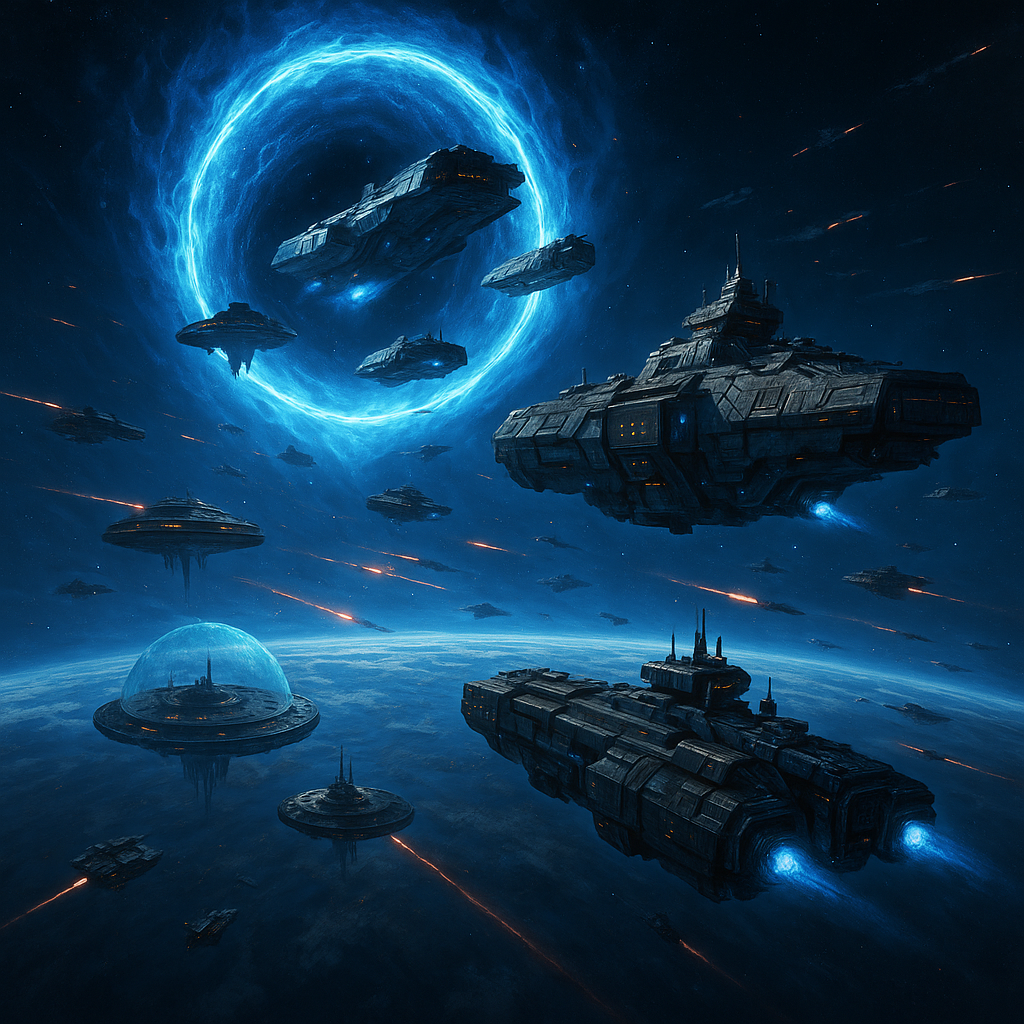
Teleport in War for Galaxy: When 5 Minutes Decide the Outcome of Defense
In War for Galaxy, defense rarely fails solely due to a lack of ships. Much more often the problem is that the fleet exists but is in the wrong place. Resources sit on one colony, the strike group is stuck on another, and the enemy is already approaching a third. A usual interplanetary flight may not arrive in time for the battle, and then even a strong empire turns into a collection of isolated targets.
The Teleport in War for Galaxy solves exactly this problem. It's a strategic building for rapid redeployment of your fleets between your own planets that also have a Teleport built. The key parameter is simple: movement takes a fixed 5 minutes. It doesn’t depend on usual flight logistics and doesn’t stretch across the galaxy for hours. If the route is prepared in advance, the fleet gets a chance to be where it’s needed right now.
Therefore, War for Galaxy’s Teleport is not just a decorative convenience or a "lazy button." It is a strategic mobility tool. In space games, browser strategy games, online strategy games, and real-time strategy games, the value of a fleet is determined not only by its strength but also by its availability at the right location. Ships that arrive late for battle can’t save the warehouse, cover the defense, or prevent the enemy from looting. Ships arriving five minutes before the climax can change the attacker’s calculation.
The Teleport has strict limits. It works only between your colonies and/or your main planet. Both ends of the route must have a Teleport built. It cannot be used to attack another player's planet, scout, or perform any external missions. It's not a way to suddenly jump behind enemy lines but an internal transport system of your empire.
Timing is especially critical due to the combat system. Battles in War for Galaxy last until one side is destroyed or until 10 minutes elapse; if no winner is decided, the fight ends in a draw. In this context, a five-minute redeployment is a huge operational gap. The Teleport itself doesn’t shoot but changes the decision-making tempo: instead of passively awaiting an attack, you can gather defense, pull your fleet out of danger, or prepare reserves for the next sortie.
How the Teleport Works: Requirements, Price, and Levels
The Teleport should not be considered an emergency building constructed at the moment of alert. It is expensive infrastructure for an already developed empire. To unlock it, you need:
- Dock level 8;
- Subspace Movement level 10;
- Tachyon Scanning level 10.
The cost of the first level itself requires advance planning: 2,000,000 Titanium, 4,000,000 Silicon, and 2,000,000 Antimatter. Each subsequent level doubles standard building costs. This is not a trivial purchase but an investment in the survivability of your entire colony network.
The Teleport level affects two parameters: the maximum fleet cargo capacity that can be moved at once and the cooldown time. With each level, capacity increases and cooldown decreases. Practically, this means a low level may transfer light reserves but cannot handle a large strike group; a long cooldown might leave another planet without a quick response to the next attack.
The exact formulas for cargo capacity and cooldown are not disclosed by the developers, so strategies shouldn’t rely on unconfirmed tables. It’s more reliable to check limits in-game and form combat groups in advance so they fit within your Teleport levels.
The basic operation rules to remember by heart are:
- each teleportation consumes 1 fleet slot, just like a regular flight;
- movement does not consume fuel or require separate antimatter;
- once started, teleportation cannot be canceled;
- if the fleet is too large for the current Teleport level, the system will warn and not send it;
- redeployment always takes a fixed 5 minutes.
The main takeaway: the Teleport is powerful but not infinite. It needs prepared planets, a free fleet slot, an appropriately sized group, and awareness that the decision is final once sent.
Defense Scenarios: When 5 Minutes Really Save
The Teleport shines not during peaceful resource gathering but at the moment an enemy fleet is already en route on the timer. In space combat games and spaceship games, one late squadron can cost ships, defense structures, resources, and battle rating. In War for Galaxy, this is especially evident because the attack winner can destroy ships and defenses on the planet and seize half the resources. The planet cannot be completely destroyed, but you losing your fleet and half the warehouse is very painful.
Urgent Reserve Redeployment
A classic situation: the enemy spots a weak colony and expects easy loot. If you have pre-built a Teleport network, you can redeploy reserves from another planet and meet the attack not with bare defenses, but with a combination of stationary structures and arriving fleet. Sometimes that's enough for the attacker to face a battle far different from what they planned.
Pulling the Fleet Out of Danger
The Teleport is useful not only for reinforcement but also for evacuation. If you detect an enemy sortie aimed at a planet with valuable fleet, you can relocate your fleet to another owned planet with a Teleport. This does not eliminate the need for free slots and cooldown management but offers an emergency maneuver unavailable in static defense. As a result, the enemy might arrive at an empty orbit or a much less valuable target.
Consolidation Before Major Operation
You cannot use the Teleport to attack another player’s planet directly, but it helps prepare an attack. Before a big operation, you can quickly assemble ships at one of your own planets, check composition, adjust groups to fit limits, and then plan the further sortie through a regular mission. In browser strategy games, this internal logistics often resolves more than spontaneously sending "whatever is at hand."
Saving Antimatter on Internal Logistics
Because teleportation does not consume fuel, regular movement between your own borders does not burn antimatter. For an active player, this translates into long-term savings: fewer costs on routine transfers mean more resources available for construction, research, and real combat tasks.
But remember: strong defense is not just the "most expensive fleet." In battle, damage is first absorbed by shields, then armor. Destroyed defensive structures may regenerate based on their recovery chance. Destroyed ships can only be restored if you win, according to each ship’s specific odds. Therefore, a strong fleet is a well-assembled fleet: composition, shields, armor, weapons, and mission suitability matter as much as the number of ships. The Teleport gives you the chance to bring this correct assembly timely to where it is needed.
How to Build a Teleport Network
A lone Teleport is not a network but an expensive monument to future plans. It is useless without a Teleport at the other end of the route. If you try to send a fleet to a planet without a Teleport, the system won’t allow the dispatch. Therefore, planning must involve a route system: which points link your empire into a defensive ring?
A practical scheme for a galaxy game with multiple colonies looks like this:
- Main planet or production center as a hub. This is convenient for holding your main reserve, freshly built ships, and quick reaction fleet.
- Border colonies as alert points. If neighbors are active nearby, frequent scans or contested systems, the Teleport turns a colony from an isolated outpost into a position where support can be rapidly sent.
- Reserve planet as a hidden fist. Part of the fleet can be kept not on the obvious target but within reach of your network.
Meanwhile, the network must be developed in advance. The Teleport level determines the practical group size you can transfer and the usage frequency due to cooldown. If your entire reserve is sent to one front, another colony may temporarily lack quick response. Thus, it is better to divide fleets in advance into groups fitting cargo capacity rather than trying to rush the entire armada through in panic.
The Teleport is a mobile defense layer but doesn’t replace static defense. Ground defense structures are stationary and fire 360 degrees. Energy domes work differently: they don’t shoot but absorb damage directed at planetary defense. On one planet, you can build one Small and one Large energy dome. Important: domes protect only the ground defense, not fleets. Ships still need to be timely withdrawn, covered, or redeployed.
Simple navigation is useful for managing the network. When you have several colonies, names like "Hub-North," "Front-3," or "Reserve-AM" save seconds at moments of alert. Planet naming can be changed using the "Astronomics" item, which is applied through the "Arsenal" and available in the premium shop. Renaming doesn’t affect coordinates, characteristics, or production but helps make faster decisions.
What the Teleport Does Not Do
The biggest costly mistakes happen when players expect the impossible from the Teleport. It does not work with enemy planets. It cannot be used to attack, scout, or conduct external missions. It does not move other players’ fleets—even allies. It is the personal mobility of your empire, not an alliance portal.
For joint defense of an allied planet, a separate mission called "Defense" is used. It’s available only between members of the same alliance. The receiving allied planet must have a Refueling Base built; its level equals the number of slots for allied fleets. Without a Refueling Base, defense is impossible even between allies.
Fleets in "Defense" mode stay in orbit around the allied planet for up to 3 days (72 hours) unless canceled earlier. Fuel for flight is deducted once upon sending; holding the fleet in orbit consumes no fuel. This is a different tool: the Teleport moves your fleets between your own planets, while "Defense" allows allies to temporarily cover each other's orbits.
Checklist Before Teleportation
- Is the target yours? The Teleport doesn't work with other players' planets.
- Is there a Teleport on both planets? Without the second node, the route is impossible.
- Is the fleet yours? Allied ships don’t move via your Teleport.
- Does the group fit the cargo capacity? If not, the system will warn and refuse dispatch.
- Is there a free fleet slot? Teleportation uses 1 slot.
- Is your decision final? After launch, cancellation isn’t possible.
- Is the cooldown considered? A fast response on another planet may be unavailable immediately after use.
Summing up, the Teleport turns scattered colonies into a mobile defense network. It doesn’t win battles for you, replace a proper fleet composition, or negate static defenses. But it provides the main thing—time. Five minutes to pull ships out of harm’s way. Five minutes to strengthen a weak planet. Five minutes to make the enemy recalculate risk.
Such decisions make War for Galaxy interesting for players looking for space games, online strategy games, space MMO games, and games about spaceships with real tactical defense. Try playing War for Galaxy in your browser, plan your Teleport network in advance, and see how defense changes when your empire stops being static. You can also download the client or find the game on Google Play, App Store, and VK Play.