

Teleport in War for Galaxy: How to Quickly Transfer Your Fleet Between Your Own Planets
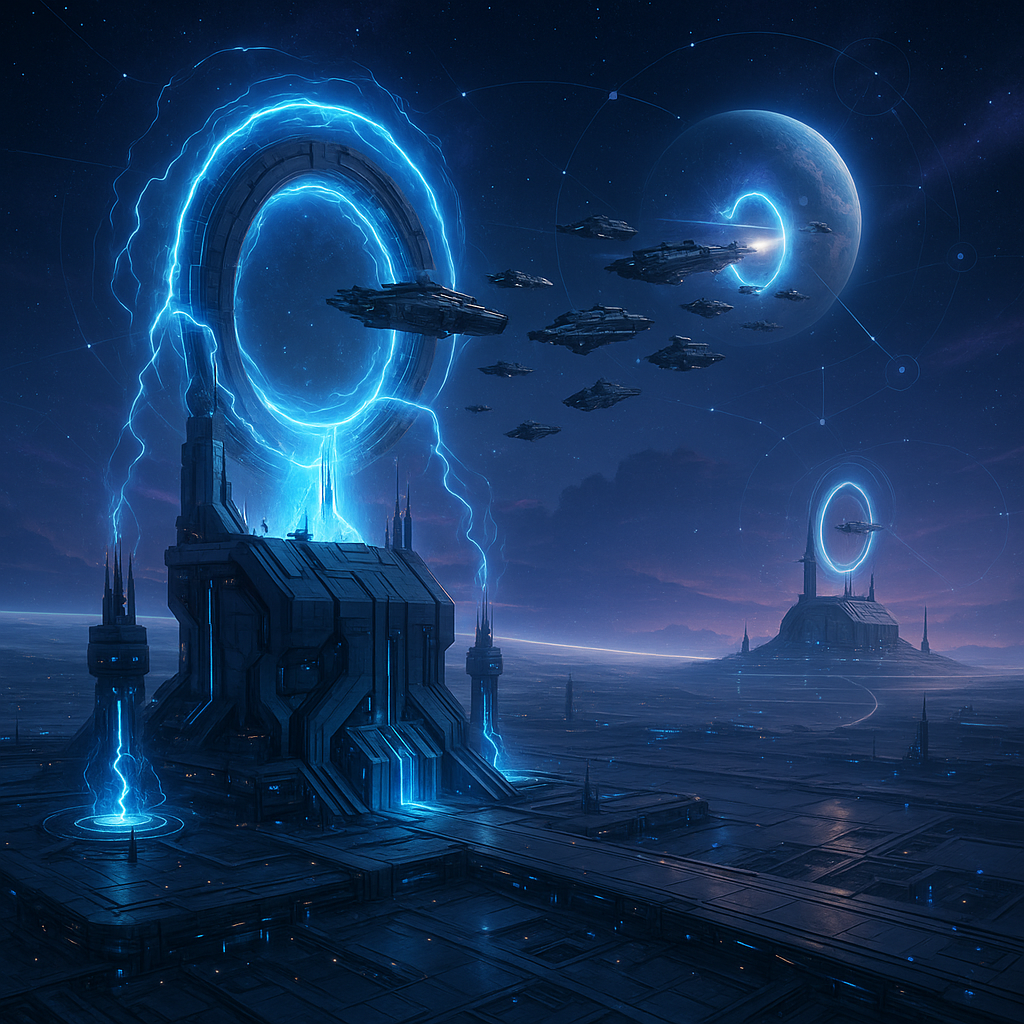
Teleport in War for Galaxy: Instant Fleet Transfer Between Your Own Planets
War for Galaxy Teleport is often perceived as a "portal" that should solve any mobility issues: attacking enemies without flight time, suddenly appearing at an ally, transferring ships anywhere in the galaxy. In reality, it's a different mechanic. The Teleport is a strategic building for rapid redeployment of your own fleets between your own planets where such a building is constructed.
That is why Teleport is important not as a weapon but as infrastructure for your empire. In War for Galaxy, like in other strong space online strategies, the outcome of confrontation is decided not only by fleet size. Equally important are reaction speed, ability to hold multiple fronts, and skill to gather the right ships at the right point before the situation becomes critical.
The main rule is simple: Teleport works only between your colonies and/or the capital, and Teleports must be built on both sides of the route. If there is a building only in the capital, no full route will appear. The departure planet must have a Teleport, and so must the destination planet.
It is also essential to understand limitations. Teleport cannot be used to attack foreign planets, spy, transport to another player, or any tasks unrelated to relocating your own fleet within your empire. It does not replace espionage, normal flights, alliance joint attacks, or alliance defense. Its role is narrower, but within that role it becomes one of the strongest fleet management tools.
How to Unlock and Build the Teleport
Teleport is not an early building placed "just in case" near mines. It is an expensive and technologically demanding infrastructure for players who already develop multiple planets, build battle fleets, and understand the need for internal mobility.
To get access to the Teleport, three requirements must be met:
- Dock — Level 8;
- Subspace Movement technology — Level 10;
- Tachyon Scanning technology — Level 10.
These conditions show the building's place in development. First, the player upgrades production base, research, and shipbuilding, then gains access to a rapid fleet transfer network between their worlds. For beginners, this is a future milestone; for intermediate and advanced players — a moment to start transforming scattered colonies into a unified military system.
The cost for Teleport Level 1:
- 2,000,000 Titanium;
- 4,000,000 Silicon;
- 2,000,000 Antimatter.
The cost of subsequent levels doubles according to the standard building upgrade scheme. Therefore, upgrades should be planned for specific tasks, not impulsively because resources have accumulated on a planet. Teleport must answer a clear strategic question: which pair of planets does it connect, what fleet will be transferred, and how often will this route actually be needed?
A key mistake is building a Teleport on only one planet. By itself, it does not create an "open portal" to the galaxy. At least two Teleports on your planets are needed for a working route. One Teleport without a pair is an expensive preparation for a future network, but not a ready tool for redeployment.
How Fleet Transfer Works: 5 Minutes, Slot, and No Fuel Consumption
Although players often call Teleport a method for instant fleet redeployment, technically the move does not take zero seconds. Transfer time through Teleport is fixed at 5 minutes. Compared to ordinary flights between distant colonies, this is very fast, but in PvP situations even these five minutes must be considered.
If an attack is already underway on a planet, plan timing in advance. Teleport does not make your fleet invulnerable at the decision moment nor does it stop enemy sorties. It simply allows quick transfer of ships to another of your Teleport-equipped planets or to bring reserves where needed. This is the difference between a "magic save button" and strategic logistics.
Each teleport occupies 1 fleet slot, just like a normal flight. If all slots are occupied by attacks, transports, processing, or other tasks, launching a quick redeployment won't be possible. Therefore, active players develop the habit of not filling all slots before important operations, leaving room for maneuver.
The main economic advantage of Teleport is that fuel is not consumed during teleportation. Movement occurs without antimatter costs. For an empire with multiple colonies, this is a significant benefit: normal fleet transfers between planets gradually consume antimatter, while Teleport saves it for internal moves.
Before sending, the system checks whether the chosen fleet fits within the current Teleport level's capacity limit. If the fleet is too big, it will not be sent: the game will warn you of insufficient cargo capacity. This limitation cannot be bypassed by selecting "all ships at once." You must either reduce the fleet size, upgrade the Teleport level, or split the transfer if the situation and cooldown allow.
There are several strict rules:
- You cannot send a fleet through Teleport to a planet without a Teleport;
- You cannot use Teleport against other players' planets;
- The mechanic does not work with fleets of other players, including allies;
- Once teleportation is launched, it cannot be canceled.
The practical takeaway is simple: before pressing the button, check the destination, free fleet slot, ship composition, and cargo capacity limit. The cost of errors is not fuel but position: after five minutes, the fleet will arrive where you sent it, even if plans have changed in the meantime.
Why Upgrade the Teleport Level
Level 1 Teleport unlocks the mechanic itself, but building levels have direct practical meanings. Teleport has two parameters dependent on its level: maximum transferable fleet cargo capacity and cooldown time.
Cargo capacity determines what fleet size you can move at once. With every level, the maximum fleet volume increases. This directly affects playstyle: small mobile groups can be transferred earlier, while large strike forces, heavy ships, and large battle packs require a more developed Teleport.
Cooldown defines how soon the Teleport can be used again. After transferring, it cannot send fleets back-to-back endlessly. Each level reduces cooldown time, which is especially important in active PvP: during scans, sorties, and pressure on different planets, the ability to execute the next redeployment sooner can determine fleet fate.
The exact formula for cargo capacity and cooldown is not disclosed by developers. Therefore, do not base your strategy on doubtful chat tables. It is more reliable to focus on your empire's practice: which ships you really move, volumes, frequency, and scenarios.
If you aim to keep a quick reserve between two fronts, reducing cooldown is valuable. If the task is to move a large strike force without splitting into batches, cargo capacity is the main limit. In both cases, upgrading Teleport is not cosmetic but an investment into the entire empire's controllability.
Tactical Importance: Defense, Evacuation, and Fleet Assembly
Teleport shows its strength most when players stop thinking planet-by-planet and start managing a colony network. For fans of strategy games, browser strategy games, online strategy games, and space combat games this logic is familiar: not only army strength matters, but also the ability to quickly change its location.
Defense of Key Fronts
The first scenario is transferring reserves between fronts. Suppose you have an industrial capital, a resource colony, and a border planet near active enemies. Without Teleport, you must pre-guess where to keep the fleet. A mistake in placement might mean needed ships are too far away.
With Teleport, you can keep reserves at a safe point and rapidly redeploy them to another own planet if the situation changes. This does not guarantee victory but allows facing threats with prepared ship groups rather than leftover local defense.
Evacuation Under Attack
The second scenario is fleet rescue. If enemy flight is detected from a planet, Teleport can serve as an emergency corridor: move ships to another Teleport-equipped planet. Here, the 5-minute transfer time, a free fleet slot, and current Teleport capacity are especially important.
Teleport does not automatically save resources or remove the need to monitor the map. But if fleet is the main value on a planet, quick relocation capability greatly increases fleet survivability. Often, it is cheaper to build the route in advance than to restore a shattered armada later.
Assembling a Strike Force
The third scenario is preparation for a major operation. Ships are built on various colonies but need gathering at one point for a serious attack. Normal flights within your empire may take long, especially if planets are scattered across the galaxy. Teleport helps consolidate personal forces before attack without spending hours on internal logistics.
Important: the attack on the enemy still proceeds by normal combat mechanics. Teleport only assembles your ships on your planet. It does not open a portal to enemy orbit, shorten enemy flight time, or turn redeployment into an attack.
Antimatter Savings
The fourth scenario is economy. Since fuel is not consumed during teleportation, every internal transfer via Teleport saves antimatter compared to normal fleet movement. The more you shuttle ships between colonies, the more noticeable the benefit.
This is especially important for players who operate a full network of planets: harvesting resources behind lines, building ships on production worlds, holding reserves at safe points, and regularly preparing PvP operations.
What Teleport Does Not Replace
Teleport is useful precisely because it has a clear role. Errors start when trying to use it instead of other War for Galaxy systems.
- It does not work against other players’ planets. You cannot "teleport an attack" to an enemy, send a probe through it, or bypass normal flight time to the target.
- It does not transfer ships to other players. War for Galaxy does not allow transferring troops to other players by any means, and Teleport does not change this rule.
- It does not replace alliance "Defense." Joint defense is available among alliance members and requires a Refueling Base on the defended planet. Teleport does not place your fleet in an ally’s orbit.
- It does not replace "Joint Attack." Mass fleet joining in attack is a separate alliance mechanic. Teleport can help gather your personal forces earlier but does not combine fleets from different players into one strike.
The correct formula is: Teleport is strategic mobility for your personal empire. It is great for defense, evacuation, internal fleet assembly, and antimatter savings. For enemy planet attacks, troop transfers to allies, and combined alliance operations, other tools are needed.
Checklist Before Building
Before investing millions of resources, go through this short checklist:
- Are requirements met? You need Dock level 8, Subspace Movement level 10, and Tachyon Scanning level 10.
- Is the first pair of planets chosen? Teleport is useless without Teleport on the other side. Plan for at least two buildings.
- Is route purpose clear? Connect not random colonies but truly important points: capital and frontier, production base and fleet assembly planet, resource rear and combat outpost.
- Are there enough resources for a network, not just a single building? The first level is expensive, and subsequent levels double in cost.
- Is cargo capacity checked? Teleport level directly affects what fleet size can be transferred at once.
- Is there a free fleet slot? Teleportation uses 1 slot, like any normal flight.
- Are you sure to launch? After sending, teleportation cannot be canceled.
Even Level 1 Teleport is a big step toward tactical freedom but only if integrated into a route. Two planets provide the first working link; three or four create a flexible maneuver network where fleets are not tied to one orbit permanently.
Conclusion: When Teleport Becomes Essential
Teleport becomes essential the moment your empire outgrows the "one main base and a few minor colonies" format. If you have frontline points, valuable production worlds, reserve bases, and fleets needing rapid relocation, Teleport turns from an expensive building into the foundation of strategic freedom.
The main takeaway: Teleport is valued not as a weapon but as mobility infrastructure. It does not win battles alone but allows you to be ready where the enemy expects weaknesses. It does not replace alliance mechanics but makes your personal operations faster and more flexible. It does not negate economy but helps save antimatter on interplanetary moves.
If you already develop multiple colonies and want to play not only by fleet size but also reaction speed, it’s time to start: visit the War for Galaxy game platform, upgrade your Dock and technologies, choose your first key planet pair, and begin building your own Teleport network. And if you want a convenient platform to launch the game, use the War for Galaxy download page. The galaxy rewards those who can move fleets faster than the enemy can rearrange plans.