

Alliance Wars for Planets: What Happens When Capturing Another's Multi-Account in War for Galaxy
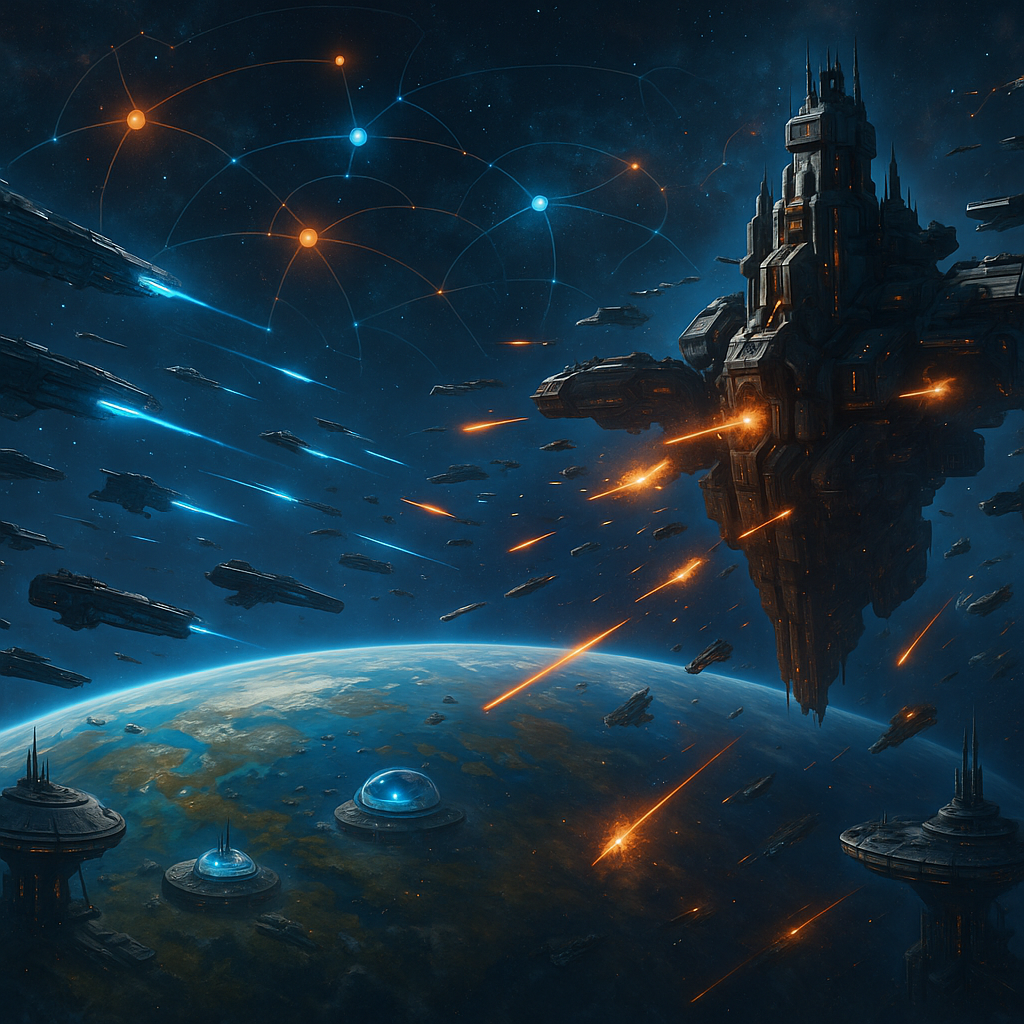
Alliance Wars for Planets: What Happens When Capturing Another's Multi-Account in War for Galaxy
In War for Galaxy, the war quickly goes beyond the usual raid pattern of “fly in, break through defenses, take resources.” With a personal account, a player develops their own empire: building planets, accumulating fleets, choosing PvP targets, and managing their economy. But once an Alliance enters the game, the focus shifts. Territory control, systems control, rating, and a team's ability to hold the map—not just winning individual space battles—come to the forefront.
An Alliance is a union of players creating a shared Alliance multi-account to capture and control territories in the galaxy. While a normal account is a personal space power, an Alliance is a collective military and territorial structure. Its members can use the shared multi-account, supply it, transfer ships, participate in joint actions, and wage wars against other Alliances.
The multi-account is not for standard solo development but for map-level tasks: capturing and holding Alliance planets, fighting other Alliances, and controlling territory. Alliance planets are marked specially on the map and differ from regular player planets. Such a point is not just a resource source but a stronghold, a bridgehead, part of the front line, and an element of the rating position.
That's why capturing a planet from another's multi-account is one of the core mechanics of Alliance Wars. War for Galaxy combines features of space games, browser strategy, online strategy games, and galaxy games: it's important not only to assemble a powerful fleet but also to correctly turn victory into a territorial result.
Who Can Capture Planets: Why Multi-Account to Multi-Account Attacks Matter
The main rule is simple but often misunderstood: a planet belonging to another Alliance multi-account can only be captured from another Alliance multi-account. Not from a player's personal capital, not from their colony, and not just because they have the strongest fleet in the system. In War for Galaxy, winning a fight and changing the planet's owner are different mechanics.
To initiate a real capture, the procedure must be:
- Open the Alliance account via the corresponding button. While in a normal account, you manage your personal empire, not the Alliance's territorial instrument.
- Select the target — a planet of another Alliance multi-account. Capture mechanics work between Alliances, not against regular player planets.
- Send a fleet from the multi-account and assign a standard attack mission. There's no separate "capture button" here: if the multi-account attack on another multi-account's planet ends in victory, ownership logic triggers.
The practical takeaway: only Alliance multi-accounts can capture planets, and only from other Alliances' multi-accounts. If a normal player attacks a planet of another Alliance and wins, it will be a standard raid with looting. They can inflict damage, destroy some defenses or fleet, and take resources per raid rules, but the planet's ownership will not change.
This is especially important for players used to other browser strategy games and online strategy games where victory in battle sometimes automatically means occupation. In War for Galaxy, a personal account can assist operations: pressuring the economy, joining joint attacks, supporting the Alliance with resources and ships. But the Alliance flag on a planet changes only with a multi-account to multi-account attack.
Meanwhile, regular members are not cut off from Alliance planets. From their own accounts, players can send fleets to their Alliance planets on "Transport" and "Relocation" missions: delivering resources or transferring ships to the Alliance. The reverse transfer doesn’t work: Relocation from the multi-account to normal planets is unavailable. The multi-account can receive ships but cannot distribute them back to players.
What Happens After Battle: Planet, Buildings, Defenses, and Fleets
In a multi-account to multi-account attack, it’s not just a battle report at stake. The result determines who owns the planet, who inherits the infrastructure, and which fleet secures the new territory. Hence, this operation is closer to a full territorial war than a regular PvP resource raid.
If the Attacking Multi-Account Wins
When the attacking Alliance multi-account wins, the planet transfers to the attacking Alliance's ownership. The new owner receives not an empty coordinate but a full asset: buildings, defenses, infrastructure, and the planet's contents. The expanded Alliance description states this directly: upon capture, an Alliance gains the planet and all contents — buildings, resources, and restored defenses.
This makes target selection a strategic decision. A weakly developed planet may be useful as a control point, but a developed planet with buildings and defenses is valuable as a ready base. Capturing it, the Alliance acquires invested enemy resources and can use the position for further pressure.
Who Remains on the Captured Planet
After a successful capture, the fleet of the attack organizer remains on the planet. This is a key rule in joint operations. In space combat and real-time strategy games, the deciding factor is not just the total army strength but who launched the operation. In War for Galaxy, this is especially true: the organizer doesn’t just lead the strike — their fleet becomes the first garrison on the captured planet.
If other fleets, including normal Alliance member fleets, participated, they return to their original planets after battle. They can inflict major damage, help break defenses, and affect the battle outcome, but do not stay on the new territory. Therefore, officers must understand in advance whose fleet will anchor the capture and if it’s sufficient to hold the planet right after ownership changes.
If the Defender Wins
If the defending multi-account repels the attack, no capture occurs. The attacker’s fleet is destroyed, and the planet’s ownership remains unchanged. The planet stays with the previous Alliance, and the attacker suffers losses and must revise their campaign plan.
There is also a general battle timer: fights last until one side is destroyed or 10 minutes expire. If neither side is eliminated by then, the battle ends in a draw. For capture, this means the attacker needs a clear victory, not just a good fight.
Post-Battle Recovery
Destroyed defensive structures may be rebuilt according to the "Chance of Recovery" parameter. So after capture, defenses may include both surviving and restored parts.
For ships, the rule is stricter: destroyed ships can only be restored if victorious and according to the recovery chance of the ship type. The losing side cannot expect restoration. That’s why attacking an enemy multi-account requires power reserves: miscalculations can cost fleets, war momentum, and the possibility of holding the target.
How Capture Affects Alliance Rating and System Control
Capturing a planet from another's multi-account is not just a nice victory. It changes the economic, rating, and territorial map. A planet in Alliance Wars is an asset: it has value from buildings, defenses, ships, resources, and strategic position.
When successful, the attacking Alliance’s rating increases by the captured planet's value. New Alliance descriptions state the captor gains rating points equal to the planet’s total worth. Conversely, an Alliance losing a planet loses corresponding rating points.
The multi-account’s overall rating depends directly on the total value of all owned buildings, ships, and defenses. The more developed the planets, the denser the defenses, and the more valuable the fleet, the heavier the Alliance's weight. Alliances may also have ratings based on the number of controlled planets — a pure territorial metric.
The system control rules are: an Alliance owns a planetary system if their multi-account has at least one planet there. If multiple Alliances have captured planets in the same system, the owner is who owns more planets there. If the number is equal, the system belongs to no one.
- One Alliance in system — the system belongs to them if their multi-account has a planet there.
- Multiple Alliances — control goes to the one with more captured planets.
- Tie — the system becomes contested and belongs to no one.
Because of this, it’s sometimes more important to capture not the richest planet but the one that breaks the opponent’s majority in a system. One precise strike can topple control, open a path to neighboring systems, or disrupt the enemy’s economic link.
There is also a synergy bonus for controlling neighboring systems. It applies locally — only to multi-account planets in connected neighboring systems. Controlling 3 adjacent systems grants a base synergy bonus of +1.5% to titanium, silicon, and antimatter production. Each additional system adds +0.5%, up to a maximum base increase of 50%. Therefore, strong Alliances plan not just individual battles but chains of systems: where to hold, where to push enemies out, and where to maintain lines for the economy.
Complex Cases and Common Mistakes
Allied wars often lose not due to weak fleets but poor organization. The first typical mistake is forgetting the organizer's role. In a joint attack on another multi-account’s planet, after battle all participating fleets return to their original planets, leaving only the organizer's fleet on the captured planet. Normal player fleets may help strike but do not garrison the new point.
The second critical situation concerns the starting planet. If a fleet launches a multi-account to multi-account attack and its starting planet is captured during flight, it loses the ability to return and effectively flies “one way.” If victorious, it will capture the target planet and stay. If defeated, it’s destroyed.
This rule shouldn't be confused with missions that imply returning. If a fleet was on such a mission and its starting planet was captured, it returns to its start coordinate and begins battle there. For teams planning operations like in spaceship or space combat games, this nuance is crucial: losing a start point can turn an ordinary return into an unexpected fight.
The third mistake is treating the Alliance multi-account as a normal player account. It is a special military tool with unique restrictions:
- The multi-account has no main planet;
- You cannot delete planets within it;
- Missions, Shop, Profile, and Reward Calendar are unavailable;
- No Marauders spawn and it doesn't affect pirate spawns;
- The multi-account cannot attack pirates: attempts prompt "Alliance Code forbids attacking Pirates";
- The "Navigation" technology has a higher fleet slot bonus in the multi-account: +2 instead of +1.
The practical tip for officers: before operations, check not only combat strength. Understand who the organizer is, from where fleets start, what happens if the start planet is lost, and whose fleet remains on the planet after victory.
Checklist Before Capture
Before sending fleets, an Alliance leader or officer should run a quick check:
- You are in an Alliance multi-account, not a personal player account.
- The target is a planet of another Alliance multi-account; otherwise ownership won’t change.
- The attack mission is properly selected and the operation actually launches from the multi-account.
- The organizer is consciously chosen: their fleet will remain on the captured planet.
- Allies understand their roles: participating fleets return to start planets after battle.
- The target’s value is calculated in advance: planet, buildings, defense, infrastructure, and rating transfer to the new owner upon victory.
- There is a plan for failure: if defenders win, ownership stays the same and attackers lose their fleet.
Capturing another’s multi-account in War for Galaxy is a core Alliance war mechanic. The winner gains a territorial asset with infrastructure, defenses, and rating value. The loser loses not abstract points but a real planet in their galactic network. Victory goes not to who clicks "attack" harder but to who organizes the war right.
If you want to try this mechanic, visit the official Russian War for Galaxy site or launch the game directly in your browser at the game page. Join an Alliance, prepare your fleet, calculate the target rating — and turn victories into real galaxy control.