Why does Earth look blue from space
Space & Astronomy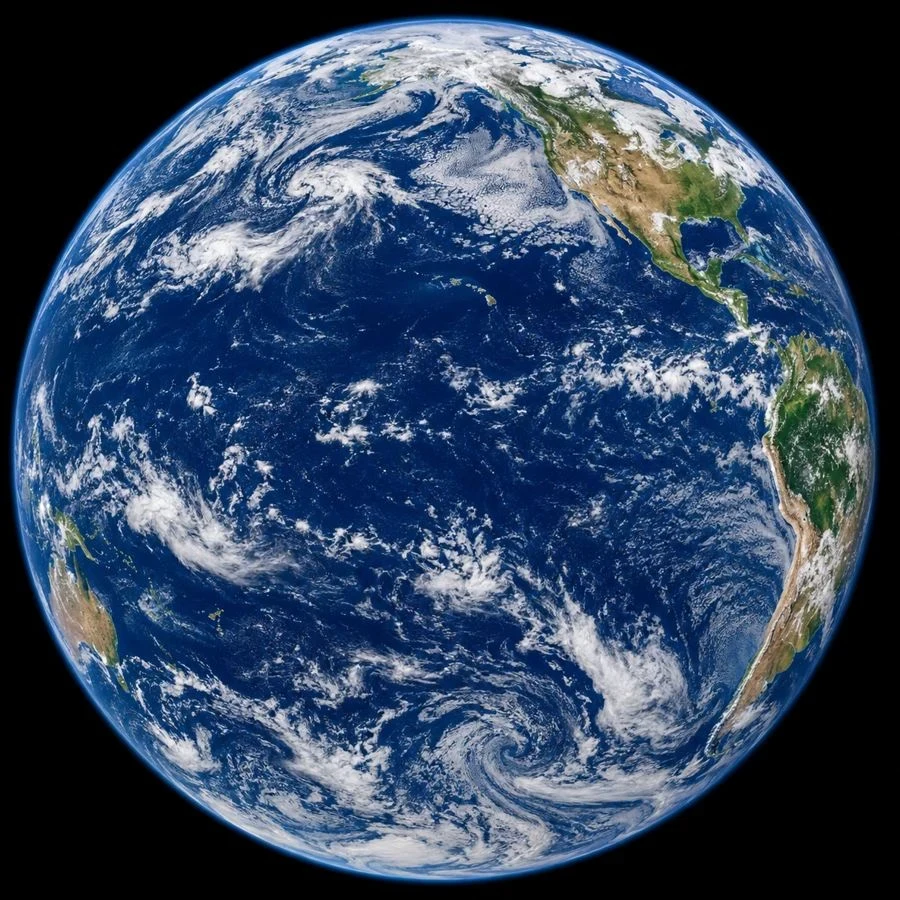
From space, Earth resembles a brilliant blue marble decorated with white clouds, green continents, and bright polar ice. This recognizable appearance has earned our home the nickname "the Blue Planet." But why does Earth look blue from space when water in a glass is almost transparent and the planet's surface contains so many different colors? The explanation involves how sunlight interacts with water, atmospheric gases, clouds, and land. In this article, we'll explore the physics of light wavelengths, examine the main factors shaping Earth's appearance, and discover whether climate change could eventually make our planet look different.
The physics of light wavelengths
To understand Earth's blue appearance, we first need to examine how light interacts with matter. Sunlight appears white, but it contains electromagnetic radiation across a wide range of wavelengths. The visible spectrum includes colors ranging from violet and blue to orange and red. Blue light has a shorter wavelength than red light, and different materials absorb, scatter, transmit, and reflect these wavelengths in different ways. The colors we observe depend on which portions of the incoming light ultimately reach our eyes or the sensors of a camera.
Four physical processes are particularly important: absorption removes certain wavelengths from transmitted or reflected light, scattering redirects light through interactions with particles, reflection sends some radiation back from a surface, and transmission allows light to pass through a material. These effects often occur simultaneously, making the appearance of natural objects more complicated than simply assigning one color to a particular substance. For example, the deep blue of an ocean and the blue sky above it result from related optical principles, but their dominant physical mechanisms are different.
Water has an especially important property: it absorbs longer visible wavelengths, particularly red light, more strongly than blue wavelengths. As sunlight penetrates the ocean, the red and orange components weaken more rapidly. Some of the remaining shorter-wavelength light is scattered back toward the surface, creating the familiar blue appearance of clear, deep water. This explains why a glass of clean water looks almost colorless while an enormous ocean can appear intensely blue. In a small container, light travels through too little water for selective absorption to become obvious, whereas the longer optical paths in the ocean reveal the difference.
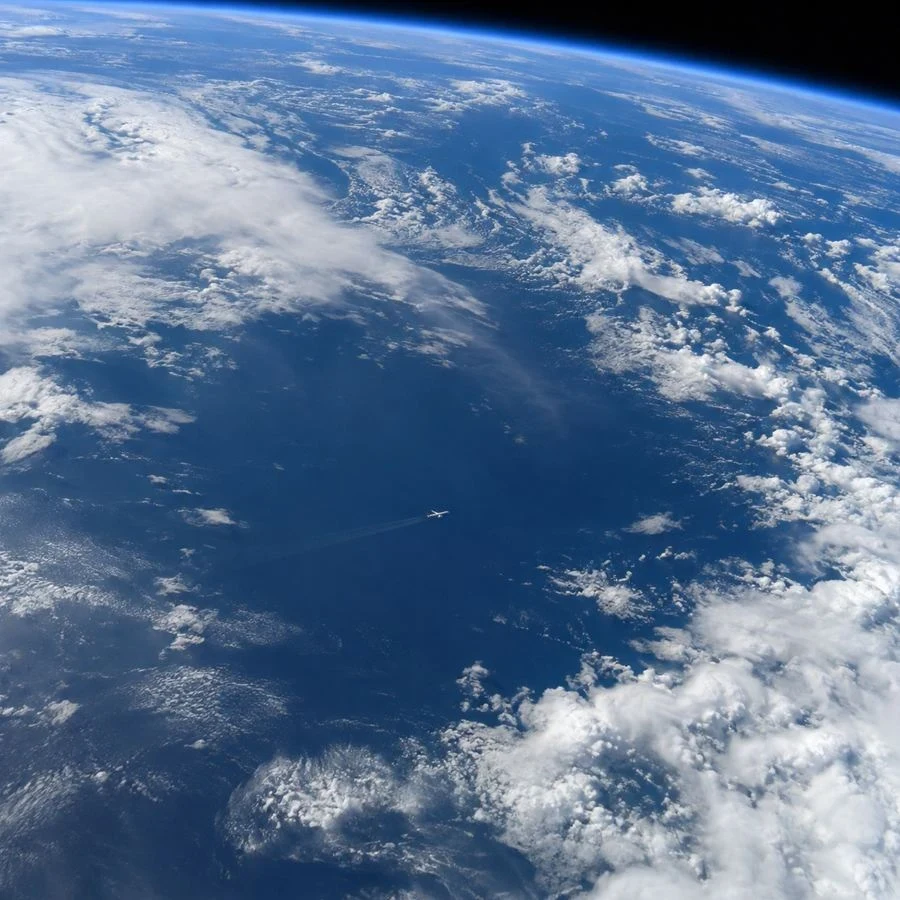
Earth's atmosphere contributes through another mechanism known as Rayleigh scattering. Nitrogen, oxygen, and other small atmospheric molecules scatter shorter visible wavelengths much more efficiently than longer ones. This is why Earth's daytime sky usually appears blue rather than red or orange. When viewed from space, scattering also produces a delicate blue atmospheric haze, particularly along the planet's curved horizon.
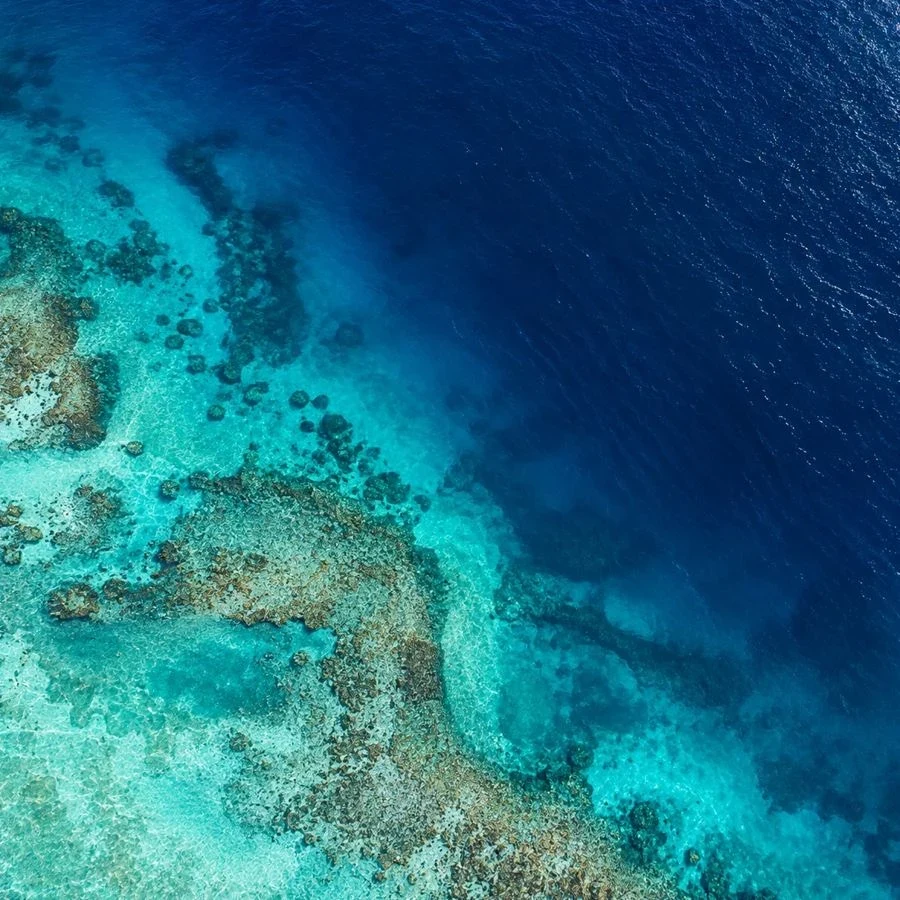
However, Earth's overall appearance cannot be explained by atmospheric scattering alone. Light reflected and scattered by oceans, clouds, ice, and continents also contributes to what an observer sees. The dominant color depends on which hemisphere faces the camera, the direction of sunlight, and the physical characteristics of the surface.
What affects Earth's color?
Earth doesn't have one perfectly uniform color. Depending on the viewing angle and location, satellite photographs reveal dark blue oceans, turquoise coastal waters, white cloud systems, green forests, brown deserts, and snow-covered regions. These different components combine to create the planet's familiar appearance. Understanding their individual contributions also explains why some photographs look much bluer, brighter, or more colorful than others.
Oceans and seawater
Oceans cover approximately 71% of Earth's surface, making them one of the most important reasons our planet looks blue from space. Their enormous area means that blue and blue-green shades dominate much of the sunlit hemisphere, particularly when the camera faces the Pacific or Atlantic Ocean. In clear deep water, the color comes primarily from the selective absorption of longer wavelengths and the scattering of shorter-wavelength light within the water. Reflection from the sky can contribute to the appearance, especially at particular viewing angles, but it isn't the fundamental reason deep water is blue.
Ocean color changes considerably from one location to another. Clear tropical shallows may appear bright turquoise because sunlight interacts with the water column and reflects from light-colored seabeds. Coastal waters can look green or brown when they contain suspended sediments, dissolved organic matter, or large concentrations of microscopic organisms. Phytoplankton are especially important because their photosynthetic pigments affect how different wavelengths are absorbed and scattered. The angle of incoming sunlight and reflections from the sea surface introduce additional variations.
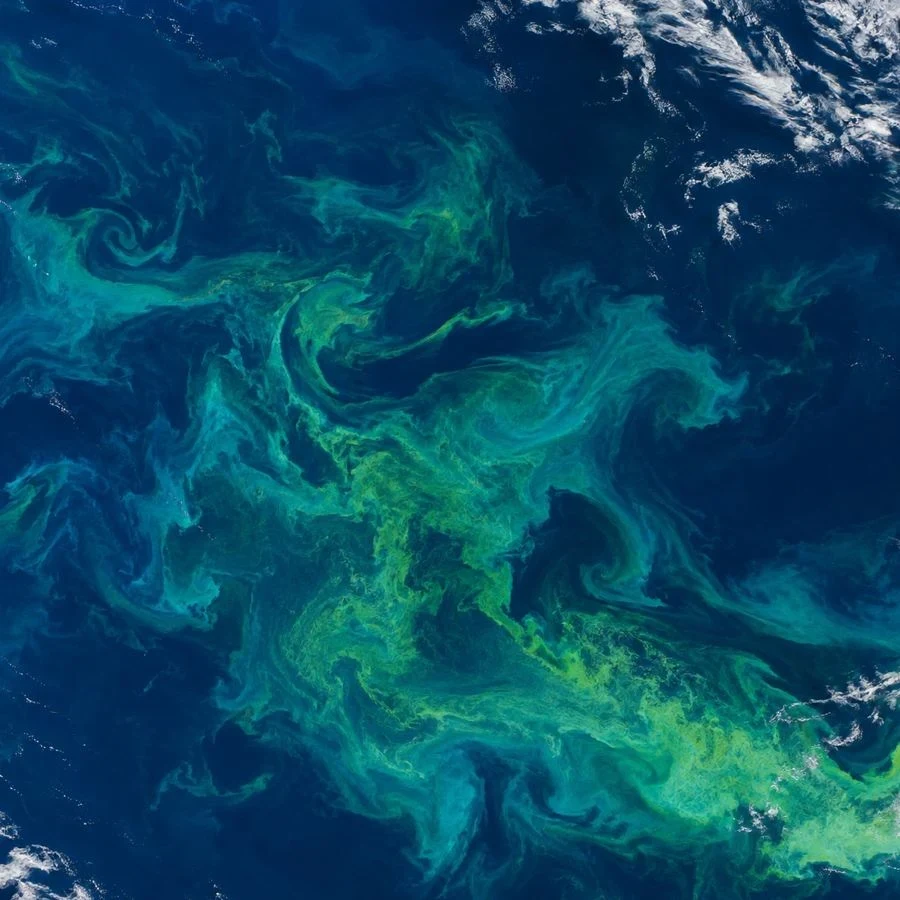
These differences aren't merely decorative. Satellite instruments measure subtle changes in ocean color to study phytoplankton populations, sediment transport, and marine ecosystems. A region that appears uniformly blue to a human observer may contain complex spectral patterns revealing conditions beneath the surface. This makes ocean color an important scientific measurement as well as one of Earth's most recognizable visual characteristics.
The atmosphere and light scattering
Earth's atmosphere adds a distinctive blue tint, especially when viewed near the edge of the planet. As sunlight passes through the gases surrounding Earth, short-wavelength radiation is scattered in different directions. The effect becomes particularly noticeable when looking along a long path through the atmosphere, creating a thin luminous blue band against the darkness of space. This isn't a solid protective shell but an optical effect produced by sunlight interacting with gas molecules.
The atmosphere can also influence how the surface appears from orbit. Aerosols, dust, smoke, and water droplets scatter and absorb incoming and outgoing radiation, sometimes creating pale, yellowish, or brownish hazes. Major dust storms can temporarily obscure continents, while smoke from extensive wildfires may spread across enormous regions. These atmospheric changes can alter satellite measurements even when the underlying land or ocean remains unchanged.
It's important to distinguish the reason Earth's sky looks blue from the reason the entire planet appears blue. Rayleigh scattering explains much of the color of a clear daytime sky, while the huge area covered by blue oceans plays a major role in Earth's familiar distant appearance. Both effects operate together, with their relative contributions depending on illumination and observation conditions.
Clouds and polar ice
Clouds cover substantial portions of Earth at any given moment, adding enormous white patterns to the planet's appearance. They consist of water droplets or ice crystals that scatter visible wavelengths relatively evenly, making thick clouds look white when illuminated by sunlight. From space, weather systems can create impressive swirling structures, broad cloud bands, and bright tropical formations that temporarily hide the land or ocean beneath them.
Snow and ice provide another important source of brightness. Earth's polar regions and snow-covered mountain ranges reflect a significant proportion of incoming solar radiation, producing white areas that contrast sharply with darker oceans and continents. The extent of snow and ice changes with the seasons and over longer climatic periods, which means the planet's appearance is never completely static.
The ability of a surface to reflect incoming radiation is described by its albedo. Clouds, fresh snow, and many icy surfaces have relatively high albedo, while open oceans typically absorb much more sunlight. These differences are important for Earth's energy balance as well as its appearance. Changes in cloud cover or sea ice can therefore influence both the colors visible from space and the amount of solar energy retained by the planet.
Continents and vegetation
Although oceans dominate much of Earth's surface, continents contribute a wide variety of colors. Dense forests often appear green, deserts range from pale yellow to reddish brown, and rocky mountain regions may look gray or dark brown. These differences reflect the composition of the landscape and the way different materials interact with sunlight. The boundaries between vegetation, exposed soil, water, and ice create many of the recognizable patterns visible in global satellite photographs.
The green color of most vegetation is closely associated with chlorophyll. This pigment absorbs substantial amounts of red and blue light for photosynthesis while reflecting and transmitting more green light. Consequently, densely vegetated regions appear green in natural-color imagery. Specialized satellite sensors can also observe vegetation using near-infrared wavelengths, which reveal plant characteristics that aren't visible to the human eye.
Seasonal changes produce noticeable differences across continents. Forests develop new foliage during growing seasons, agricultural landscapes change as crops mature, and dry regions may become greener after periods of rainfall. Drought, wildfires, and deforestation can also alter the colors of large areas. Meanwhile, volcanic eruptions and dust storms may temporarily affect the appearance of both land and the atmosphere above it.
Sunlight and satellite photography
Earth's apparent color also depends on how it is photographed. On the illuminated side, oceans and continents reflect sunlight toward the observer. On the nighttime side, these features become much harder to distinguish, while artificial city lights, auroras, and natural atmospheric emissions may remain visible. The same region can therefore look dramatically different depending on the time of observation.
Distance and camera settings introduce further variations. A photograph taken from low Earth orbit may reveal detailed differences between coastal waters and inland vegetation, while a distant view combines these details into broader patterns of color. Exposure, white balance, and image processing can affect how saturated or bright the resulting picture appears.
Not every satellite image represents colors as a human observer would see them. Scientists frequently combine measurements from infrared and other invisible wavelengths and assign visible colors to highlight particular features. Vegetation may appear red, clouds may be shown in unusual shades, and oceans may look nearly black. Such images are valuable for scientific analysis, but they shouldn't be confused with ordinary natural-color photographs.
Could Earth's color change in the future?
Earth hasn't always looked exactly as it does today. Over billions of years, continents have shifted, oceans have changed, atmospheric composition has evolved, and life has transformed the planet's surface. Its current blue appearance is therefore not guaranteed to remain identical forever. Even today, scientists can detect subtle changes in how different regions reflect sunlight, particularly across the oceans.
A major area of research involves changing ocean color. Phytoplankton communities respond to water temperature, available nutrients, ocean circulation, and other environmental conditions. When these factors change, the mixture of organisms and suspended substances near the surface may change as well, altering the wavelengths reflected toward satellite instruments. These variations can provide information about marine ecosystem changes long before they become noticeable in ordinary photographs.
A study published in Nature in 2023 analyzed satellite measurements collected between 2002 and 2022 and identified widespread changes in ocean color. Following a correction published in 2024, the researchers reported statistically significant trends across approximately 40% of the global ocean at a 95% confidence level. Many tropical waters showed a tendency toward greener spectral characteristics, with the findings consistent with expected climate-related ecological changes. These differences are generally too subtle to be noticed directly by the human eye and don't mean that the entire ocean is visibly turning green.
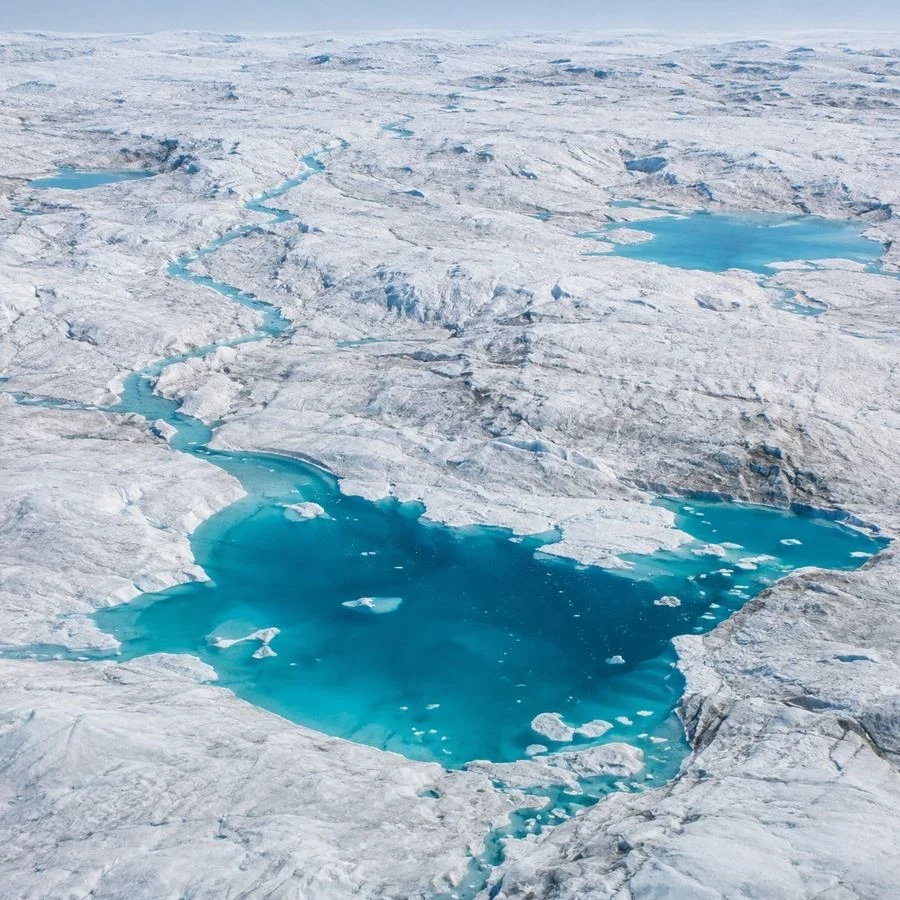
Climate change may also alter Earth's appearance through shrinking ice cover, changes in vegetation, and shifts in cloud patterns. When bright ice retreats, darker water or exposed land becomes visible, changing the balance of reflected sunlight. Extended droughts may cause vegetated regions to become browner, while changes in rainfall can produce the opposite effect elsewhere. These processes vary by location, so the planet won't necessarily experience one uniform color change.
Over much longer timescales, geological activity and the evolution of the Sun could produce even greater transformations. Continental drift will continue rearranging landmasses, while changes in the planet's climate and water distribution could alter its appearance substantially. However, predicting Earth's exact colors hundreds of millions of years into the future involves considerable uncertainty.
For the foreseeable future, Earth's oceans will continue covering most of its surface, so there's no reason to expect the Blue Planet to suddenly lose its recognizable appearance. Its shades will keep changing with seasons, climate, and marine ecosystems, while the combination of oceans, atmosphere, clouds, and sunlight will continue making Earth one of the most visually distinctive planets in our Solar System.
Explore new worlds with WarForGalaxy
Earth's appearance is shaped by a remarkable combination of water, atmosphere, and environmental conditions. If you're fascinated by planets and the possibilities of exploring distant worlds, WarForGalaxy offers an opportunity to build your own civilization among the stars.
WarForGalaxy is a free cross-platform multiplayer 4X space strategy game where you can develop planetary colonies, manage resources, research technologies, and construct military fleets. Starting with a small settlement, you'll gradually expand your territory and transform your civilization into a growing interstellar empire. Every decision contributes to your long-term development, from improving your economy to preparing for conflicts over strategically valuable planets.
The game connects players from around the world, allowing you to establish alliances, cooperate with other commanders, and participate in large-scale galactic wars. WarForGalaxy also features Hermes, an AI assistant designed to help with strategic analysis and selected routine tasks, giving you more opportunities to focus on planning and expansion.
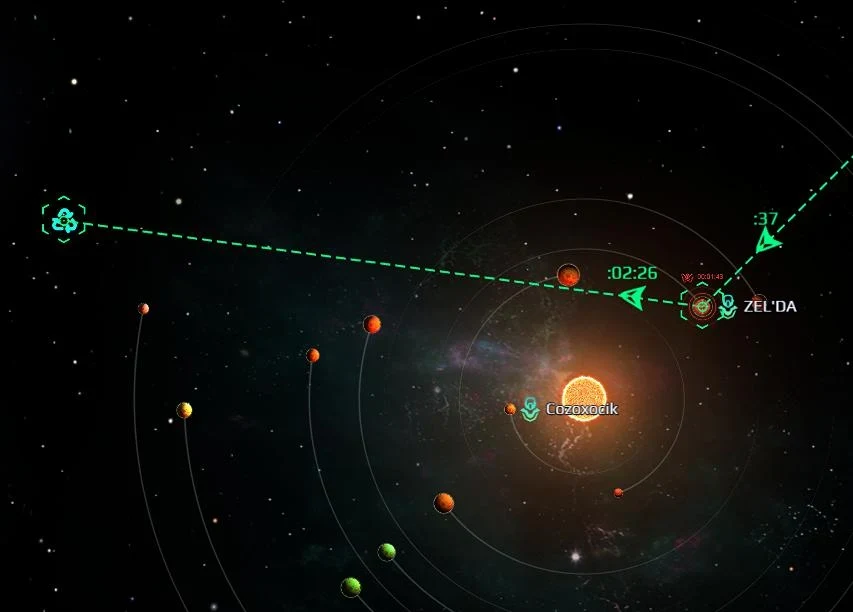
You can play on computers and smartphones, with browser-based access on PC that doesn't require installing a separate game client. Ready to establish your own empire? Play WarForGalaxy for free, discover distant planets, build powerful fleets, and compete for influence across the galaxy.