Why is space dark
Space & Astronomy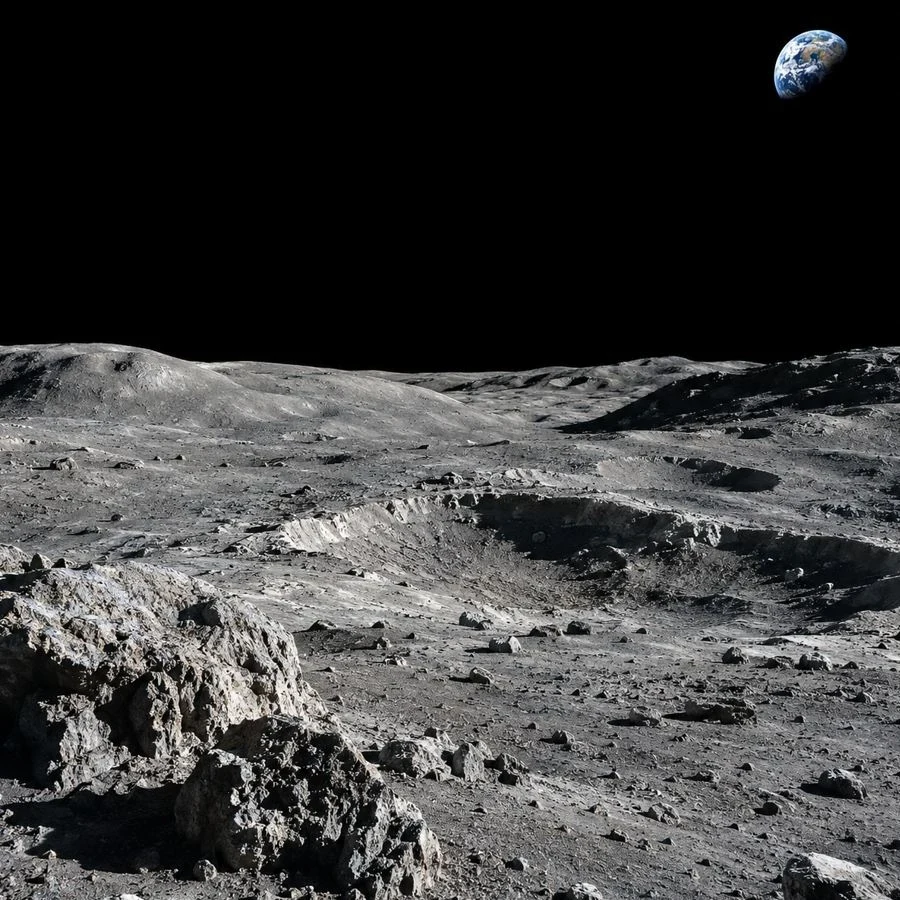
The Sun illuminates Earth, and countless stars fill the universe with light. In sci-fi movies and space exploration games, distant galaxies often glow with spectacular colors, yet real photographs show that most of outer space looks almost completely black. Why is space dark if so many celestial objects are constantly producing energy? The answer involves how light travels, the enormous distances between stars, the age of the universe, and the limitations of human vision. In this article, we'll explore why sunlight doesn't illuminate empty space like it illuminates Earth's sky, explain Olbers' paradox, and discover the hidden radiation that fills the seemingly endless darkness.
Why isn't the light from trillions of stars enough
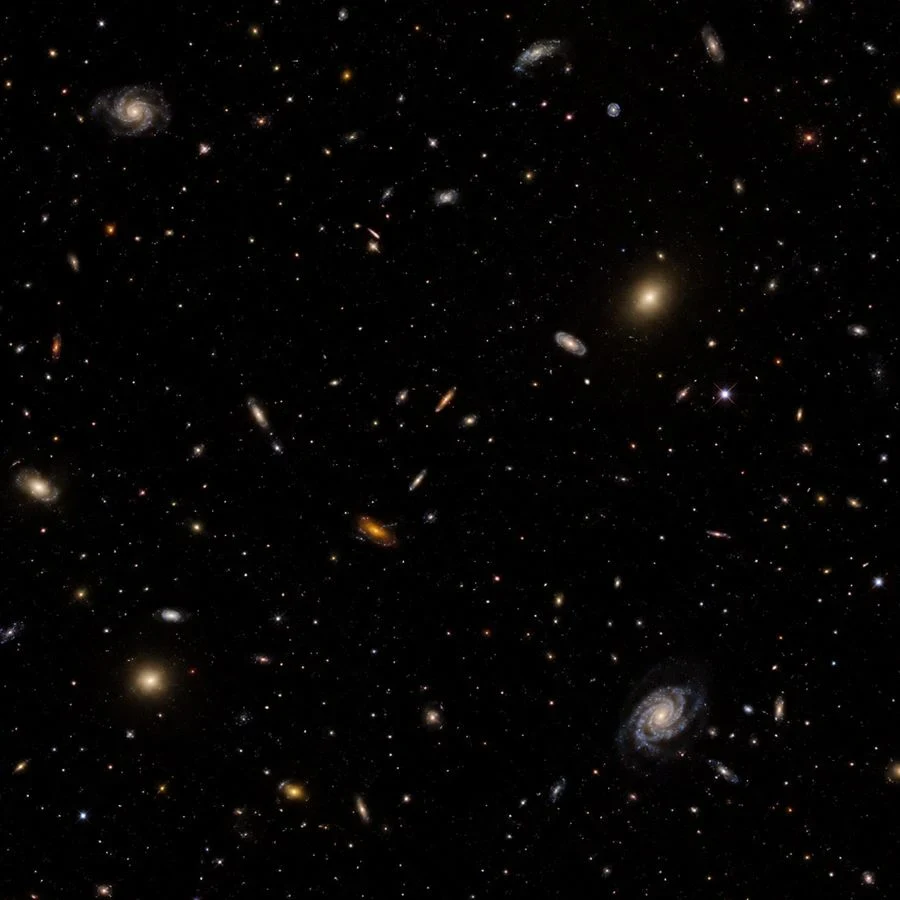
The observable universe contains an extraordinary number of stars, distributed among billions of galaxies. Our own Milky Way alone contains hundreds of billions of them, and each generates energy through nuclear fusion. With so many sources of radiation scattered across space, it might seem logical that the entire sky should always be bright. However, having a huge number of luminous objects doesn't mean the empty regions between them will glow like Earth's daytime sky.
The most immediate explanation involves the way light interacts with matter. On Earth, sunlight enters the atmosphere and encounters molecules and tiny particles that scatter part of the incoming radiation in different directions. Shorter visible wavelengths are scattered particularly effectively, which helps explain the familiar blue appearance of the daytime sky. This scattered light reaches our eyes even when we aren't looking directly toward the Sun. Without an atmosphere, the same effect becomes much weaker, and the surrounding sky can appear black despite powerful sunlight.
Outer space contains scattered gas and dust, but most interplanetary regions are far too empty to create a bright, uniformly illuminated background. Sunlight still travels through these regions and can heat a spacecraft, planet, or asteroid when it strikes their surfaces. Yet the light passing through a nearly perfect vacuum doesn't become visible simply because it exists. An observer sees it when radiation reaches their eyes directly or after being emitted, reflected, or scattered by matter. That's why a spacecraft can be brilliantly illuminated while the space surrounding it remains black.
Enormous distances also make individual stars appear faint. As their light spreads outward, the energy received per unit area decreases with distance. Stars far beyond our Solar System may be incredibly luminous, but the amount of light reaching a small detector can be extremely low. Still, distance alone doesn't fully explain cosmic darkness. In a hypothetical infinite universe filled uniformly with stars that had existed forever, increasingly distant layers would contain more light sources. This leads to a famous astronomical question that helped scientists understand the universe's history.
What is Olbers' paradox
Olbers' paradox asks a surprisingly simple question: if the universe contains an enormous number of stars, why is the night sky dark? The problem is named after German astronomer Heinrich Wilhelm Olbers, although similar ideas were discussed by earlier thinkers. It challenges the assumption that the universe is infinitely old, static, and uniformly filled with shining stars.
Imagine looking in any direction through such an eternal universe. Eventually, your line of sight should encounter the surface of a star, no matter how far away it is. A distant star appears dimmer because its light spreads over a larger area, but a more distant spherical layer of space also contains more stars. In an idealized model, those two effects compensate for each other. If stars had been shining forever throughout infinite space, the sky would be far brighter than what we actually observe.
Modern cosmology resolves this apparent contradiction through the finite history and expansion of the universe. The universe is approximately 13.8 billion years old, meaning that light has had only a limited amount of time to travel since its early development. We can observe an enormous region of space, but there are limits to which events have been able to send signals to us. Furthermore, stars didn't exist immediately after the Big Bang. The first generations formed only after the universe had cooled enough for matter to gather into suitable structures.
Cosmic expansion provides another essential part of the explanation. As light travels through expanding space, its wavelength becomes stretched, reducing the energy of individual photons. Radiation originally emitted as visible light can arrive at Earth in the infrared or other longer-wavelength regions of the electromagnetic spectrum. As a result, much of the universe's radiation is invisible to the human eye. The darkness of the sky therefore tells us something fundamental: the universe has evolved over time rather than remaining an eternal, unchanging collection of stars.
How does the Doppler effect work
The Doppler effect describes how the observed frequency of a wave changes when its source and observer move relative to one another. A familiar example is the sound of an approaching vehicle's siren. Its pitch seems higher as the vehicle moves closer and lower after it passes and travels away. Light can show a comparable change in observed wavelength, although its behavior must be understood through the principles of relativity.
When a light source moves away from an observer, its radiation can undergo redshift, meaning that its wavelength becomes longer. When the source approaches, its light can undergo blueshift, producing shorter observed wavelengths. Astronomers study these changes to investigate the motion of stars, galaxies, and other celestial objects. By measuring the positions of recognizable spectral features, they can identify shifts that would be impossible to detect with the naked eye.
However, the redshift of extremely distant galaxies is not simply the ordinary Doppler effect of objects moving through otherwise static space. Cosmological redshift primarily results from the expansion of space itself while light travels between galaxies. The longer that expansion affects a traveling photon, the greater its wavelength may become. This is one reason powerful infrared observatories are essential for studying distant galaxies whose originally visible radiation has shifted beyond human vision.
Visible and invisible light
Human eyes detect only a small part of the electromagnetic spectrum. Visible light generally covers wavelengths of approximately 380 to 750 nanometers, including the familiar colors from violet to red. Outside this relatively narrow range, radiation continues to exist even though we cannot see it directly. Infrared light, ultraviolet radiation, microwaves, radio waves, X-rays, and gamma rays are all forms of electromagnetic radiation that differ in wavelength, frequency, and energy.
This means that a region of space appearing completely dark to an astronaut or ordinary camera may contain enormous amounts of information. Infrared telescopes reveal cool dust clouds, regions of star formation, and distant galaxies whose light has been stretched by cosmic expansion. X-ray observatories detect extremely hot gas and energetic processes around compact objects, while radio telescopes investigate structures and events that optical instruments cannot observe. The appearance of the universe changes dramatically depending on which wavelength range scientists choose to examine.
One particularly important example is the cosmic microwave background, the faint radiation remaining from the early universe. This radiation was released when the universe had cooled enough for light to travel freely over large distances. Since then, cosmic expansion has stretched its wavelengths into the microwave range. Today, it corresponds to a temperature of approximately 2.725 kelvins and can be detected across the sky using specialized instruments. Although it cannot illuminate our surroundings like visible sunlight, it provides valuable evidence about the universe's early conditions and development.
Astronomical images are sometimes presented using colors assigned to invisible wavelengths, allowing researchers to display differences in temperature, chemical composition, and radiation intensity. These visualizations aren't necessarily what a human observer would see through a spacecraft window, but they reveal genuine measurements. In other words, space isn't empty of light simply because it looks black. Much of its radiation exists outside the range that human vision can perceive.
What creates light besides stars
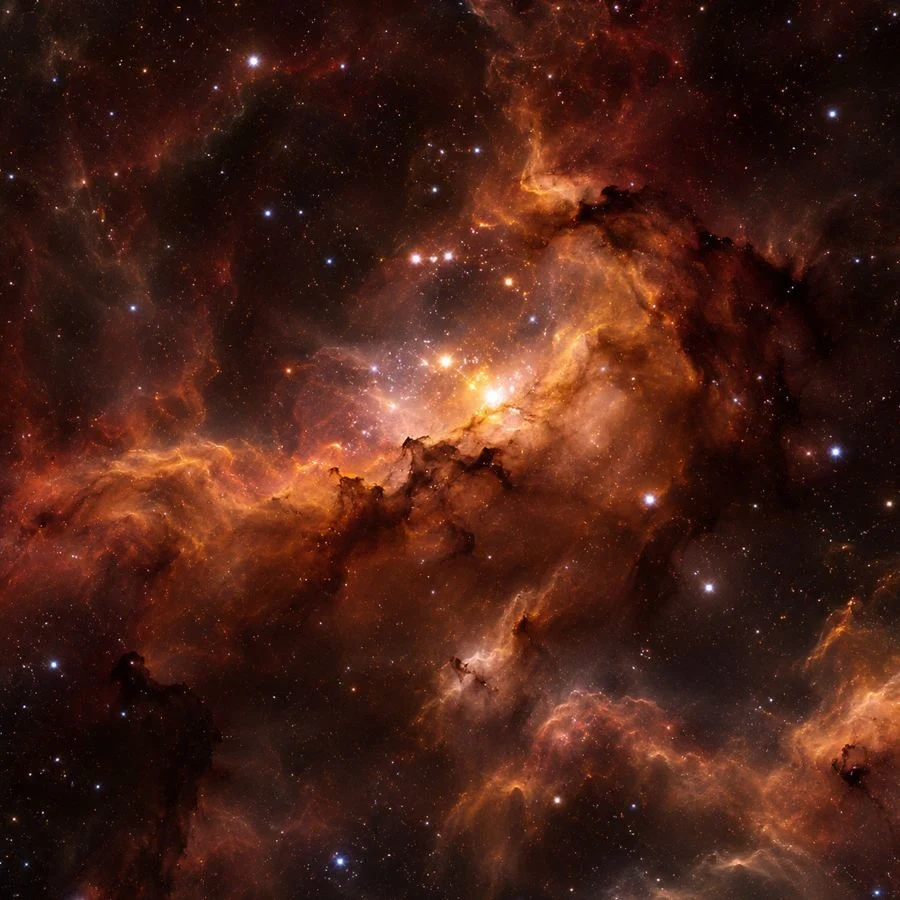
Stars are major sources of visible light, but they aren't the only objects or phenomena that contribute to the universe's brightness. Some cosmic structures produce radiation through physical processes unrelated to ordinary stellar fusion, while others become visible by reflecting or scattering light. This distinction helps explain why glowing clouds, planetary surfaces, and energetic galactic centers can appear in astronomical photographs.
Quasars and active galactic nuclei are particularly powerful examples. Gas falling toward a supermassive black hole can form a rapidly moving accretion disk, where matter becomes extremely hot and emits tremendous amounts of energy. Under certain conditions, these regions can outshine the combined light of many stars in their host galaxies. The black hole itself doesn't emit ordinary light from within its event horizon; the observed radiation comes from surrounding material and energetic processes outside it.
Nebulae provide another striking example. Some clouds of gas glow when energetic radiation excites or ionizes their atoms, which subsequently emit light at characteristic wavelengths. Other nebulae primarily reflect nearby starlight or absorb the light of more distant objects. Supernova explosions also produce intense temporary illumination as stellar material expands and releases energy. Although these events can become extraordinarily bright, they occupy comparatively small regions of the sky.
Planets and natural satellites generally shine in visible light because they reflect radiation from their parent stars. The Moon, for example, isn't producing its own significant visible illumination; sunlight reflected from its surface makes it bright in Earth's night sky. Interplanetary dust can also scatter sunlight, creating the faint zodiacal light sometimes visible from dark locations on Earth. Together, these different sources contribute to the universe's overall brightness, but they don't create a continuous, daylight-like glow throughout space.
Space isn't quite as dark as scientists once thought
Modern astronomical instruments can detect light in regions that appear completely black to the naked eye. Even after bright stars and nearby galaxies are excluded, sensitive measurements reveal a faint glow produced by distant sources throughout cosmic history. Astronomers call the visible component of this diffuse radiation the cosmic optical background, and measuring it helps researchers understand how much light galaxies have produced over time.
Detecting this background is surprisingly difficult from inside the Solar System. Sunlight scattered by interplanetary dust creates zodiacal light, which can overwhelm the much fainter radiation arriving from distant galaxies. Additional light from stars and dust in the Milky Way complicates the measurements. Separating these contributions requires extremely careful observations and analysis.
NASA's New Horizons spacecraft offered scientists an unusual opportunity. After traveling far beyond the inner Solar System, the spacecraft could observe distant regions of the sky with much less interference from interplanetary dust. Researchers used its Long Range Reconnaissance Imager to measure faint background radiation while accounting for stars, galaxies, and scattered light along the line of sight.
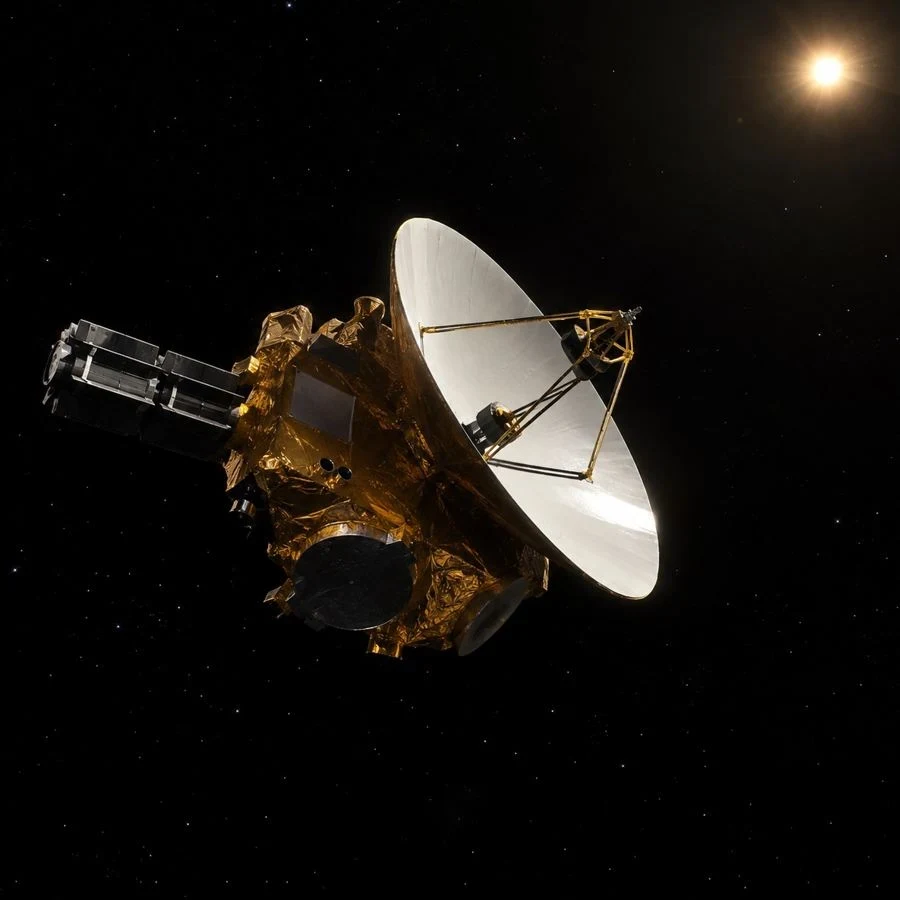
A study published in 2024 reported a cosmic optical background intensity of approximately 11.16 nanowatts per square meter per steradian at a reference wavelength of 608 nanometers. This measurement was consistent, within the uncertainties, with the expected contribution from galaxies. Earlier observations had suggested that an additional unexplained source might be contributing significant amounts of light, but the improved analysis found no convincing evidence that such a source was necessary.
These findings don't mean outer space is secretly bright enough for humans to see everything around them. The detected glow is extraordinarily faint and requires sensitive scientific instruments. Instead, the observations demonstrate that even apparently empty regions contain measurable radiation from the universe's distant past. Space looks dark because of the way light travels, the history of cosmic expansion, and the limits of our vision—not because light is completely absent.
Explore the galaxy with WarForGalaxy
The darkness between the stars hides an extraordinary universe of planets, distant systems, and unexplored territories. If you enjoy the idea of discovering new worlds and building your own interstellar civilization, WarForGalaxy offers a chance to turn that fascination into a strategic adventure.
WarForGalaxy is a free online multiplayer 4X space strategy game where players develop planetary colonies, research advanced technologies, manage resources, and assemble powerful military fleets. You begin with a small settlement and gradually expand your influence across the galaxy, making decisions that shape the future of your civilization.
The game connects commanders from around the world, allowing you to establish alliances, cooperate with other players, and participate in large-scale space wars. Strategic planning, diplomacy, and military development all play important roles as you compete for control of valuable territories.
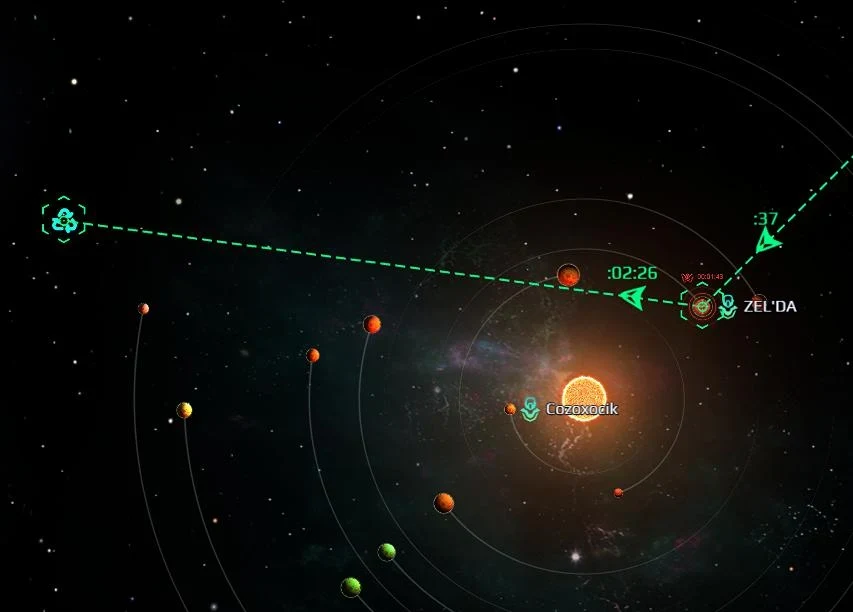
WarForGalaxy also features Hermes, an AI assistant designed to help players understand game mechanics, analyze situations, and manage selected routine tasks. The game is cross-platform and accessible on computers and mobile devices. On PC, you can play directly in a browser without downloading or installing a separate client.
Ready to explore the galaxy and build your own empire? Play WarForGalaxy for free, establish your first planetary colony, find allies, and begin your journey toward interstellar domination.