Why does time pass differently in space
Space & Astronomy
Imagine two perfectly synchronized clocks. One stays on Earth, while the other travels through space aboard a powerful spacecraft. When they finally meet again, their readings may be different, even though neither clock has malfunctioned. This isn't just a sci-fi plot device: it's a real consequence of Einstein's theory of relativity. But why does time pass differently in space, what makes it run slower or faster, and could it ever stop completely? Let's explore how time works beyond Earth, examine famous atomic clock experiments, and discover what these effects mean for astronauts.
How does time work in space
In everyday life, time seems universal. We count seconds, schedule meetings, and assume that one hour passes at exactly the same rate for everyone. This approach works extremely well for ordinary activities, but modern physics reveals a more complicated reality. Time doesn't flow at one universal rate throughout the entire universe.
Albert Einstein demonstrated that space and time are connected. Together, they form spacetime, a four-dimensional framework in which events are described by their positions and moments of occurrence. According to relativity, the amount of time experienced between events depends on an observer's motion and the gravitational conditions along their path.
Physicists use the term proper time to describe the time measured by a clock traveling alongside an observer. For someone aboard a spaceship, everything feels normal. Their watch ticks steadily, their heart beats at its usual rate, and everyday processes continue without any strange sensations.
Differences become apparent only when comparing clocks that have followed different paths through spacetime. Two travelers can leave the same location, experience different journeys, and reunite having accumulated slightly different amounts of time.
Importantly, this isn't caused by inaccurate instruments. Every physical process follows the same local passage of time, including biological aging. The distinction is real and measurable, although it usually becomes noticeable only with extremely precise equipment or under exceptional conditions.
Why does time move slower or faster in space?
Two major factors influence how clocks compare: relative velocity and gravity. Their effects are described by special and general relativity, and both have been confirmed through experiments.
Special relativity explains how motion affects time measurements. When an object travels at high speed relative to an observer, its moving clock accumulates less time between appropriately compared events. This phenomenon is called time dilation.
The effect becomes particularly significant as speed approaches the speed of light, approximately 300,000 kilometers per second. Imagine a fictional spacecraft traveling steadily at 80% of light speed relative to Earth. Ignoring acceleration and braking, ten years measured in Earth's reference frame would correspond to approximately six years aboard the spacecraft.
There's an important detail, however. During uniform relative motion, each observer can describe the other's clock as running slowly. To determine who has experienced less time when they reunite, physicists must consider their complete journeys, including changes in motion.
Gravity introduces another effect. According to general relativity, clocks deeper inside a gravitational field run more slowly relative to clocks located farther from the massive object. A clock on Earth's surface therefore runs slightly slower than a comparable clock at a higher altitude when differences in motion are accounted for.
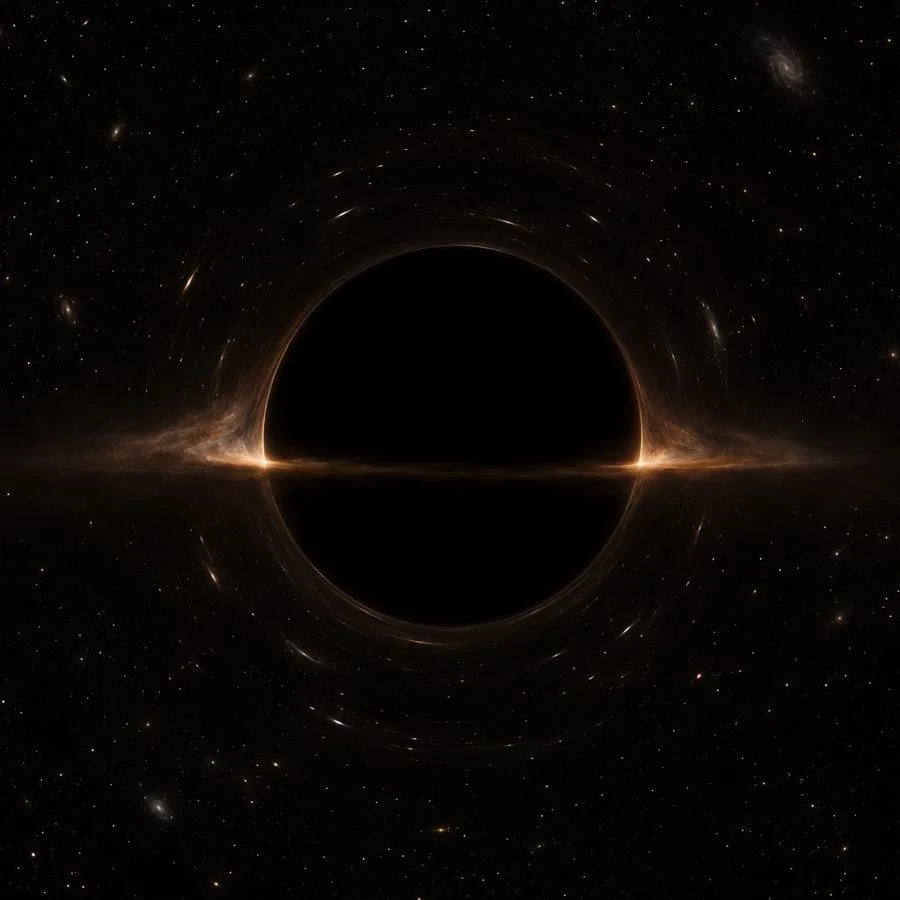
Near neutron stars and black holes, this effect can become enormous. A distant observer may receive signals from an object approaching a black hole's event horizon at increasingly stretched intervals. Meanwhile, the falling observer's own clock continues ticking normally.
The crucial point is that space itself doesn't automatically make time faster or slower. The difference depends on velocity, gravitational conditions, and how the clocks are compared.
Can time stop completely in space?
Science-fiction stories sometimes feature mysterious regions where time freezes or ceases to exist. But does modern physics allow something similar?
There's no evidence that ordinary outer space contains places where time simply disappears. Even in the nearly empty regions between galaxies, physical events continue. Radiation travels, particles move, and celestial bodies change position. These processes still require time to describe their evolution.
Black holes present a more complicated situation. Their gravity bends spacetime so strongly that the behavior of clocks and light becomes very different from what we experience near Earth.
From the perspective of a distant observer, signals emitted by an object falling toward an event horizon become increasingly redshifted and delayed. This can create the impression that the object is slowing down and fading away.
However, that doesn't mean time literally stops for the falling traveler. An observer falling freely into a sufficiently large black hole can cross its event horizon within a finite amount of their own proper time.
Another unresolved question concerns the beginning of the universe. Modern cosmology describes the development of spacetime from an extremely hot, dense early state, but whether time existed before that phase remains an open theoretical question. Current physics doesn't provide a universally accepted, experimentally confirmed answer.
For now, the scientifically accurate conclusion is that time doesn't vanish simply because we're in space. It remains part of our description of the universe, although extreme gravity and motion can make its behavior surprisingly different.
Atomic clocks and the Hafele–Keating experiment
For centuries, differences in the passage of time were far too small to measure with ordinary clocks. The development of atomic timekeeping changed that by allowing scientists to detect incredibly tiny variations.
Atomic clocks use the precise frequencies associated with transitions between atomic energy states. Their stability makes them essential for scientific research, telecommunications, and navigation systems.
One of the most famous tests of relativity took place in 1971. Physicists Joseph Hafele and Richard Keating transported four cesium atomic clocks aboard commercial passenger aircraft, flying around Earth first eastward and then westward. After the journeys, they compared the clocks with reference time maintained by the U.S. Naval Observatory.
The experiment was particularly interesting because both gravitational and velocity-based time dilation influenced the results. Higher altitude caused the airborne clocks to gain time relative to ground clocks, while the aircraft's motion introduced additional differences.
The measured results were remarkable:
Eastward journey. The airborne clocks lost approximately 59 nanoseconds relative to the reference;
Westward journey. The airborne clocks gained approximately 273 nanoseconds.
A nanosecond is one billionth of a second, so these differences were far too small for anyone to notice. Nevertheless, they agreed with the predictions of relativity within the experiment's measurement uncertainty. The findings were published in the scientific journal Science in 1972.
Later experiments achieved even greater precision. In 2010, researchers at the US National Institute of Standards and Technology measured differences between atomic clocks separated vertically by only 33 centimeters. In 2022, another experiment detected gravitational frequency differences across approximately one millimeter within a cloud of ultracold atoms.
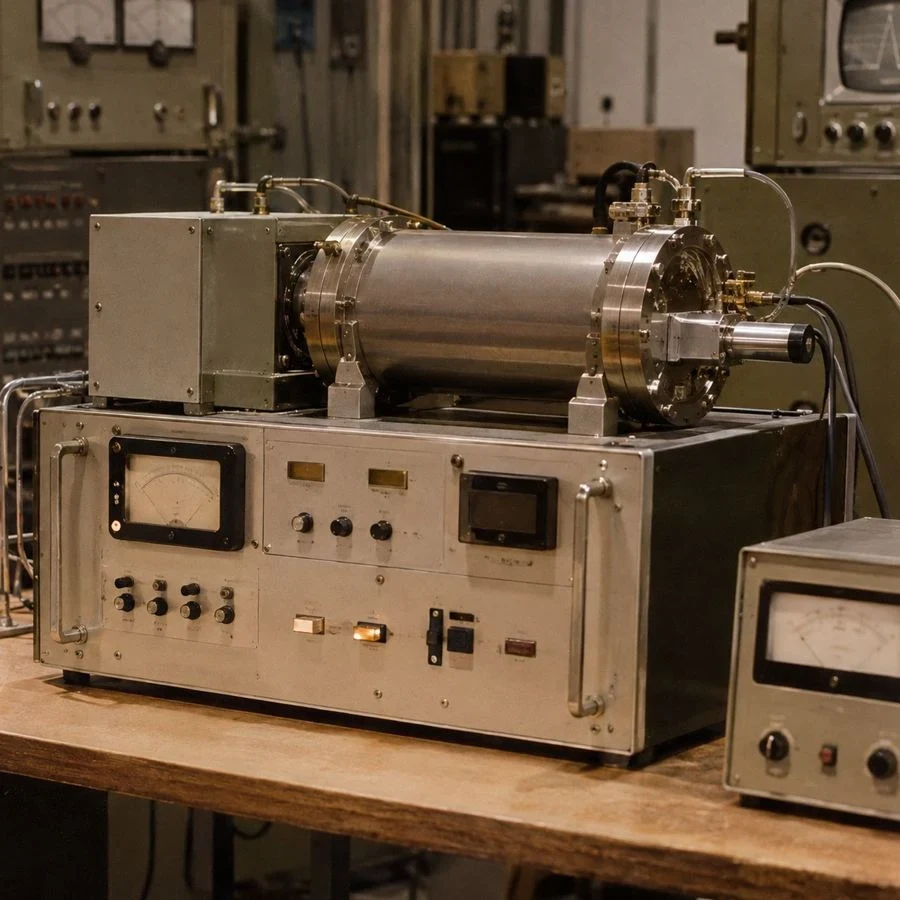
Relativity also plays a practical role in GPS navigation. Satellite clocks are affected by both their orbital speed and the weaker gravitational field at their altitude. Together, these effects cause GPS clocks to run approximately 38 microseconds per day faster than clocks on Earth's surface.
Without accounting for these differences, navigation errors would accumulate rapidly. The same physics that sounds like futuristic time travel is therefore essential to technology used every day.
How does time dilation affect astronauts
Astronauts aboard the International Space Station experience time slightly differently from people on Earth's surface. However, the difference is far too small to affect their daily routines or produce noticeable changes in aging.
The ISS orbits approximately 400 kilometers above Earth and travels at roughly 28,000 kilometers per hour. It completes one journey around the planet in about 90 minutes.
Two competing relativistic effects influence clocks aboard the station. At higher altitude, Earth's gravitational field is weaker, which tends to make time pass faster relative to clocks on the ground. At the same time, the station's considerable orbital velocity produces a larger time-slowing effect.
For the ISS, the influence of motion outweighs the gravitational contribution. Consequently, astronauts accumulate slightly less time than comparable observers remaining on Earth's surface.
Over a six-month mission, the difference is on the order of a few milliseconds. An astronaut returning home would therefore have experienced a tiny amount less time than someone who remained on Earth, assuming their clocks were initially synchronized and the complete journeys were compared appropriately.
Astronauts don't feel this change. Their biological processes continue normally relative to their own clocks. The physical challenges of spaceflight, such as muscle loss, radiation exposure, and disrupted sleep, are considerably more important for their health.
For missions traveling toward the Moon or Mars, calculations must account for changing speeds and gravitational environments. Yet current spacecraft move far too slowly for astronauts to return years younger than people who stayed behind.
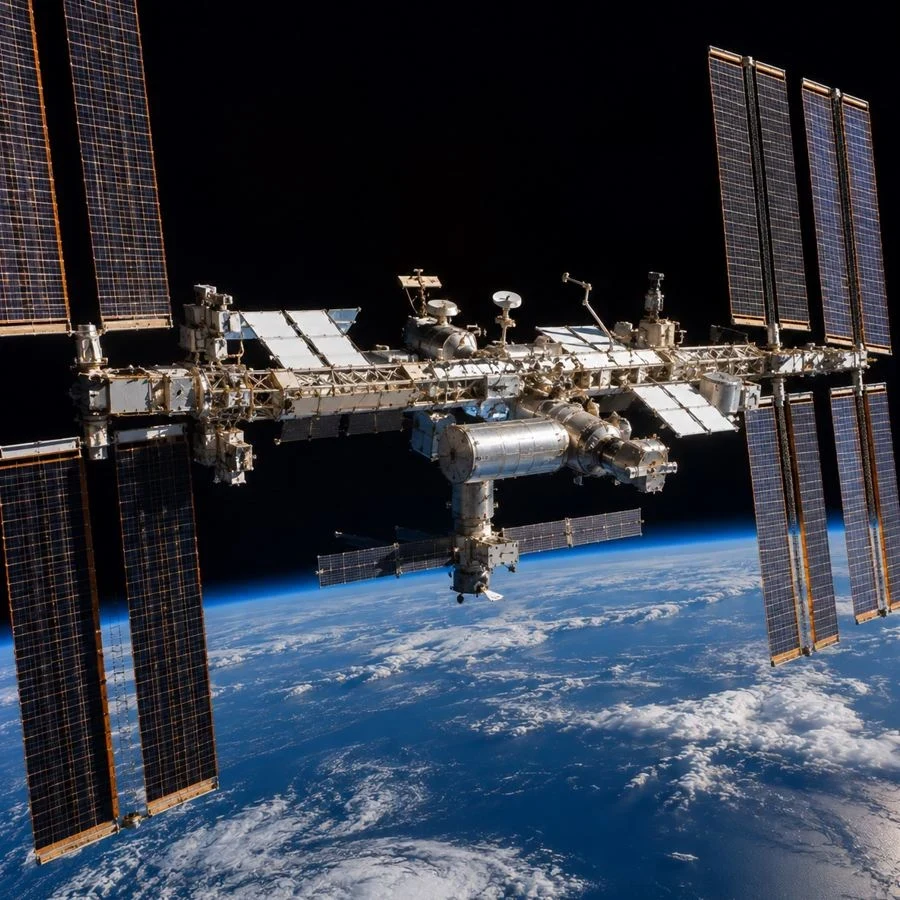
Interstellar travel at speeds approaching that of light would be a different story. A spacecraft capable of such a journey could experience years of onboard time while a much longer period passes on Earth. This remains beyond present-day engineering capabilities, but the underlying physics is firmly established.
Ultimately, time in space doesn't follow a separate set of rules. The same laws of relativity operate everywhere, from laboratories on Earth to spacecraft orbiting distant worlds.
Explore the galaxy with WarForGalaxy
The mysteries of spacetime make the universe fascinating, but you don't need a near-light-speed spaceship to enjoy an interstellar adventure. WarForGalaxy lets you create your own civilization, explore distant planets, and compete for control of valuable territories in a vast online galaxy.
WarForGalaxy is a free multiplayer 4X space strategy game built around exploration, expansion, resource development, and interstellar warfare. You begin with a small planetary colony and gradually transform it into a powerful empire by constructing infrastructure, researching technologies, and assembling military fleets.
Strategic planning is essential. Developing a strong economy gives you the resources needed to expand, while technological research unlocks additional opportunities. You can strengthen your defenses, establish new settlements, and prepare campaigns against rival powers.
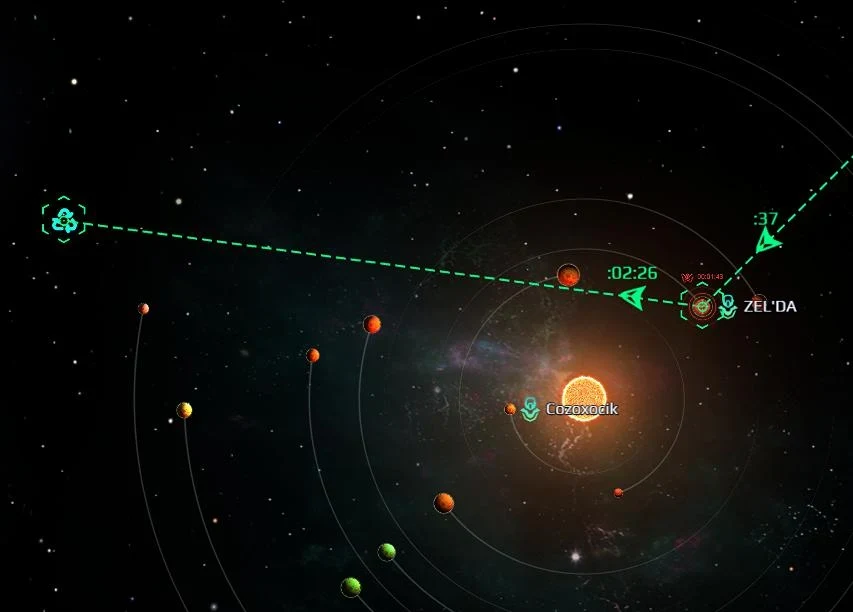
The galaxy is populated by real players from around the world. You can form alliances, coordinate military operations, support friendly civilizations, and participate in large-scale space wars. Diplomacy and cooperation can become just as important as military strength.
WarForGalaxy also features Hermes, an AI assistant that helps players understand game mechanics, analyze strategic situations, and manage selected routine tasks. This support gives commanders more opportunities to focus on long-term development and important decisions.
The game is cross-platform and accessible on computers and mobile devices. On PC, you can play directly in your browser without downloading or installing a separate game client.
Ready to build your own interstellar empire? Play WarForGalaxy for free, develop your first planet, discover reliable allies, and begin shaping the future of the galaxy.