

How to Farm Pirates and Properly Collect Debris with Collectors in War for Galaxy
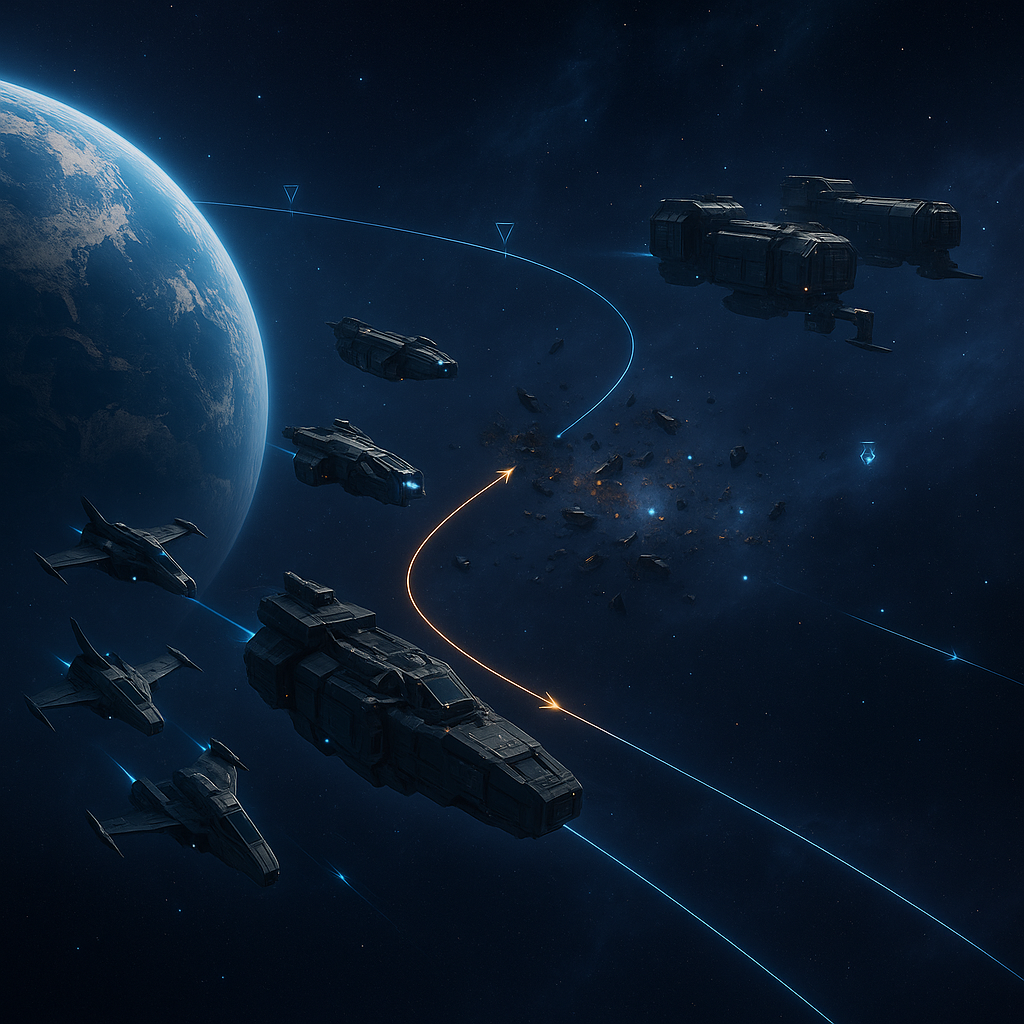
How to Farm Pirates and Properly Collect Debris with Collectors in War for Galaxy
One of the most common questions among newcomers in War for Galaxy is roughly: "I found pirates and want to get debris. Should I add Collectors directly to the battle fleet or send them afterward?" This question is completely normal: the mechanics aren't obvious, especially if you're just getting into space games, browser strategies, and the galaxy game format where fleets have different tasks, not just a "fly" button.
The short answer: first send the battle fleet against the pirates, and then send the Collectors in a separate trip after victory. The working sequence is: combat ships attack pirates, battle occurs, after victory a debris field appears, and only then you send Collectors to these coordinates with the task "Recycling".
The main mistake is thinking that Collectors added to the attacking fleet will automatically gather resources after the fight. The mechanics don't work this way. If you take Collectors into the attack, they participate in battle as ships: they join the fleet, can take damage, and count as battle participants. But at that moment they do not perform debris recycling and do not convert the post-battle field into resources on their own.
Therefore, for farming pirates keep in mind a simple logic: attack and debris collection are two different actions. The battle fleet's task is to win. Collectors have another task — to collect the debris field through a separate mission. In War for Galaxy, as in good online strategy games, not only the fleet size but also the order of actions matters. Sometimes one incorrect mission type costs more than lacking a couple of ships.
Why Pirates Are Useful: Debris, Training, and Less PvP Pressure
Pirates in War for Galaxy are autonomous combat formations that appear in planetary systems with active players. They belong to no player and are not someone’s hidden army. For a beginner, they are a convenient training target: you can practice space battles without initiating direct conflict with a neighbor in the system.
The main value of pirates is the debris field after battle. In this sense they behave like a regular fleet: when you destroy a pirate group, debris remains which can be recycled. Hence, farming pirates often becomes the first clear exercise in fleet economy: not just "flew and won," but evaluated the target, counted losses, read the report, and understood if the attack was worth the debris gained.
At the same time, pirates have an important limitation: they cannot be scanned. You can’t send a spy probe and get an exact composition beforehand as with spying on a player’s planet. Fleet composition is built from practice: start with targets that look manageable, study battle reports, gradually strengthen your lineup, and observe which ships survive particular fights better.
Another plus — pirates almost do not give battle rating. If your goal is not a league rush but a calm training and debris collection, this format is convenient. You learn to manage battle composition, check the ratio of light to heavier ships, notice lack of damage, armor, or shields — all without immediately declaring war on another player.
But farming pirates cannot be considered completely safe. Pirates are not players, but they still fight. Sending a weak or poorly assembled fleet can lead to ship losses and going negative. This is typical for space combat games and RTS: one total power number doesn’t replace a smart fleet composition. More details about the game format can be found on the official War for Galaxy page.
The Proper Sequence: Battle Separately, Recycling Separately
In a simple formula: battle fleet fights, Collectors collect. These are two separate missions. Debris is not picked "along the way" nor recycled by any cargo ship. For collection you need specifically Collectors sent on a "Recycling" mission.
- Find a suitable pirate fleet in nearby systems. Don’t just attack blindly, especially if you’re just learning to farm pirates in War for Galaxy. Assess the distance to the target, flight time, and your current battle composition. The closer the target, the easier and quicker the battle and subsequent Collector dispatch.
- Send a battle fleet to attack. Include fighters, assault ships, corvettes, frigates, and other combat units for the fight. Don’t add Collectors into this attacking fleet. Combining roles complicates the process if your goal is to quickly hit pirates and then retrieve debris.
- Wait for the battle result. The fight must finish first. After victory, check if a debris field appeared. Collectors won’t automatically receive a “collect all” command just because your fleet was nearby.
- Select Collectors and send them to debris coordinates. Use the needed amount of Collectors and assign them the "Recycling" mission. This task activates their core function — collection and recycling of debris.
- Wait for Collectors to return with resources. After completing recycling, the fleet returns to the home planet with loot. This closes the farming cycle: the battle fleet does its job, the Collectors theirs.
Important: other ships cannot recycle debris. Transports, shuttles, and combat ships have cargo holds, weapons, armor, and speed, but they aren’t recyclers. Cargo holds are for carrying resources; debris recycling is a unique Collector mechanic.
Remember the order: battle with combat fleet → victory → debris field → separate Collector trip on "Recycling". This scheme reduces confusion, aids precise economy calculations, and prevents slow industrial ships from flying where they can’t do their main job.
What Happens If You Add Collectors to the Attack
Beginner logic: “I want to destroy pirates and immediately gather debris, so I add Collectors to the same fleet.” The problem is the game treats such Collectors not as resource gatherers but as normal combat participants. They join the fight, can take damage, and can be destroyed. But they do not auto-collect debris after battle.
Collection activates not by being near battle but by a separate "Recycling" order. Thus, Collectors belong not to the strike group but to a second flight after battle is over and debris appears.
Why mixing Collectors into attack is often disadvantageous? First, speed. Collector base speed is only 2000. For attack, that’s slow — it can slow down the entire route especially if other units are much faster. The attack takes longer, and you wait for a ship that doesn’t perform its main function in this mission.
Second, risk. Collectors aren’t "invisible cargo trucks behind the scenes." They have combat stats: roughly power 14, armor 6400, shield 250, Boron engine, fuel use 300, and cargo capacity 20,000. They have weapons and defenses but their key value is not fighting but hauling resources after battle. Destroyed Collectors means lost ships that should have brought loot home.
Easiest to remember roles as:
- Combat ships destroy pirate fleets;
- Collectors fly separately after battle for "Recycling";
- Transport, shuttles, and other ships do not replace Collectors for recycling;
- Collector in attack is a battle participant, not an automatic resource gatherer.
In strategy and spaceship games, proper role assignment often matters more than wanting to send "everything at once." For pirate farming, don’t make adding Collectors to attack your standard practice. Cleaner and clearer: first the strike fleet, then a separate Collector trip for "Recycling."
Pirate Refresh, Fleet Strength, and Debris Lifetime
Farming becomes calmer once you understand not only whom to attack but how pirates spawn. Pirate fleets can refresh every 4 hours. At set times, the server checks planetary systems with active players. If there are fewer pirates than required, it randomly adds a number of new pirate fleets — from zero up to the deficit.
This doesn’t mean every four hours an ideal target appears nearby. Sometimes several fleets spawn, sometimes fewer, sometimes nothing useful for your current level. So good habit — regularly scan nearby systems, not just wait for a spawn at your home planet.
Pirate fleet composition depends on average combat power of all inhabited planets in the system. In newbie systems with small fleets, pirates tend to be light. In systems with strong players and big fleets, pirates are tougher. The takeaway: don’t blindly attack every pirate you spot. Since pirates can’t be scanned, rely on past reports, strengthen gradually, and be cautious in systems near stronger players.
Debris also has a key rule: it has no normal lifetime timer. The field exists until someone recycles it with Collectors or until a server restart. This is convenient but don’t relax — if others see the debris, another player can snatch it first.
Practical Checklist Before Farming
- Check nearby systems after possible 4-hour refreshes, not just your home system.
- Don’t rely on pirate scans: their composition must be understood through experience, reports, and cautious attacks.
- Choose battle fleet with a margin, especially if the system has strong players.
- Do not send Collectors early to attack for collection: a separate trip on "Recycling" is needed for debris.
- Account for slow Collector speed: they may take longer than battle fleet, so plan the second trip without delay.
- Start recycling immediately after battle as debris can be claimed by anyone who arrives first.
The main habit of a good farmer is simple: first carefully select a target and win the fight, then quickly collect debris. In browser space strategies, resources often go not to the fleet that’s loudest, but to the one that manages timing best.
Short Conclusion: Two Trips — Fewer Mistakes
The final pirate farming formula in War for Galaxy is: battle fleet separately, Collectors separately. Pirates are destroyed by combat ships. Debris after victory is gathered by Collectors, but not automatically and not "on the way," rather by a separate trip with the "Recycling" mission.
If you want to keep your pace and avoid confusion, follow this order: check nearby systems, find manageable pirate fleets, pick a battle lineup, wait for the report, evaluate losses, and immediately send Collectors separately to recycle. Don’t promise guaranteed profits: poorly picked fleets can make pirate battles expensive. Start with weak targets, study reports, and gradually improve ship ratios.
For fans of online strategy games, space MMOs, and space games, War for Galaxy clearly illustrates a basic rule of the galaxy: victory goes not only to the bigger fleet but to the player who follows the correct order of actions. Want to practice? Enter the game, check nearby systems, compose a battle fleet for pirates, and remember: Collectors fly the second trip, strictly on "Recycling". You can download or open the game via the War for Galaxy download page.