

Pioneer in War for Galaxy: How to Open the Path to an Alliance and New Planets
Pioneer in War for Galaxy: How to Open the Path to an Alliance and New Planets
In the first days of War for Galaxy, many players encounter the same question: what is the Pioneer, why is it connected to the Alliance, where to send the ship, and why you can’t just hit the "create union" button without preparation. The confusion is understandable: the game quickly moves you beyond a single planet, and along with resource gathering, fleet building, and initial flights, new terms appear — empty planets, Alliance multiaccount, control of systems, and territory capture.
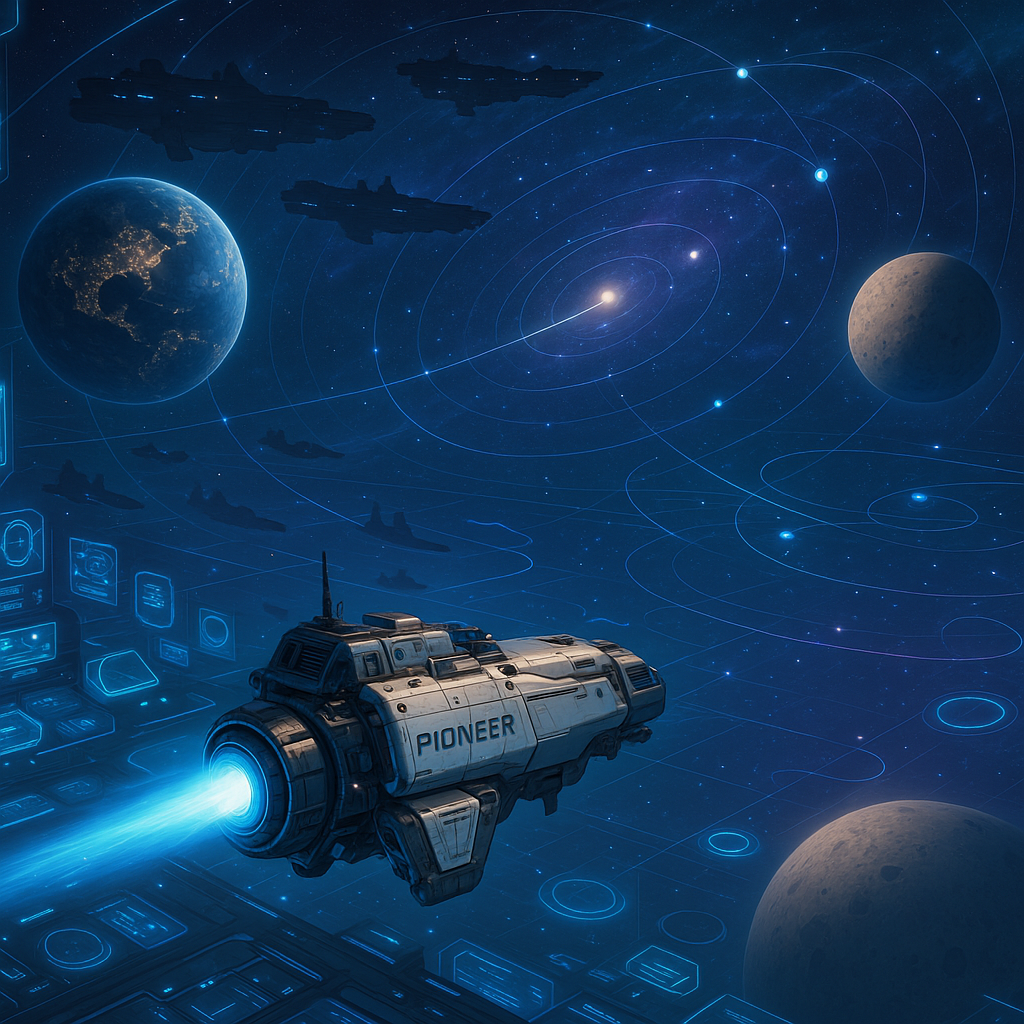
Let’s immediately clarify the key points. The Pioneer in War for Galaxy is a ship. Not a separate mode, building, faction name, or the Alliance itself. Its main value lies in expansion: under the new rules, it is required to create an Alliance and then is used by the Alliance multiaccount to colonize empty planets.
Alliance is a union of players that creates a shared Alliance multiaccount to capture and control territories in the galaxy. If a regular account is your personal empire with your own planets, economy, fleet, and decisions, then the Alliance is a joint military and territorial structure. Players sometimes colloquially call such unions "clans," but the correct term in the War for Galaxy interface and rules is precisely Alliance. This distinction is important: it’s not just a group of friends, but a unique cooperative gameplay mechanic.
War for Galaxy stands at the intersection of space games, browser strategy games, online strategy games, space MMO games, and real-time strategy games: here it’s important not only to develop a base but also to think about the map, coordinates, routes, and neighbors. Because of this, the Pioneer becomes one of the first major strategic moves for a beginner — the transition from a lone colony to team-based territorial conquest.
What is the Pioneer and Why is it Needed
The Pioneer is a specialized expansion ship. It should not be viewed as the core of your combat fleet, although it has armor, shields, weapons, and conditional combat power. In a game about spaceships, it’s easy to get caught up in combat stats, but for the Pioneer, its primary role is not space battles but access to alliance play.
The ship has two key functions. First: 1 Pioneer is needed to create an Alliance under the new rules. Second: once inside the Alliance multiaccount, the Pioneer is used for colonizing empty planets. In other words, it helps your team settle on the map and expand the Alliance’s holdings.
| Parameter | Value |
|---|---|
| Conditional Combat Power | 16 |
| Armor | 12,000 |
| Shield | 1,500 |
| Defense Level | 1 |
| Armament | 2 Small Infrared Lasers Type-2 |
| Firing Sector | 0–360 degrees |
| Base Speed | 2,500 |
| Engine Type | Annihilation Engine |
| Cargo Hold Capacity | 7,500 |
| Fuel Consumption | 1,000 |
| Chance to Recover After Victory | 25% |
These stats are useful to understand the ship’s role among other units. But the practical takeaway for beginners is: do not plan your strategy around the Pioneer as your main combat flagship. For attacks, defense, and serious battles, dedicated combat ships are needed. The Pioneer is a tool for reaching new planets and entering alliance territorial gameplay.
How to Build a Pioneer: Requirements and Cost
The Pioneer does not appear automatically when you open the Alliance window. First, you need to unlock it by developing your planet and then build it in the Dock. For beginners, this is a good economic lesson: as with any browser strategy game, a plan is important — which buildings to upgrade, which researches to prioritize, and which resources not to spend unnecessarily.
Building Requirements
- Dock level 4 — building requirement;
- Annihilation Engine level 3 — technological requirement;
- Planet Mastery level 2 — technological requirement.
There are no additional conditions. If your goal is to reach the Pioneer as quickly as possible, avoid random upgrades: check your Dock, unlock researches, and compare your current progress with these three points. Before building, double-check the game’s interface to confirm what is completed and what still blocks the ship.
Cost of One Pioneer
| Resource | Amount |
|---|---|
| Titanium | 10,000 |
| Silicon | 20,000 |
| Antimatter | 10,000 |
Pay special attention to antimatter. It’s needed not only for construction but also as fuel for flights. Beginners often look only at the ship’s cost but forget that after building the Pioneer, you must send it to the target. So don’t spend key resources blindly: keep a reserve, select your active planet for building, and consider in advance from where the ship will depart most conveniently.
If you want to check requirements right now, you can visit the browser version of War for Galaxy or open the game download page if you prefer to play on a device.
How to Create an Alliance Using the Pioneer
Now the main point: how to create a War for Galaxy Alliance under the new rules. For this, you need exactly 1 Pioneer. Not several ships, not a separate building, and not an instant action without a flight. The ship must launch from an active planet to a chosen empty planet, and the Alliance will be created only upon arrival.
- Make sure the Pioneer is on the active planet. This is where it will launch from after you confirm creating the Alliance.
- Open the "Alliance" window. If you’re ready to create your own union, select the "Create" action.
- Specify the Alliance name. Other players, allies, and opponents will see it, so it’s better to choose a clear and meaningful name.
- Enter the coordinates of an empty planet. It must be a free object, not a player's planet and not another Alliance's planet.
- Click "Create". After this, the Pioneer will launch from the active planet.
- Wait for the ship to arrive. The Alliance will be created only when the Pioneer reaches the specified destination.
The most common mistake is to think that the Alliance is created instantly upon clicking the button. In War for Galaxy, coordinate choice matters: you select a point on a living galactic map, and the ship physically flies there. Before confirming, check three things: the ship is on the correct active planet, the name is entered correctly, and coordinates lead to an empty planet.
What the Alliance Provides: Multiaccount, Territories, and Cooperative Actions
The Alliance is not just for gaining a badge next to your name. It unlocks a separate gameplay layer — a shared Alliance multiaccount usable by all members. Through it, the team captures and holds alliance planets, wages wars with other Alliances, and controls territories.
The difference between a personal account and a multiaccount is fundamental. A regular account is your personal empire. The Alliance multiaccount is a collective entity created for war and territorial control, not for typical solo development.
Main Features of the Alliance Multiaccount
- Capture and holding of alliance planets. The Alliance expands its holdings through the multiaccount.
- Wars with other Alliances. This is more than just resource raids; it’s a battle for planets and systems.
- Control of systems. An Alliance owns a system if its multiaccount has at least one planet there; in disputes between Alliances, the owner is the one with more captured planets.
- Cooperative logistics. Players can send fleets from their personal accounts to their Alliance planets on "Transportation" and "Relocation" missions.
Relocation here means transferring ships into Alliance ownership. There is no reverse transfer: the multiaccount cannot relocate ships back to players’ personal planets; it can only receive ships.
Multiaccount Limitations
- There is no main planet in the multiaccount;
- You cannot delete planets;
- Marauders do not spawn;
- The multiaccount does not affect pirate spawns;
- You cannot attack pirates — attempting to do so results in an Alliance Code prohibition error;
- Missions, Store, Profile, and Rewards Calendar are unavailable;
- No free tokens for Hermes;
- You cannot delete reports.
At the same time, the multiaccount has an important alliance feature: the "Navigation" technology gives a bonus to fleet slots higher than that on a regular account — +2 instead of +1. This matters greatly for territorial warfare because it allows more flexibility in planning flights, attacks, and supplies.
It is also worth remembering the system ownership rules. If an Alliance multiaccount has at least one planet in a system, the Alliance is considered the owner. If multiple Alliances have planets in the same system, ownership goes to the one with more captured planets. If the numbers are equal, the system belongs to no one. Additionally, controlling neighboring systems can grant local synergy bonuses for multiaccount planets within the connected network: controlling 3 adjacent systems grants bonuses to titanium, silicon, and antimatter production, and newly connected systems enhance this effect within set rules.
Colonization and Capture: What the Alliance Can Do That a Regular Player Cannot
Now let’s clarify the key boundary. In War for Galaxy, personal attacks, alliance colonization, and territory capture are different mechanics. A strong fleet of a regular player does not become a tool to seize other players' planets.
How an Alliance Occupies an Empty Planet
To capture an empty planet for the Alliance, you must act within the Alliance multiaccount. From there, send a Pioneer on a "Colonization" mission to the empty planet. Upon fleet arrival, the planet becomes property of the Alliance multiaccount.
The scheme is simple: multiaccount → Pioneer → empty planet → "Colonization" mission. If you act from a personal account or select the wrong target, the situation differs.
What Happens When a Regular Player Attacks
A regular player’s account cannot capture other players’ planets. When attacking an enemy planet, you can destroy its fleet and defense, and if victorious, loot some resources according to standard raiding rules. But ownership of the planet does not change.
The same applies to Alliance planets. Attacking an Alliance planet from a regular account results in a standard attack with looting, and even a victorious attacker does not gain the planet. Territory capture is available only to Alliance multiaccounts and only against other Alliances.
How Planets of Other Alliances Are Captured
To capture a planet from another multiaccount, you must switch to the Alliance multiaccount, select the other Alliance multiaccount’s planet, and send a fleet on a standard attack mission. If the attacking multiaccount wins, the planet transfers to the attacking Alliance’s ownership. The new owner receives buildings, defenses, and infrastructure, and the Alliance's rating increases by the captured planet's value.
There is also an important rule about fleets. The attack organizer’s fleet remains stationed on the captured planet. All additional joined fleets return to their home planets. If the defenders win, the attacker's fleet is destroyed, and ownership remains unchanged.
Summary: Your First Route to the Grand Galaxy
The Pioneer may be limited in combat role but is huge in strategic significance. It connects a beginner’s personal economy with the larger alliance map: first you develop your Dock and technologies, then build the ship, choose an empty planet, and open the way to the Alliance. After that, team play begins — system control, logistics, defense, attacks, and territorial struggle.
Take the next step now: go to War for Galaxy, open your Dock and research, verify the requirements of Dock 4, Annihilation Engine 3, Planet Mastery 2, accumulate 10,000 Titanium, 20,000 Silicon, and 10,000 Antimatter. Then decide whether to build the Pioneer and form your own Alliance or join an active team to master cooperative play faster. The official War for Galaxy web shop can guide you through available in-game purchases, but the foundation of success is still planning, discipline, and allies.
The galaxy doesn’t wait for the perfect moment. Check requirements, prepare your First Route, coordinate with future allies — and let your Pioneer become the start of a territory worth fighting for.