

Where Did the Pirates Go? How Pirate Spawn Works in War for Galaxy
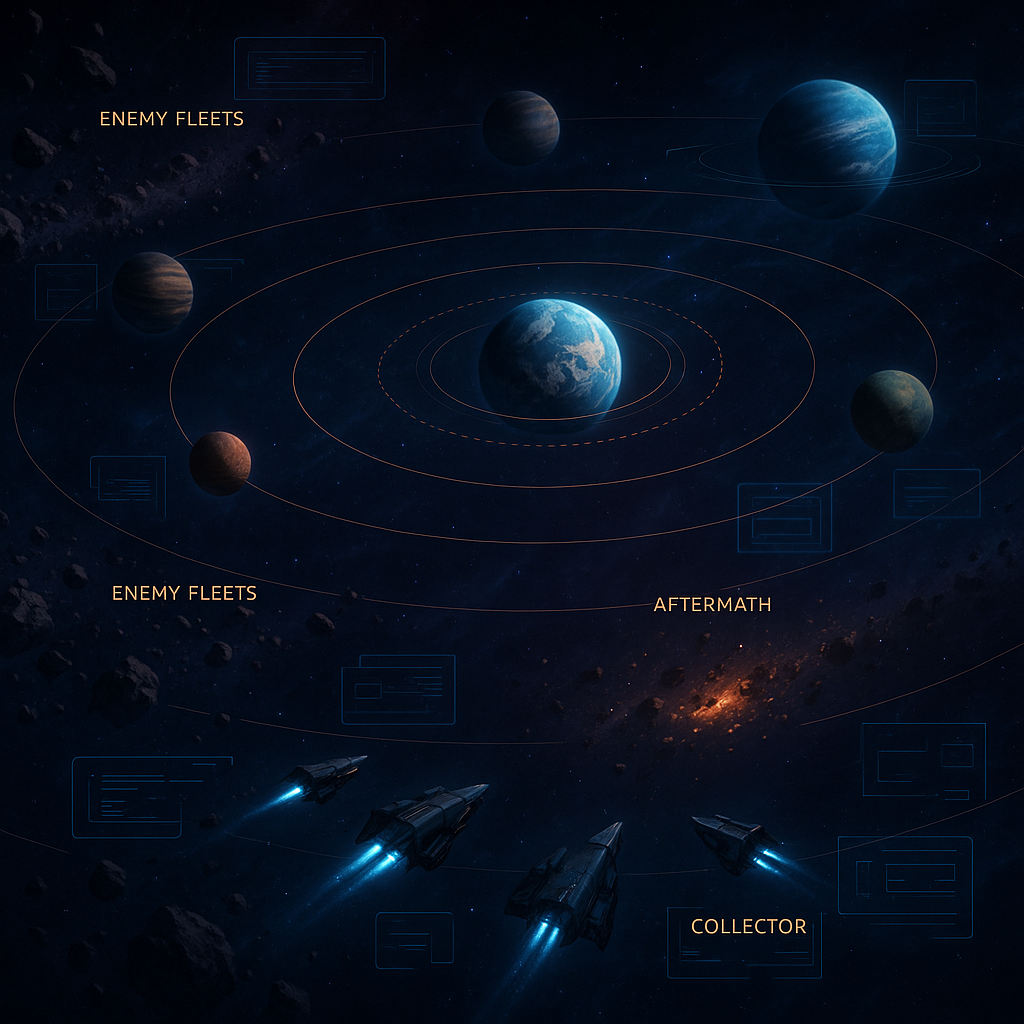
Where Did the Pirates Go? How Pirate Spawn Works in War for Galaxy
A familiar situation for many players: you log into War for Galaxy, open your planetary system, and there's silence. Not a single pirate fleet. You check neighboring coordinates, recall yesterday's cleanup, look at the chat—and the question arises in your mind: "Where did the pirates go? Have they been disabled? Why hasn't anyone appeared again?"
The short answer: pirates in War for Galaxy have not been removed as a mechanic. But their presence in a particular system at a specific moment is not guaranteed. A system can temporarily be empty according to the regular spawn rules, and this alone doesn't mean something is wrong with the game.
Pirates in War for Galaxy are autonomous combat scout fleets. They appear in planetary systems with active players, do not belong to other players, and are not fleets of a separate NPC empire. This is an independent PvE activity within the galaxy: a target to attack, a way to train your fleet composition, and to obtain debris fields after battles.
This topic is important for both newcomers and experienced commanders. For a newcomer, pirates are one of the first understandable ways to try space battles without direct conflict with a live neighbor. For a more advanced player, they are a regular farming route for debris and checking combat readiness. In a browser-based online space strategy game, such activity fits well into the daily rhythm: find a target, assess risk, attack, send Collectors, and come back later.
Let's analyze the mechanics calmly, without assumptions about bugs, server incidents, or hidden changes. Below is only what follows from the game's rules and the War for Galaxy knowledge base.
How Pirate Spawn Works: Checks Every 4 Hours
Pirate spawn is not based on the principle "destroy a fleet and immediately get the next one." It's a server check that can occur once every 4 hours server time. At a fixed moment, the game iterates through planetary systems and looks where conditions exist for new pirate groups to appear.
The process can be broadly represented as:
- The server cycle begins. Every four hours, the systems are checked. This is not an instant respawn and not a guarantee that pirates will appear everywhere at once.
- The server looks at suitable systems. Primarily important are systems with active players and active inhabited planets. Pirates are tied not to empty map areas but to the galaxy's living zones.
- The current number of pirate fleets is checked. If the system already has enough pirates per internal norm, the server might add nothing.
- If pirates are fewer than needed, replenishment is possible. But replenishment is not obligated to cover the entire deficit.
The most important detail: when a system lacks pirate fleets, the server can add a random number of new flotillas from 0 up to the missing amount. Zero is included in the range. Therefore, even an active system with fewer pirates than the norm might get no new fleets during a specific four-hour cycle.
This is why players often feel that after a cleanup "pirates haven't returned." In reality, respawn doesn't work like a button. Suppose there were several pirate groups, players destroyed them, and by the next check there's a deficit. The server sees fewer pirates but the random addition result can be anything within the rule: one group, several, or zero.
So it's best not to promise yourself an exact time for a specific pirate fleet to appear in a system. It's more accurate to think in cycles: check the map, clear available targets, return after the possible next update. War for Galaxy is a real-time space strategy, but piracy farming here still depends on system conditions and the random server verification result.
Why There May Be No Pirates in Your System
If there are no pirates in your system currently, it may be a normal outcome according to spawn rules. The absence of pirates at one map point does not mean the mechanic disappeared from the game. Most often, the reason is one of the following conditions:
- The system is empty. Pirates do not appear in empty systems. If there are no active inhabited lifeforms at the coordinates, the server has nothing to "hook onto" during the check.
- Only banned or dead planets are in the system. Such systems are not considered normal zones for pirate spawns.
- All around are "sevens." A "seven" is a planet of a player who has not been online for seven or more days. Having such planets is not the same as having active players for pirate spawning.
- The system was recently cleared. If previous pirate fleets were destroyed, new respawn is not required immediately after the last battle.
- The last cycle added zero fleets. Even if the system fits conditions and has fewer pirates than required, the random check result may be zero.
This explains the typical difference between players: a neighbor in another system has pirate farming targets, and yours is empty. There is no contradiction. Different systems have various active inhabited planet sets, different clearing histories, and different last server check results.
It is especially important not to confuse pirates with "sevens." A planet of a long-inactive player is one thing; an autonomous pirate fleet is another. "Sevens" may be visible on the map and used by players for their own goals, but they don't guarantee that pirates will necessarily appear nearby.
Another common question concerns the Alliance multi-account. By rules, it does not affect pirate spawn, and attacking pirate fleets with a multi-account is not allowed: the game returns an error if tried. For hunting pirates, use a regular player account and look for systems with active inhabited planets.
Why Pirates Are Sometimes Weak or Too Strong
Sometimes a player observes a light pirate group that can be almost dismantled with a basic setup. In another system, the target looks as if it shouldn't be touched without a serious armada. This is not personalized adjustment to your planet nor "random mood." In War for Galaxy, each new pirate fleet's composition depends on the average combat power of all inhabited planets in the system.
The game looks at the system as a whole: which inhabited planets are there, how developed they are, whether players have combat ships, and the sector's average power. So two players with similar personal development may see completely different pirates if they live in different galaxy areas.
In systems with beginners, few ships, and low overall combat power, lighter pirate fleets are generated more often. These fleets may include low-rank ships such as fighters, shuttles, and transports. This is a normal starting threat level: it helps practice, understand battle logic, and begin farming debris without excessive risk.
In developed systems, the picture is different. If experienced players with serious fleets reside nearby, pirates can also be tougher. In such places, more dangerous elite compositions appear: frigates, bombers, and in very developed systems—even Colossi. For space combat and galaxy games, this is logical: sectors with high average power get more serious targets.
The main takeaway: evaluate pirates not only by your planet's perspective. If a target seems too strong, it may be due to neighbors in the system. If too weak—the average system power is probably still low. Always plan with a strength margin because pirate fleets cannot be scanned beforehand.
How to Farm Debris After Pirates and What to Prepare in Advance
The main value of pirates is not their combat rating. Pirate fleets practically do not give combat rating but leave behind a debris field after battle, just like ordinary destroyed fleets. That is why they are loved by players who regularly collect resources through recycling.
However, there are two important limitations. First: pirates cannot be scanned. They are immune to espionage, so you cannot use reconnaissance probes to preview the exact composition. Attacks must be planned carefully: don't send your fleet "blind," don't strike without a margin, and especially be cautious with pirates in developed systems.
Second: debris is not collected by combat ships or transports. In War for Galaxy, recycling is a separate logistics matter:
- other ships cannot recycle debris;
- only Collectors can recycle debris;
- Collectors must be sent on the "Recycling" mission;
- the debris field exists until someone recycles it or the server restarts.
In other words, defeating pirates is only half the job. Until Collectors pick up the field, resources aren't yours yet. If debris is left in the system, someone else might recycle it, or it may disappear at the server reboot.
Brief Farming Algorithm
- Find a system with active inhabited planets and available pirate fleets.
- Choose a target your fleet can attack with a strength margin, considering you cannot scan them.
- Send your combat fleet and wait for the battle result.
- After debris appears, send Collectors on a "Recycling" mission.
- Do not expect immediate repetition: new pirates are not guaranteed to appear right after cleanup.
Collector is a separate ship, not a transport mode. Its base parameters: speed 2000, cargo capacity 20000, fuel consumption 300. To build, you need Dock level 4, Barion Engine level 6, and Ship Defense level 2.
If you are a newcomer planning to regularly attack pirates for debris farming in War for Galaxy, don't postpone building Collectors. Without them, piracy farming is incomplete: the battle is won, but the main resource gain might remain floating in space.
What to Do If There Are No Pirates Right Now
If you open the map and don't find pirates in your system, act according to a checklist. It helps avoid getting stuck at one coordinate and making hasty conclusions.
- Check neighboring active systems. Pirates spawn where active inhabited planets exist, so the situation nearby could be different.
- Wait for the next cycle. Updates happen every 4 hours server time but it's not a timer guaranteeing appearance.
- Don't confuse pirates with "sevens." Planets of players absent for seven or more days do not indicate upcoming pirate spawns.
- Remember randomness. If a system lacks pirates, the server can add from zero up to the necessary number of fleets.
- Don't expect instant respawn after a cleanup. Destroyed all pirates—great, but the next fleet may appear later.
- Keep Collectors ready. After a successful attack, time is better spent on recycling rather than urgent logistics construction.
Mini FAQ on War for Galaxy Pirates
When do pirates update?
Pirates can update every 4 hours server time. But new fleet appearance isn't guaranteed each cycle: the system must meet conditions, and the number of added fleets is random.
Why does my neighbor have pirates, but I don't?
Because systems differ in activity, inhabited planet presence, and last check results. Even close coordinates may have different situations.
Why are pirates weak or very strong?
A pirate fleet's composition depends on the average combat power of inhabited planets in the system. Mostly beginner surroundings produce lighter targets; developed systems host tougher pirates.
Can pirates be scanned?
No. Pirate fleets are unscannable and immune to espionage. Plan attacks conservatively.
How to collect debris after the battle?
Only with Collectors via the "Recycling" mission. Combat ships, transports, and others cannot recycle debris.
Does Alliance multi-account affect pirates?
No. It doesn't influence pirate spawn, and pirate fleets cannot be attacked from the multi-account.
The practical takeaway is simple: if there are no pirates right now, don't consider the system broken or "disabled." Check neighboring active systems, wait for the next four-hour cycle, and keep your logistics ready. Open War for Galaxy, move through coordinates around your planets, and find a target your fleet can handle. If playing through VK Play, you can visit the War for Galaxy: New Era page. For newcomers, the main advice: prepare Collectors before hunting pirates—after a successful battle, they turn the debris field into real resources for your empire's development.