

Which Planets Can Be Captured in War for Galaxy: Players' Personal Colonies and Alliance Planets
Which Planets Can Be Captured in War for Galaxy: Players' Personal Colonies and Alliance Planets
A common question often arises in the War for Galaxy chat: can you capture another player's planet and make it your own? The short answer: you cannot claim another player's personal planet through a regular attack. You can't arrive with your fleet, win the battle, and transfer the opponent's colony to your account. Nor can you completely destroy someone else's planet so that it disappears from the map as a player-owned object.
During a regular attack, something else happens: a battle and looting. If the attacker wins, they can destroy ships and defenses on the planet, as well as take half of the resources from that planet. However, the owner does not change. The colony remains part of the previous player's empire, even if after the raid the fleet burned, defense weakened, and resources were taken.
Confusion arises because of the word "capture." Players sometimes say "I've captured a planet" meaning a successful raid: came, broke through defense, took spoils. It sounds impressive conversationally, but by ownership rules, this is not a territorial capture. In this article, we will distinguish three mechanics: regular attack, colonizing empty planets, and real owner change of Alliance planets.
Newcomers can breathe easy: one successful enemy attack shouldn't be seen as a threat to lose your entire personal colony. But don't relax too much either: resources, ships, and defense can still be PvP targets. War for Galaxy is a game about development, logistics, and space battles, and it's safest to understand where a planet's looting ends and the war for territory begins. Start or return to the game on the official site War for Galaxy.
Three Different Entities: Personal Planet, Alliance Planet, and Alliance Multi-Account
To understand the topic "planet capture in War for Galaxy," first you need to separate three entities. A regular account is a player's personal empire: your colonies, buildings, fleet, research, resources, and decisions. You expand, build Pioneers, choose free worlds, defend warehouses, and are responsible for your planets.
An Alliance is a different layer of the game. It is a player union that creates a shared Alliance multi-account to capture and control territories in the galaxy. If a regular account is a personal empire, then the Alliance is a joint military and territorial structure. Here, not only individual raids but also holding planets, system control, fleet coordination, and overall strategy matter.
The Alliance multi-account is a shared account for the Alliance, which participants can use. It is not for "playing a second profile" but for specific tasks: capturing and holding Alliance planets, fighting other Alliances, and controlling territory. Real territorial war happens through it. Alliance planets on the map are marked specially and differ from regular player planets.
The multi-account has limitations important to know before starting war. It has no main planet and you cannot delete planets. Marauders do not appear on the multi-account; it doesn't affect pirate spawns and cannot attack pirates. Also unavailable are Missions, Shop, Profile, and Reward Calendar, no free tokens for Hermes, and reports cannot be deleted. However, the "Navigation" technology in the multi-account gives a greater fleet slot bonus: +2 instead of +1.
There is a separate rule for ships. Regular players can transfer ships to the Alliance through relocation to their Alliance planets. The reverse path is closed: relocation from a multi-account to regular planets is unavailable, the multi-account can only receive ships. Therefore, before transferring fleet to the Alliance, understand this is a contribution to the collective military machine, not temporary storage.
What Happens During an Attack: Three Scenarios
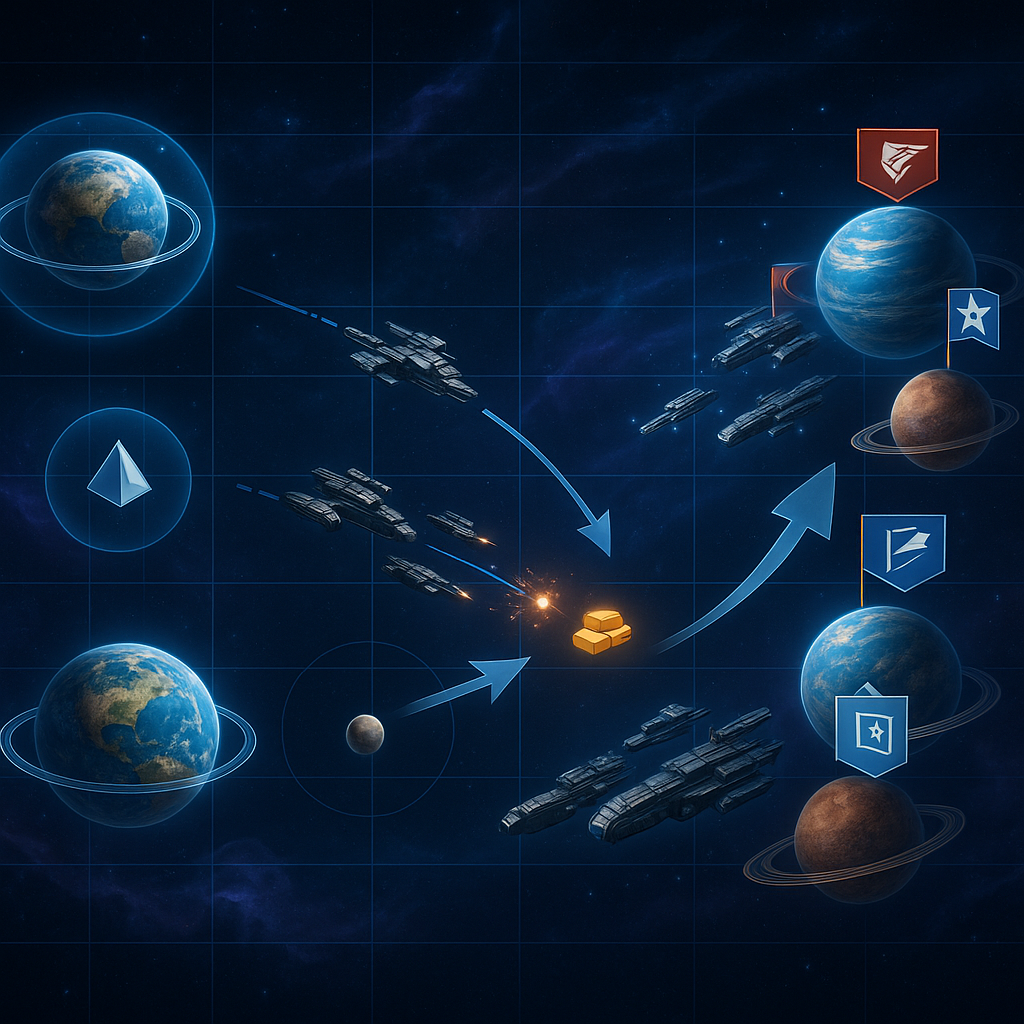
War for Galaxy can be described as a browser strategy game, an online strategy game, and a space MMO game: it has personal development, resource raids, joint actions, and map wars. But ownership mechanics do not mix everything into one button. Only Alliance multi-accounts can capture planets, and only from other Alliances. Other attacks involve battle, losses, and looting, but not a change of planet ownership.
| Target | Attacker | What Happens on Victory | Is Owner Changed |
|---|---|---|---|
| Personal planet of a regular player | Regular player | Battle and looting occur: fleet and defenses can be destroyed, and half the resources taken. | No. The planet remains with the previous owner. |
| Planet of another Alliance | Regular player from personal account | Standard attack with looting. This is a raid, not a territorial capture. | No. Ownership of the Alliance planet does not change. |
| Planet of another Alliance multi-account | Alliance multi-account | On victory, the planet transfers to the attacking Alliance with buildings, defenses, and infrastructure; the Alliance's rating increases by the captured planet's value. | Yes, but only in a multi-account vs. multi-account scenario. |
Regular Player Attacks Regular Player
This is a usual PvP scenario. You send a fleet to an opponent's personal planet, and battle begins. If the attack is successful, the defender loses ships and defenses, and attacker takes spoils. But the planet does not become yours nor a free point. Even complete orbital clearance does not make the enemy colony a trophy. In War for Galaxy terms, this is planet looting, not planet capturing.
Regular Player Attacks Another Alliance's Planet
A player from their personal account can send a standard attack on a planet of another Alliance. This is similar to a raid: arrive, fight, and if victorious, take resources. But the personal account does not rewrite Alliance territory for themselves or their Alliance. Such a raid can be an economic strike, reconnaissance battle, or pressure tactic, but not a way to expand territory.
Alliance Multi-Account Attacks Multi-Account
Real capture only starts here. If an Alliance multi-account attacks a planet of another Alliance multi-account and wins, the planet transfers to the attacking Alliance. All buildings, defenses, and infrastructure become property of the new owner, and the Alliance rating increases by the planet's value.
An important detail about fleets: the attacker organizer's fleet remains on the captured planet. All fleets that joined the battle return to their start planets after. If the defending multi-account wins, the attacker's fleet is destroyed and ownership does not change. So, in War for Galaxy, space battles and territorial capture are linked but operate under strict rules.
Empty Planets: Colonization for Player and for Alliance
Not every new planet appears after a battle. The galaxy has empty planets that do not need to be taken from another player or Alliance — you colonize them. For a regular player, the process is straightforward: build a Pioneer, pick a free planet, and send it to settle. After successful colonization, the planet becomes the player's personal colony.
For an Alliance, it's different. An empty planet for the Alliance is colonized not by a participant's personal account but by the Alliance multi-account. If the goal is to own the planet as an Alliance, you must be in the multi-account and send a Pioneer to the empty planet with the "Colonization" mission. Upon arrival, the planet becomes property of the Alliance multi-account.
A simple way to recall: a personal Pioneer creates a personal colony, a Pioneer from the multi-account creates an Alliance planet. There is no battle here: an empty planet is not another player's colony and is not defended as owned territory. This is galaxy exploration characteristic of space games, where expansion is built not only on war but also choosing new worlds.
A separate note is creating an Alliance under new rules. Starting requires 1 Pioneer. In the "Alliance" → "Create" window, you specify the Alliance's name and coordinates of an empty planet. After clicking "Create" from an active planet, a Pioneer is launched, and when it reaches the destination, the Alliance is formed.
Parameters of the free planet cannot be known in advance. Number of fields/sectors and temperature become available only after colonization. This means before the Pioneer arrives, you don't know exactly how suitable the planet will be for building and climate. If you want to install the client or return to exploring the galaxy, use the War for Galaxy download page.
Practical Conclusions for Alliances
Alliance territorial wars are not resource raids or attempts to seize personal player planets. They are built around the Alliance multi-account, Alliance planets, and system control. If your Alliance wants to play on the map and not just raid, goals should be planned as a campaign: where to settle, which system to contest, which planet to attack, and what fleet remains after victory.
Control rules of a system are also important. An Alliance owns a planetary system if its Alliance account has at least one planet there. If several Alliance accounts have captured planets in the same system, the owner is the one with more planets in the system. If the number is equal, the system belongs to no one. Thus, one additional Alliance planet in a disputed system can be more important than a nice outpost far from the front.
The multi-account rating depends on the total value of all constructions, ships, and defenses it owns. When capturing a planet of another Alliance, the winner gets not an empty point but the planet with all contents: buildings, resources, and restored defenses. Along with that come rating points equal to the planet's cost. The losing Alliance loses the corresponding points. Therefore, a strike on a developed Alliance planet means both flag change and direct rating shift.
Before a joint attack, it's important to remember logistics. If the attack goes from multi-account to another multi-account and other fleets have joined, all those fleets return to start planets after the fight. Only the organizer's fleet stays on the captured planet. Do not plan the operation as if the entire strike force automatically secures the new base.
There is also a harsh route risk. If a multi-account fleet flew on the multi-account → multi-account attack and the start planet was captured during flight, it flies "one way": if victorious, it captures the goal and remains, if defeated, it is destroyed. So before a big sortie, check not only the target's strength but also the safety of the start planet. More about Alliances can be found on the official about War for Galaxy page.
Summary: You Can Attack Many, But Capture Only Alliance Planets
The main formula is simple: a player's personal planet does not transfer to the attacker through a normal attack. You can win the battle, destroy fleet and defense, take half of the resources, but colony ownership remains unchanged. This is a raid, attack, looting, PvP clash — not a true capture.
Owner changes occur in another context: Alliance multi-account against Alliance multi-account. If the attacking multi-account defeats another Alliance's planet, that planet transfers to the new owner with infrastructure. This is real territorial war, not just hunting for resources.
This separation makes War for Galaxy understandable for newcomers and deep for players who enjoy real-time strategy games, space combat games, and browser online strategies with politics, fronts, and system control. In your personal empire, you develop colonies and survive raids. In the Alliance, you play on the galaxy map where collective goals, fleet discipline, and multi-account understanding matter.
Want to fight for territory? Join an Alliance, learn the Alliance multi-account mechanics, and check targets carefully. Don't confuse resource raids with system wars: you won't send your fleet on a regular raid expecting planet capture. You can play right now in the web version of War for Galaxy, or install the client from the download page. Choose your Alliance, plan campaigns consciously, and turn space battles into real galaxy control.