

How Combat Works in War for Galaxy: Why Fleet Power Doesn't Guarantee Victory
How Combat Works in War for Galaxy: Why Fleet Power Doesn't Guarantee Victory
One of the most common questions about PvP and attacking defenses is: why do battles with similar power levels end differently? In one sortie, losses seem manageable, while in another, with close numbers, part of the fleet disappears much faster than expected. The main reason is that combat in War for Galaxy is not just about comparing a single line in the report.
Relative combat power is indeed useful. It helps roughly estimate who has the advantage, and with a large margin, the victor usually loses less. If the margin reaches about five times, the winner almost incurs no losses. But this value is not an exact battle simulator. It does not replace analyzing composition, weapons, defense levels, shields, armor, firing sectors, planetary defenses, and recovery.
War for Galaxy is a space-based browser online strategy, similar in logic to galaxy games and browser strategy games: the outcome depends not only on number of ships but also on which combat groups meet, who shoots whom, how effectively damage passes through, and which targets are within the strike zone. Thus, a mixed fleet is not necessarily a mistake but also doesn't guarantee victory. You can assemble different ship types for specific tasks and achieve strong results. Or you can add a bit of everything, raise total power, and still lose more than expected because some groups don't fulfill clear roles.
Below is a calm framework for understanding the mechanics. No analysis of controversial battle reports, no promise of absolute prediction in every fight, but relying on key rules that should be considered before a major attack.
Basic Combat Structure: Battlefield, Super Units, and Time Limit
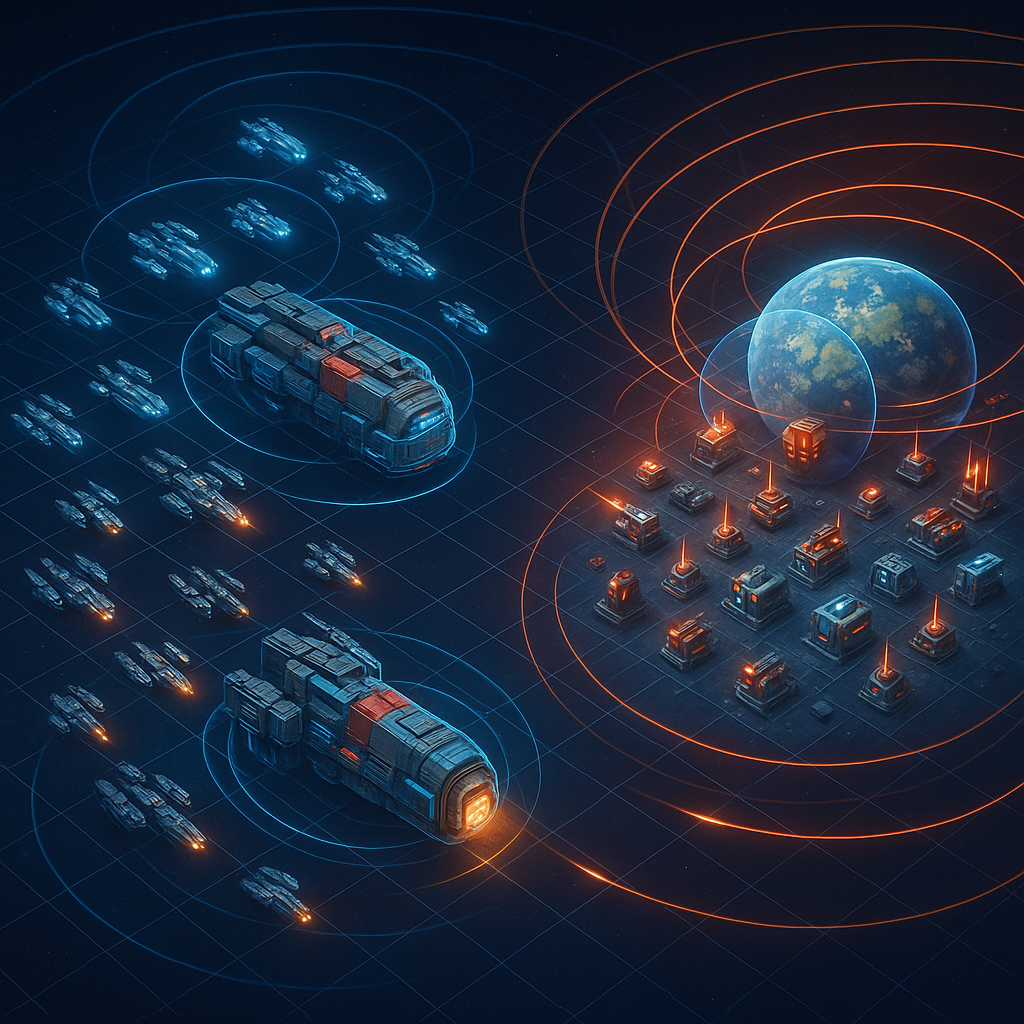
To read space battles in War for Galaxy, it's helpful to imagine a tactical field, not just two abstract numbers. The battle takes place on a 20×20 cell field. Each side starts from opposite edges occupying 4 rows each. This shows that positioning, target availability, and which squads can open fire at a given moment are important.
Ships of the same type in combat unite into one super-unit. If hundreds of Fighters participate in the attack, they don't act as hundreds of separate objects: the system treats them as one squad of this type. The same applies to Destroyers, Bombers, Colossi, and other ships. As a result, the fleet composition is a set of combat groups with different durability, weapons, speed, firing sectors, and recovery chances.
The battle continues until one side is destroyed or a 10-minute time limit expires. If no one is fully eliminated by then, the battle ends in a draw. This is especially important in dense fights where sides have many shields and armor but lack damage pace to secure victory.
Within the combat cycle, all squads simultaneously check available targets and fire at those within their weapon's strike zone. The system automatically picks the most advantageous target within a weapon’s range, but if the target is outside the sector or range of a gun, that weapon does not fire at it.
Relative combat power is a parameter for approximate comparison of invasion and defense fleets. For example, 1 Colossus in relative power roughly equals 86 Destroyers. But this does not mean identical behavior in real combat. The Colossus is a huge, slow, heavy super-unit with its own firing sectors and damage density. Destroyers have a different profile: different numbers, weapons, and loss distribution inside the squad. Therefore, similar total power can produce very different battle patterns.
Why Equal Power Doesn’t Mean Equal Combat
The main trap is expecting two fleets with similar relative power to have an equal duel. In practice, one composition may quickly dismantle light targets, another better absorb incoming damage, a third only unlocks fully against a certain defense level. The game has three defense levels: 1, 2, and 3. Weapons deal varying damage percentages depending on the target's matching level.
Infrared lasers are especially effective against level 1 defense: dealing 100% damage to such targets. But against levels 2–3 many infrared weapons sharply drop: their base damage is 16%. Therefore, a fleet saturated with infrared weapons may look good against light targets but perform worse against heavy units with level 3 defense.
Photon weapons deal 100% damage against level 1 and 67% against levels 2–3. Ultraviolet Laser Type-2 deals 100% damage against levels 1–2 but only 20% against level 3. Lepton weapons deal 100% against levels 1–2 and 52% against level 3. The Bomber's Rocket Salvo System deals 100% damage across all three defense levels, making it especially valuable against varied target types.
Equally important is how damage distributes. First, shields absorb it, then armor is reduced. If a hit exceeds what's needed to eliminate the current unit inside a squad, residual damage transfers to the next unit in that squad. Hence, mass light ships, Bombers, or heavy groups may behave differently than suggested by one summed number. Equal relative power does not mean identical damage structure, survivability, or compatibility with the target.
Firing Sectors: Why Ship Orientation Matters
Another reason fleet power does not guarantee victory is firing sectors. Almost all ships have weapons not covering 360°. Each weapon fires only within its sector. The angle count starts at 0°—directly forward along the ship's course—and sectors count clockwise. If a sector crosses 0°, it goes through the ship’s nose, e.g., from 355° → 360° → 0° → 5°.
This means a ship is highly dangerous when aiming at a target ahead but noticeably less effective if the target lies to the side or rear. The system picks a favorable target among available ones but won’t force a gun to fire outside its physical sector. Exceptions are rockets and some systems. For example, the Bomber’s Rocket Salvo System covers 0–360°, thus not strictly tied to the front as most guns.
The Colossus exemplifies why roles cannot be judged only by cost and power. Its relative combat power is 28,000; armor — 3,600,000; shield — 500,000; defense level —3. Base speed is only 100, fuel consumption 10,000, and recovery chance on victory 85%. The Colossus is especially dangerous when facing targets within the main caliber’s front lepton guns, which can decide the clash. But this does not make it a universal answer. It is expensive, slow, and requires support.
The Bomber has a different profile. Its relative combat power is 265; defense level 3; armor 30,000; shield 7,500; recovery chance 65%. Its value is not size but role: 0–360° rocket weapons and active skill "Hail," meaning massive rocket fire against defensive structures. Therefore, Bombers are especially useful against defenses, though they still need protection and thoughtful integration.
Galaktion matters in battles against fleets heavily relying on active abilities. Its "Radio Suppression" disables enemy unit skills and reduces the target's attack by 50%. This effect may not be obvious through relative power but can alter battle tempo in the right matchup.
Light and medium ships should not be dismissed as useless or assumed universal screens. Their effectiveness depends on mass, enemy defense level, weapon profile, and overall mission. Light ships can be useful against heavy ones by massing and dodging; medium ships better clear light targets; heavy ships are strong against large targets and defenses. The question is not which class is the "best," but why it is included in a particular fleet.
Mixed Fleets and Planetary Defense
Mixed fleets in War for Galaxy often cause unexpected losses when assembled by "adding a bit of everything" logic. Different ship types have different shields, armor, defense levels, speed, firing sectors, and recovery chances. Without clear roles for every type, parts of the composition may become easy prey and die faster than expected.
This is especially noticeable when attacking planetary defenses. Defensive structures are stationary and fire 360°, without facing or angle constraints. They don’t need to turn, find targets in sectors, or wait for an opportunity. They just shoot all available targets within range. So a fleet that looks decent against ships might receive unpleasant incoming damage on a fortified planet.
Bombers are indeed useful against defenses but are not invincible. If the fleet composition is poor, if the defense matches damage types well, or if domes and heavy guns protect the target, Bombers can suffer losses. Light ships with defense level 1 quickly fall before weapons effective against that level. This can sometimes appear in reports as sudden disappearance of small groups, although it is mechanically explained by weapon-defense matching.
Energy domes deserve separate attention. They don't shoot or attack and do not recover after battle, but absorb damage aimed at ground defenses. Domes protect defensive structures, not the fleet on the planet. The Small Energy Dome has shield 30,000, armor 8,000, defense level 2, and zero recovery chance. The Large Energy Dome has shield 150,000, armor 40,000, defense level 3, and also no post-battle recovery. Only one Small and one Large Dome can be built per planet.
If domes exist, part of the damage first hits this protective layer. Hence, attacking a planet with domes can cost more than a similar defense without them. Remember recovery too: destroyed ships recover only on victory according to their post-win recovery chance. Destroyed defensive structures can recover after any battle outcome based on their chance. For Rocket Block and Infrared Laser that is 25%; for Ultraviolet Laser and Photon Gun 35%; for Graviton Gun and Lepton Gun 75%.
Approach Fleet Assembly Before a Major Attack
A strong fleet is not necessarily the most expensive. A strong fleet is one correctly assembled for the task. Before a major attack, it’s useful to follow a short checklist:
- Define the target. Are you targeting the fleet, ground defenses, heavy units, a base with energy domes, or mixed defenses? Different targets require different compositions.
- Check defense levels. Weapons differ in effectiveness against levels 1, 2, and 3. Nice relative power won’t help if main damage doesn’t go through the target’s defense well.
- Don’t build an armada of one type without understanding weaknesses. One type is easier to count and produce, but each class has situations where it performs worse.
- Don’t mix ships haphazardly. Each added type must have a role: breaking a needed target, absorbing damage, attacking defenses, controlling skills, or supporting heavy units.
- Consider not just winning but the cost of victory. Fleets recover only on victory; defenses recover by chance after any outcome. Sometimes a formal win is too costly if composition ignores recovery.
The practical logic of roles is simple: light ships are useful versus heavy ones in mass and dodging; mediums clear light targets better; heavies excel against big targets and defenses; Bombers pressure defensive structures; Galaktions are key versus fleets with skills; Colossus is strong but expensive, slow, vulnerable without support.
Before a serious sortie, open ship and defense stats, look at shields, armor, defense levels, weapons, sectors, recovery odds, and each squad’s role. Combat in War for Galaxy is won not by one number but by understanding exactly which scenario you impose on the enemy.
If you want to return to the galaxy, test compositions practically, or start playing, visit the official War for Galaxy website, launch the web version, or download the game from the download page. And if a battle report still seems strange, bring the question to the community: discussing mechanics often helps see what a single fleet power number hides.