

Pirates in War for Galaxy: Spawn Mechanics, Fleet Strength, and Dangerous Targets Near Colossi
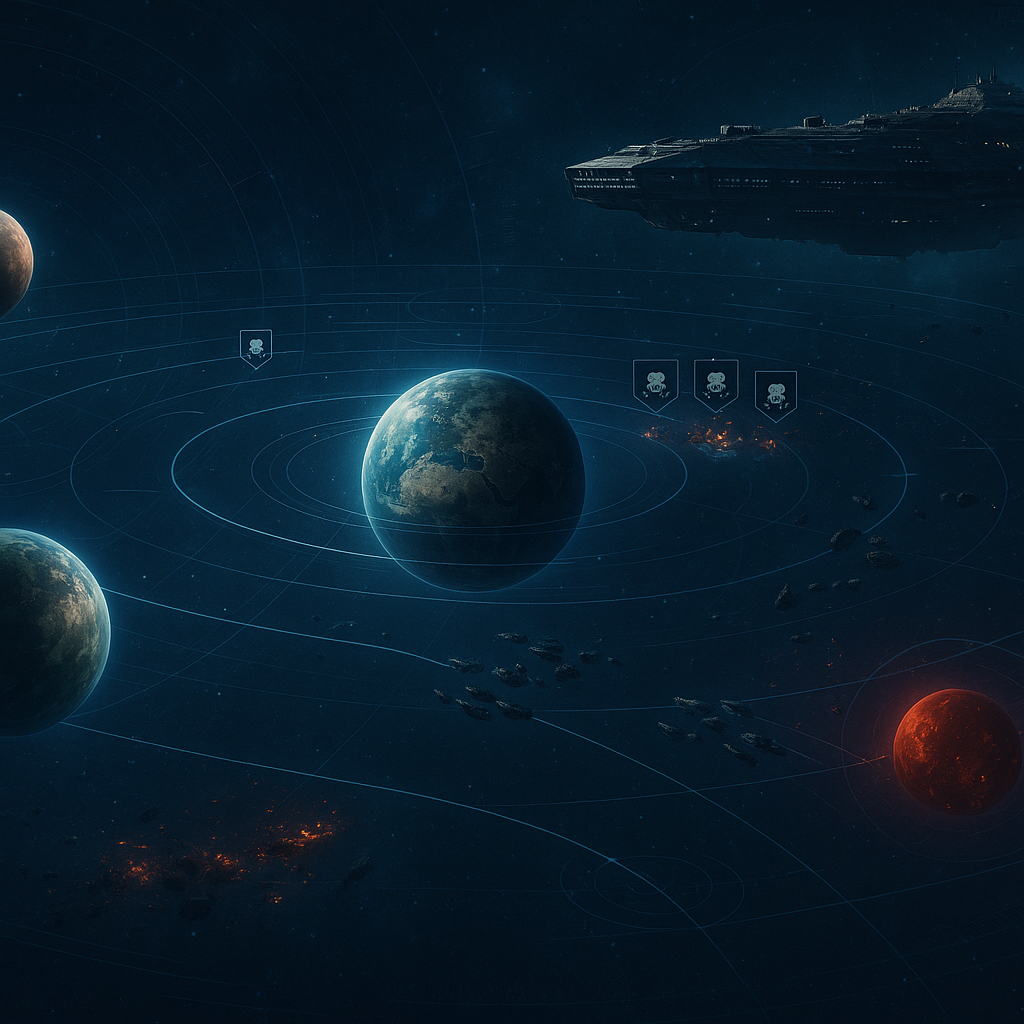
Pirates in War for Galaxy: How Spawn Works, What Determines Fleet Strength, and Why Dangerous Targets Appear Near Colossi
If you open the map and see a strange picture — pirates abound in one system, almost absent in another, and near strong fleets there suddenly are targets you no longer want to blindly attack — you’re not the only commander noticing this. Questions about pirates in War for Galaxy often arise: whether there are fewer pirates, if they’ve "disappeared," or why systems with Colossi feature fleets that can no longer be called easy prey.
It's best to analyze this not through rumors or random personal stories but through the game mechanics. Pirates in War for Galaxy are autonomous combat groups spawning in planetary systems with active players. They aren’t another player’s fleet, don’t belong to hidden commanders, and aren’t personal traps on the map.
Their role is simple but essential: to keep the galaxy in combat readiness. Even if you don’t live in constant PvP, don’t hunt neighbors by timing, or don’t make night sorties, pirates encourage fleet assembly, composition testing, attack training, and collecting debris after battles. For an online space strategy, this is an important layer of activity between economy, planetary development, and real space battles with other players.
The main point — don’t treat pirates as a guaranteed "debris source" button. It’s not static loot on a schedule but a system with regular server checks, randomness in reinforcement, and linking to the surrounding force. Thus, two players in different systems can see completely different pictures: one sees easy targets, another faces dense pirate fleets that require preparation.
Let’s examine in detail: when the server checks for pirate appearance, why new fleets aren’t guaranteed every 4 hours, what determines pirate composition per system, why Colossi increase threat level, and what to assess before sending your fleet to attack.
When Pirates Refresh: The 4-Hour Check Is Not a Guaranteed Spawn
Confusion mostly begins with the phrase "pirates refresh every 4 hours." It sounds like every four hours a fresh set of targets must appear in a system. In reality, the mechanic works differently: every 4 server hours a check occurs, not a guaranteed distribution of pirates to all systems.
The server doesn’t just add flotillas everywhere in the galaxy. It scans planetary systems with life—active players and inhabited planets. Only such systems interest the pirate mechanic since pirates are needed as combat activity near players, not as decorations in empty space. Empty systems and those with banned or "dead" planets don’t normally spawn pirates.
Simply put, the process is:
- Step 1. A 4-hour server interval arrives.
- Step 2. The server checks planetary systems with active inhabited planets.
- Step 3. For each system, it counts how many pirate fleets are already present.
- Step 4. If fewer than the system’s quota, the server may add new fleets.
- Step 5. The number of new fleets is randomly chosen from zero up to the needed amount.
This is crucial: even if reinforcement is warranted, the server might add zero fleets due to randomness, so players may see empty systems after waiting. This is not a bug, nerf, or someone "stealing your spawn." It’s just the zero option in the allowed range.
For example, if a system needs 3 more pirate fleets, the server randomly chooses from 0 to 3 new fleets. If it picks 0, nothing will appear after the check, leaving players wondering where the pirates are. The answer is simply that the check happened, but no fleets were added this time.
Thus the 4-hour interval is a time for a server check, not a timer guaranteeing a new fleet. Don’t plan farming as if a new easy target will spawn exactly on schedule. War for Galaxy’s mechanic combines timing with randomness: the server regularly reviews systems’ state but does not promise a pirate fleet after each cycle.
What Determines Pirate Fleet Strength: Average Combat Power of the System
Once the server decides to generate a pirate fleet, the next step is choosing its composition. Here's a key point for those farming War for Galaxy pirates: the composition isn’t based on a guess, last battle, or who opened the map recently. It depends strictly on the average combat power of all inhabited planets in the system.
The game evaluates not just your planet, but the system overall: which inhabited planets exist there, their average strength, and threat level from players nearby. That’s why two visually similar targets on the map might feel very different—one system’s pirates act as light warm-up targets, the other’s as serious combat challenges.
You should distinguish between "my fleet is weak" and "the system is weak." If you’re developing but strong commanders are nearby, the system’s average power might be higher than you think. Conversely, if only fresh colonies and nearly no combat fleets surround you, pirate pools tend to be softer.
- Beginner systems. With little fleet strength and low overall threat, light low-rank pirates appear more often: fighters, shuttles, transporters. These targets suit early sorties, battle report testing, and careful debris gathering.
- Advanced systems. Where players have developed fleets and high tech, the server tends to spawn more powerful compositions: frigates, bombers, destroyers, and other heavy or elite targets appropriate to the system’s strong average power.
This shows why War for Galaxy isn’t a simple timer-based farm but a living online space strategy. In browser strategy games, online strategy games, and space combat games, the key is not just a fleet strength number but an actual combat build: which ships compose the fleet, what weapons they use, which defenses they counter effectively, and how prepared your fleet is for that specific target.
So don’t think "pirate = easy loot." For beginner systems, that’s often close to true; for strong systems, no. Pirates adapt to average inhabited planets’ strength, not to one commander’s comfort. If you colonize a new spot or move closer to strong neighbors, don’t be surprised when tougher fleets start appearing instead of usual light targets.
Why Dangerous Pirates Can Appear Near Colossi
One of the toughest questions from advanced players is: "Why don’t I get weak pirates in my system with Colossi like before?" The answer is logical though unpleasant: the system is no longer considered weak. A Colossus isn’t just a big ship decorating an orbit. It has very high conditional combat power compared to typical ships, and the server weighs it much heavier than a batch of light ships when assessing threat.
When Colossi, Destroyers, Bombers, and other serious forces inhabit a system, the average combat power rises. This average power determines what pirates the server will generate upon reinforcement. The server views the system as a combat zone with heavy fleets, so it may spawn correspondingly powerful pirates.
Important: such pirates don’t "hunt" the Colossus owner personally. They don’t belong to neighbors or hidden fleets, nor are they secret player attacks under a false flag. They’re autonomous pirate groups appearing due to overall system strength. So if a threatening target emerges near your Colossus, it’s usually not a conspiracy but simply because the system power rose.
Another nuance: pirates can’t be scanned with espionage probes. Spy probes won’t give usual intel like for player planets. Thus, you must decide about attacking based on available info and understanding your fleet, not defaulting to "pirate = safe."
Overall strength helps estimate the situation, but victory depends on more than one number. Fleet composition, defense levels, weapon effectiveness, firing arcs, and the battle scenario itself matter. Ships often have sector-limited weaponry, so one ship might shine in one fight and underperform in another.
The Colossus is powerful, no doubt. But it’s costly, slow, and needs proper support. It’s not absolute protection from any battle. If your system reached the Colossi level, pirates also may stop being easy strolls. Before attacking, assess the target type, your setup, defenses, weapons, and potential losses.
How to Read Map Situations: Few Pirates, New Colonies, and Attack Risks
If you open the map and see few pirates in a system, don’t rush to chat about bugs or hidden nerfs. Pirate spawn isn’t a vending machine dispensing fresh targets every 4 hours. Keep three things in mind: the check happens every 4 hours, reinforcements are only where pirates are below the norm, and the number added varies randomly, even down to zero.
An "empty after the check" situation is normal. The server may detect a deficit but add 0 fleets due to allowed randomness. So don’t judge pirate reduction, disabling, or moving to other galaxy parts based on just one or two 4-hour cycles.
- Don’t plan farming as a strict timer. Pirates can appear after checks or not. Plan raids flexibly, not by alarm clock.
- Watch neighboring systems. If yours is temporarily empty, nearby systems may be active, especially those with inhabited active planets.
- Don’t mistake absence of targets for errors. Sometimes it’s just result of checks, quota, and random zero.
A special note about alliance multi-accounts: they don’t affect pirate spawn or attack pirates. Attempting an attack triggers Alliance Code restrictions: "Alliance Code forbids attacking Pirates." So if piracy changes near alliance planets, look for reasons in active inhabited planets and system average combat power, not the multi-account itself.
After Battle: Debris, Collectors, and Calm Community Observations
Don’t see pirates in War for Galaxy as a quick way to boost combat rating. Pirates yield near-zero rating, but after destruction, they leave a debris field just like normal fleets after battle. Many commanders hunt pirates not for score but to collect resources from debris.
The main rule is simple: if you plan to hit pirates, keep Collectors ready. Debris can only be salvaged by them via the "Recycle" mission. Shuttles, transports, combat ships, and others can’t gather debris — they are not designed for that. A bad scenario is winning a fight and having debris appear but no Collectors nearby. Someone else might collect it faster while you prepare.
Debris don’t have a fixed timer like "disappear in an hour." They remain until either collected or a server reboot occurs. So debris can linger for some time, but don’t rely on eternity. If you see profitable debris, send Collectors promptly.
- Check your system and adjacent ones. Pirates need not spawn where convenient for you.
- Don’t panic after empty checks. 4 hours is a server check period and zeros can occur.
- Pick targets by composition. Don’t treat all pirates as free loot.
- Prepare Collectors in advance. Victory without salvage is only half the operation.
- Share observations calmly. One or two checks without new targets don’t prove hidden nerfs.
Pirate mechanics rely on three things: scheduled server checks, random reinforcement, and system strength adaptation. Keeping these in mind makes the map clearer and hunting a commander’s routine rather than chat guessing. Visit War for Galaxy, check sectors, select targets by composition, ready Collectors, and collect debris with "Recycle." If you prefer mobile, download links are on the official site, and mobile versions are available in Google Play and App Store.